Release binary
18 MB
lto fat, one codegen unit, stripped
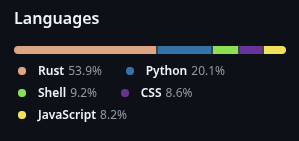
Almost everything you see here runs on Rust.
The server, routing, caching, security, analytics and content rendering all live inside a single compiled Rust binary built with Actix Web, MongoDB and Tera.
Posts, schemas, images and view analytics are stored in MongoDB, while Rust does the real work: request processing, memory caching, indexing, SEO generation, rate limiting and observability. The result is a tight, deterministic engine instead of a maze of services.
Release binary
18 MB
lto fat, one codegen unit, stripped
Debug build
289 MB
with symbols
That single binary runs the entire blog platform.
Content creation has its own twist. Meet Ø (Oxygen / O2) — a custom RAG model built to draft articles in my voice and thinking style. Shell scripts take a raw idea, activate the model locally, and produce a draft that feeds straight into the Rust publishing pipeline. Every article is still revised by hand, but the heavy creative lifting starts there.
Store
MongoDB
posts, visits, route views
Engine
Rust
render, cache, index, rate limit, serve
Draft
Ø Oxygen
local RAG model, run from a shell script
Idea → shell script → Ø drafts → Rust stores, processes, caches and serves it.
The philosophy
If a problem is deterministic, why use a non-deterministic language?
Everything ultimately runs on a deterministic computer. When the foundation is deterministic too, the system becomes predictable, debuggable and extremely fast.
2
Weeks to build
4
Days generating
~30
Minutes per post
2028
Scheduled through
I designed and built this system — backend, content pipeline and AI integration — starting with only prior experience in web apps. To validate it, I pushed it to its limit: Ø generated and iteratively refined a content pipeline scheduled all the way through October 2028.
None of it ran on high-end infrastructure. The whole pipeline ran on a modest local machine, turning constrained resources into a long-term content engine.
No bloated "AI platform" and no orchestration circus — scripts, a model, and a fast backend. Most modern complex stacks do not actually do more than this; they distribute the same logic across dozens of tools.
In practice
This is not "AI-generated content". It is a system that amplifies structured thinking into consistent, long-term output — and every article that ships has been revised by hand.