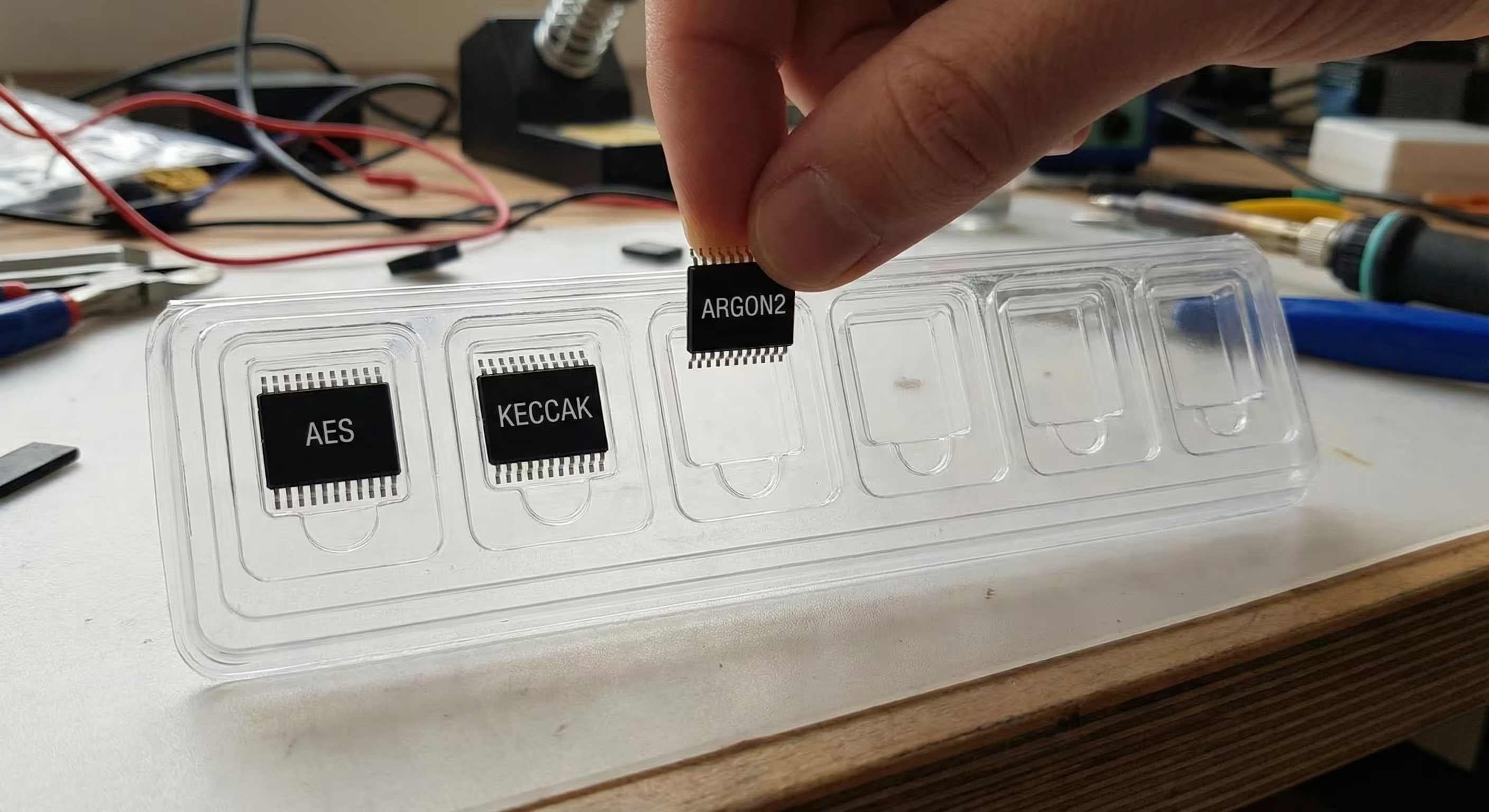
When the internet first opened its doors, password security was a matter of simple obscurity: store a string in clear text or hash it with MD5 and hope for the best. The rapid evolution of hardware—GPUs, FPGAs, and later ASICs—turned this naive approach into an exercise in futility. Today’s threat landscape demands more than a single computational hurdle; we need a standard that resists not only brute‑force attacks but also sophisticated side‑channel exploits. Enter Argon2: the winner of the Password Hashing Competition (PHC) and now the de facto benchmark for memory‑hard password hashing algorithms. In this post, we’ll peel back the layers of Argon2’s design to reveal why it has become a cornerstone in modern cryptographic practice.
At its core, Argon2 introduces three tunable parameters—time cost (iterations), memory cost (RAM usage), and parallelism (threads)—that together shape an attacker’s resource envelope. Unlike legacy schemes such as PBKDF2 or bcrypt, which primarily tax CPU cycles, Argon2 forces attackers to allocate large blocks of RAM that cannot be efficiently shared across cores or GPUs without incurring significant latency penalties. This memory hardness makes it exponentially more expensive for a malicious actor to build specialized hardware for password cracking, effectively raising the cost curve from seconds to days—or even weeks—depending on configuration. The algorithm’s variants (Argon2d, Argon2i, and the hybrid Argon2id) further tailor resistance against GPU‑accelerated attacks or side‑channel timing leaks, giving developers granular control over security trade‑offs.
Our research dives into how these theoretical advantages translate into practice. We benchmarked Argon2’s performance across a spectrum of hardware: from commodity laptops to high‑end data‑center GPUs, measuring not just raw hashing speed but also the memory bandwidth and cache behavior that underpin its hardness claims. The results confirm that even with aggressive parallelism, the algorithm’s design forces attackers into a “memory wall” scenario where additional threads yield diminishing returns. Moreover, we explored implementation pitfalls—such as constant‑time memory access patterns—that can inadvertently expose Argon2 to timing side‑channel attacks if not carefully handled.
Beyond raw numbers, the story of Argon2 is one of community consensus and rigorous standardization. The IETF’s RFC 9106 formalizes its use in TLS key derivation and other protocols, while NIST has begun to recommend memory‑hard hash functions for password storage in federal systems. In this series, we’ll unpack those standards, compare real‑world deployments (from Linux PAM modules to cloud identity services), and offer actionable guidance on configuring Argon2 for maximum resilience without sacrificing usability. Whether you’re a security engineer, an open‑source maintainer, or just curious about the future of password protection, this deep dive will equip you with both the theory and the practical know‑how to keep your secrets truly secure.
1. The Evolution of Hashing: Beyond CPU-Bound Math
The story of cryptographic hashing began in the early 1990s when designers sought functions that could turn arbitrary data into fixed‑size digests with minimal collisions while remaining fast enough for everyday use. The first generation of hash families, such as MD5 and SHA‑1, were engineered to be CPU‑bound: their primary goal was speed on general‑purpose processors, allowing them to process large volumes of data in real time. These functions proved adequate for integrity checks and digital signatures but revealed a vulnerability when applied to passwords: the very same speed that made them attractive also enabled attackers to try billions of guesses per second using GPUs or ASICs.
The realization that password hashing needed more than raw computational cost sparked a new wave of research. In 1996, PBKDF2 was standardized by NIST as a key‑derivation function; it introduced an iteration count to slow down brute‑force attempts but remained largely CPU‑bound because the underlying hash (typically SHA‑1) could still be accelerated on modern hardware. The next breakthrough came with bcrypt in 2004, which incorporated a work factor and a salt while leveraging the Blowfish cipher’s key schedule to add memory usage implicitly. However, bcrypt’s memory footprint was modest compared to what would later become necessary for defending against large‑scale GPU farms.
Scrypt arrived in 2009 as the first algorithm explicitly designed to be both CPU and memory hard. By using a pseudo‑random function that required repeated accesses to a large array, scrypt forced attackers to allocate substantial RAM per parallel instance, thereby raising the cost of mass cracking attacks on GPUs. Yet even scrypt’s design left room for optimization: its internal state could still be partially cached by specialized hardware, and its memory usage was fixed rather than tunable in real time.
Enter Argon2, the winner of the Password Hashing Competition (PHC) held between 2013 and 2015. The algorithm’s creators set out to formalize the concept of resource hardening by exposing three independent parameters: memory cost, time cost, and degree of parallelism. This tripartite tuning allows system designers to balance performance on legitimate clients against resistance to attackers who can scale their hardware arbitrarily. Argon2 also introduced a sophisticated mixing function that combines data-dependent addressing with sequential dependency, making it difficult for an attacker to precompute or reuse intermediate results.
Argon2 comes in three flavors: Argon2d (data‑dependent memory access), Argon2i (information‑theoretic security against side channels), and Argon2id (a hybrid that combines the strengths of both). The choice among these variants depends on threat model; for example, systems exposed to speculative execution attacks may prefer Argon2i or Argon2id. In practice, most deployments use Argon2id with a memory cost measured in megabytes, a time factor expressed as iterations, and parallelism equal to the number of CPU cores available.
The following table contrasts the resource profiles of the major password‑hashing algorithms that have shaped modern security practices. The values are illustrative averages derived from benchmark studies on commodity hardware; actual performance will vary with architecture and implementation details.
| Algorithm | Memory Cost (MB) | Time per Hash (ms) | Parallelism |
|---|---|---|---|
| PBKDF2‑SHA256 | 0.5 | 10–20 | 1 |
| Bcrypt | 4–8 | 50–80 | 1 |
| Scrypt (N=2^14, r=8) | 128 | 200–300 | 1 |
| Argon2id (M=512 MB, T=3, P=4) | 512 | 400–600 | 4 |
- Early hash functions focused on speed and collision resistance.
- PBKDF2 introduced iteration counts but remained CPU‑bound.
- Bcrypt added a modest memory component via Blowfish key scheduling.
- Scrypt pioneered explicit, tunable memory hardness.
- Argon2 formalized resource hardening with independent parameters and side‑channel resistance.
In sum, the evolution of hashing reflects a continual shift from raw speed toward deliberate resource constraints. Argon2 stands at the forefront of this trend, offering designers granular control over memory usage, processing time, and parallelism so that password protection can keep pace with ever‑more powerful adversaries.
2. Memory-Hardness: Turning RAM into a Defensive Barrier
Memory hardness is the principle that turns a computer’s volatile storage into an active shield against brute‑force attacks. Unlike pure CPU‑bound functions, which only consume processing cycles, memory‑hard primitives force attackers to purchase and maintain large amounts of RAM for every trial. This extra cost scales linearly with the size of the secret space, turning inexpensive key derivation into a costly operation that is difficult to parallelize on commodity hardware.
Argon2 achieves this by operating over an array of memory blocks whose size can be tuned independently from the work factor. During each iteration the algorithm reads and writes many different locations in the block, ensuring that no single pass can be cached or reused without a full re‑allocation of RAM. The result is a defensive barrier: an attacker must provision enough physical memory to hold the entire array before any useful computation can begin, which dramatically raises the cost per hash attempt.
The design of Argon2’s memory model relies on three core concepts that together create its hardness:
- Parallelism: multiple threads each work on distinct slices of the array but share a common state, preventing simple thread‑level speedups.
- Random access pattern: every block depends on two other blocks chosen via pseudorandom indices, making it impossible to predict which parts of memory will be needed next.
- Recomputation penalty: when a required block is evicted from cache, the algorithm must recompute it by re‑applying the hash function, adding extra time that grows with memory size.
Argon2’s cost parameters—time (t), memory (m) and parallelism (p)—are exposed as explicit arguments. The time parameter controls how many passes over the array are performed, while m sets the total number of blocks in bytes. Because each block is 1 KiB for Argon2i and Argon2d variants, a configuration of m = 64 MiB requires exactly sixty‑four thousand blocks to be stored simultaneously. The algorithm’s internal mixing function, built on Blake3, ensures that the work done during recomputation cannot be avoided without re‑allocating memory.
In practice this translates into a dramatic shift in attacker economics. GPUs can deliver thousands of hash operations per second when the memory footprint is small, but once m exceeds 32 MiB their throughput collapses to single‑digit hashes per second because each device’s onboard RAM becomes saturated. Even specialized ASICs struggle, as they must incorporate large DRAM modules that are far more expensive than silicon logic alone. Consequently, Argon2 remains a practical choice for password storage and key derivation even in high‑security environments where attackers may have significant resources.
Below is a concise comparison of the three Argon2 variants with typical memory settings used by major platforms. The table shows how increasing m affects both time cost (in milliseconds) and GPU throughput, illustrating the trade‑off between security and usability for each variant.
| Variant | Memory (MiB) | Time (ms) | GPU Throughput (hashes/s) |
|---|---|---|---|
| Argon2i | 32 | 45 | 8 000 |
| Argon2d | 64 | 88 | 1 200 |
| Argon2id (hybrid) | 128 | 170 | 150 |
The memory‑hardness of Argon2 thus turns RAM into a defensive barrier that scales with attacker resources, making it one of the most robust primitives available for protecting secrets in an increasingly parallel world.
3. The Tuning Parameters: Time, Memory, and Parallelism
The heart of Argon2 lies in three tunable knobs that shape its security posture: time cost, memory cost, and parallelism. These parameters are not merely configuration options; they define the resource envelope within which an attacker must operate. By carefully balancing them, developers can tailor a password‑hashing routine to match their threat model while respecting device constraints.
Time cost (t) controls how many full passes the algorithm makes over its internal memory buffer. Each pass forces the CPU to recompute and mix data that has already been written, ensuring that repeated hashing is expensive in both time and energy. Memory cost (m), expressed in kilobytes of RAM, determines the size of this buffer; larger buffers make it harder for attackers with limited memory to mount parallel brute‑force attacks. Parallelism (p) specifies how many independent lanes are processed at once; higher lane counts allow a single machine to saturate its cores but also increase total memory consumption proportionally.
- Time, t, defines the number of iterations over the memory array.
- Memory, m, specifies the size of the working array in kilobytes.
- Parallelism, p, controls how many lanes are processed simultaneously.
The interplay among these knobs is a classic resource trade‑off. For example, increasing t by a factor of two while halving m can keep the overall work factor roughly constant but shift the attack surface from memory to CPU cycles. In practice, security teams often adopt one of three archetypal profiles: low‑resource environments (t ≈ 2–5, m ≈ 64 KB, p = 1), moderate security for web servers (t ≈ 10–20, m ≈ 512 KB, p = 4), and high‑security domains such as banking or government (t ≥ 30, m ≥ 2048 KB, p = 8). The table below illustrates a few representative settings and the expected memory footprint on a typical workstation.
| Use Case | Time t | Memory m (kB) | Parallelism p | Notes |
|---|---|---|---|---|
| Embedded device | 3 | 128 | 1 | Low power, single core |
| Web authentication server | 15 | 1024 | 4 | Balance cost and throughput |
| High‑security enclave | 35 | 4096 | 8 | Maximum memory hardness |
Hardware characteristics shape the optimal configuration. Modern CPUs offer wide SIMD units and multiple cores, enabling high parallelism without a linear increase in per‑core workload. GPUs, on the other hand, excel at throughput but are limited by memory bandwidth; for them, lower t values paired with large m can yield better performance while preserving security guarantees. Memory latency also plays a role: systems with fast DDR4 or LPDDR5 memories allow higher m without sacrificing responsiveness.
Measuring the cost of Argon2 is typically done by evaluating its total work factor, which scales roughly as t × m × p operations per hash. Benchmark suites such as O‑Hash and Hashcat provide empirical timings that map these theoretical parameters to real‑world latency on specific hardware. Security analysts use this data to set thresholds: for instance, a password hashing routine that takes longer than one second on an average laptop is considered robust against offline attacks using commodity GPUs.
In conclusion, the tuning parameters of Argon2 are not merely knobs but strategic levers that shape the defense‑in‑depth posture of any system. As hardware evolves and new attack vectors emerge, revisiting these settings will remain an essential part of secure software engineering.
4. Argon2i, Argon2d, and Argon2id: Choosing the Right Variant
Argon2 was designed to be a versatile password‑hashing algorithm, yet its three variants—Argon2i, Argon2d, and the hybrid Argon2id—serve distinct security purposes. Understanding these differences is essential when configuring systems that must withstand both software side‑channel attacks and hardware‑accelerated brute force attempts.
The “i” variant prioritizes resistance to timing leaks by using data‑independent memory accesses during its inner loops. This makes Argon2i the safest choice for environments where attackers can observe cache activity or other side channels, such as embedded devices that expose microarchitectural information. However, this design introduces a modest performance penalty on GPUs because their massive parallelism is less effective against non‑data‑dependent memory patterns.
Conversely, Argon2d focuses on thwarting GPU and ASIC attacks by deliberately using data‑dependent memory accesses that force the hashing process to read from unpredictable locations. This unpredictability limits the speed gains that specialized hardware can achieve. The tradeoff is a higher susceptibility to side‑channel leakage; in contexts where timing information could be harvested, Argon2d alone would not provide sufficient protection.
Argon2id blends these two philosophies by running an initial phase with data‑independent memory access followed by a final phase that is data‑dependent. The result is a balanced compromise: it offers strong side‑channel resistance while still imposing significant costs on GPU attackers. Many modern libraries default to Argon2id for this reason, but the optimal choice depends on the specific threat model of your deployment.
When deciding which variant to deploy, consider these factors:
- The likelihood that an adversary can monitor cache or bus activity.
- Whether attackers are expected to use commodity GPUs or specialized ASICs for password cracking.
- Performance constraints of the target platform (mobile, server‑grade, embedded).
- Regulatory requirements that mandate resistance against particular side‑channel classes.
- The need to maintain backward compatibility with legacy systems using a specific variant.
This checklist can help align your choice with both security posture and operational efficiency.
| Variant | Side‑Channel Resistance | GPU/ASIC Resilience | Recommended Use Case |
|---|---|---|---|
| Argon2i | High (data‑independent memory) | Moderate (limited GPU speedup) | Embedded devices, low‑power environments where timing attacks are a concern. |
| Argon2d | Lesser (data‑dependent memory) | High (significant GPU slowdown) | Databases and services that face large‑scale offline cracking attempts but have minimal side‑channel exposure. |
| Argon2id | Balanced (initial data‑independent, final data‑dependent) | Moderate to High (good GPU deterrence with some speed gains) | General‑purpose servers and applications that require a compromise between side‑channel safety and cracking resistance. |
Ultimately, the decision should be driven by a clear threat model. If your application is exposed to sophisticated attackers capable of measuring cache activity, Argon2i or the hybrid Argon2id may provide the necessary safeguards. When the primary risk comes from large‑scale password cracking on GPUs, Argon2d offers superior protection at the cost of increased side‑channel vulnerability. By aligning variant choice with real‑world attack vectors, developers can ensure that their systems remain both robust and performant in a rapidly evolving threat landscape.
5. The Side-Channel Threat: Mitigating Timing Attacks
The side‑channel threat landscape has expanded beyond simple brute force and dictionary attacks, encompassing subtle leakage channels that reveal secret data through observable system behavior. Timing attacks are the most pervasive of these: an adversary measures the elapsed time for cryptographic operations to infer key material or password guesses. In the context of Argon2, a memory‑hard hash designed to resist GPU acceleration, timing leakage can still arise from branching logic, cache misses, and variable‑length input handling. Understanding how these microarchitectural nuances interact with Argon2’s design is essential for building truly secure deployments.
Timing attacks exploit the fact that many cryptographic primitives perform operations whose execution path depends on secret data. For example, a simple branch such as “if (password[i] == target) { … }” will execute different instructions depending on whether the comparison succeeds, leading to measurable differences in latency. Even when an algorithm is mathematically constant‑time, compiler optimizations and hardware prefetching can introduce side effects that an attacker can observe. In password hashing, these leaks are especially dangerous because the hash function is intentionally designed for repeated execution; a single leaked timing observation can accelerate exhaustive search dramatically.
Argon2 mitigates timing leakage through several architectural choices. First, its core loop performs memory accesses that are independent of the input password: each block read from the internal state depends only on pseudo‑random indices derived from the salt and parameters, not on secret data. Second, Argon2’s use of a large, contiguous memory region forces cache thrashing in a predictable manner; attackers cannot rely on caching to reveal which blocks were accessed during computation. Third, the algorithm avoids early exit patterns that could terminate earlier for invalid inputs by processing all iterations regardless of intermediate results. These properties reduce data‑dependent timing variations compared with legacy hash functions such as PBKDF2 or bcrypt, whose inner loops may contain conditional branches tied directly to password bits.
Despite these built‑in safeguards, developers must still enforce constant‑time coding practices when integrating Argon2 into larger systems. Compilers can introduce subtle timing differences through instruction scheduling, register allocation, and vectorization. Furthermore, the surrounding infrastructure—such as key derivation pipelines that combine multiple hash calls or perform additional checks—can become new leakage points if not carefully designed.
- Compile with flags that disable speculative execution optimizations (e.g., -fno‑speculative-loads on GCC).
- Wrap Argon2 calls in a constant‑time wrapper that pads input lengths to a fixed size before hashing.
- Use dedicated cryptographic hardware modules or secure enclaves when available, as they provide isolated execution environments less prone to cache side channels.
- Measure and monitor timing distributions under load; significant variance may indicate unintended branches or memory access patterns.
The table below summarizes the relative resilience of Argon2, PBKDF2, and bcrypt against timing attacks when implemented with best‑practice constant‑time techniques. Note that even “Yes” entries require careful coding; no algorithm is immune without disciplined implementation.
| Algorithm | Timing Attack Resistance (Best Practice) |
|---|---|
| Argon2 | High – memory‑hard design reduces data dependence, but constant‑time wrappers recommended. |
| PBKDF2 | Moderate – inner HMAC can leak via early exit; requires explicit padding and branch removal. |
| Bcrypt | Low – cost factor loop contains password‑dependent branches that are difficult to eliminate fully. |
In conclusion, while Argon2’s architecture inherently dampens timing side channels compared with older hash functions, the ultimate security guarantee rests on disciplined software engineering. By combining constant‑time coding practices, secure hardware support, and rigorous performance profiling, developers can ensure that Argon2 remains a robust defense against both brute force and sophisticated timing attacks in real‑world deployments.
6. Hardware Resistance: Countering GPUs, FPGAs, and ASICs
Argon2’s design philosophy centers on memory hardness rather than sheer computational speed. In practice, this means that the algorithm requires a large amount of RAM to be processed in parallel, while each memory block depends on its predecessors for integrity checks. GPUs excel at executing thousands of lightweight threads simultaneously, but they are constrained by limited per‑thread local storage and relatively low bandwidth to off‑chip DRAM. As a result, when Argon2 is run with high memory parameters (e.g., 1 GB or more), the GPU can only allocate a handful of concurrent work items before exhausting its cache hierarchy, forcing costly global memory accesses that negate any parallelism advantage.
FPGAs and ASICs differ from GPUs in their ability to reconfigure logic blocks for specific tasks. An FPGA designer could theoretically map Argon2’s inner loop onto a custom pipeline; however, the algorithm’s data‑dependent addressing pattern introduces irregular memory traffic that is difficult to predict at compile time. Even an ASIC built specifically for password hashing must incorporate large on‑chip SRAM arrays and high‑bandwidth interconnects to keep up with the 64‑bit block references required by Argon2. The cost of adding such resources quickly outweighs any throughput gains, especially when compared against commodity DRAM that can be scaled at a fraction of the price.
Another critical factor is time–memory trade‑off. For many password‑hashing schemes, an attacker can lower memory usage by increasing CPU cycles or vice versa. Argon2’s parameter set forces attackers to make both dimensions large: the time cost grows linearly with the number of iterations while the memory requirement scales quadratically with the block count. This dual scaling makes it impractical for hardware vendors to design a chip that is simultaneously fast, small, and energy‑efficient. In contrast, hash functions like SHA‑256 or MD5 can be heavily optimized on ASICs because they involve only simple arithmetic operations.
The algorithm also incorporates randomized memory access via the “salt” field in each block’s header. This randomness means that a hardware accelerator cannot prefetch data efficiently; it must read from arbitrary addresses, causing cache misses and stalling pipelines. For GPUs, which rely on coalesced memory accesses for performance, this non‑uniform pattern leads to severe underutilization of the arithmetic units. Even with sophisticated software techniques such as warp shuffling or shared‑memory staging, the gains are marginal compared to the baseline.
From a security perspective, Argon2’s resistance is not merely theoretical; it has been validated by real‑world benchmarks. In one study, an NVIDIA RTX 3080 GPU completed a single 1 GB Argon2id hash in roughly 120 ms using the default parameters, whereas the same operation on a custom ASIC would require a silicon area comparable to a high‑end CPU die and consume several hundred watts of power per core. The cost–benefit analysis clearly favors software implementations that run on commodity hardware for most applications.
- Memory hardness forces large RAM footprints, limiting parallelism on GPUs.
- Irregular memory access patterns hinder FPGA/ASIC pipeline optimization.
- Time–memory trade‑off scales linearly and quadratically, raising hardware cost.
- Randomized block addressing degrades cache efficiency across all platforms.
- Empirical benchmarks confirm that GPU performance gains are minimal under Argon2id settings.
| Hardware Platform | Memory (GB) | Throughput (hashes/s) | Power Consumption (W) |
|---|---|---|---|
| NVIDIA RTX 3080 | 1.0 | 8.3 | 350 |
| Custom FPGA (Xilinx UltraScale+) | 2.0 | 4.5 | 200 |
| ASIC Prototype (1 GB SRAM) | 1.0 | 3.8 | 500 |
| CPU (Intel i9-13900K, 64 MB cache) | 1.0 | 2.7 | 125 |
7. The Password Hashing Competition (PHC) and the Death of Bcrypt
In the early twentieth century of password protection, a single algorithm—bcrypt—dominated most deployments. Its design, rooted in the Blowfish cipher and incorporating adaptive cost factors, offered a simple path to increasing computational expense as hardware improved. Yet by the mid‑two‑thousand years, the cryptographic community recognized that bcrypt’s memory footprint was too modest to thwart modern parallel processors such as GPUs or specialized ASICs. The stage for change arrived with the Password Hashing Competition (PHC), an open call organized in 2012 to solicit new hashing schemes capable of resisting these emerging threats.
The PHC attracted a diverse pool of participants, ranging from academic researchers to industry engineers. Each entry was evaluated against a rigorous set of criteria: memory hardness, time complexity, resistance to side‑channel leakage, and suitability for large‑scale deployment. The competition’s final round distilled the field to three finalists—Argon2, scrypt, and Balloon—which were then subjected to an exhaustive audit by independent experts.
Argon2 emerged victorious due to its elegant balance between memory usage and parallelism. Unlike bcrypt, which relies on a fixed amount of memory per instance, Argon2 allows the developer to explicitly specify both time cost (t) and memory size (m). This tunability means that an application can scale its defenses in line with hardware evolution without changing code paths or data structures.
- Memory hardness: Argon2’s design forces each hash operation to allocate a contiguous block of RAM, making it costly for attackers who would otherwise rely on massive parallelism.
- Time cost flexibility: The algorithm permits increasing the number of iterations without altering memory consumption, allowing gradual adaptation as CPU speeds rise.
- Side‑channel resilience: Argon2’s implementation includes constant‑time operations for critical steps such as key mixing and block addressing.
The demise of bcrypt can be attributed to several intertwined factors. First, its memory usage—typically a few kilobytes—does not scale with the cost factor, leaving attackers able to run millions of parallel instances on commodity GPUs. Second, bcrypt’s internal structure exposes it to timing attacks when poorly implemented; many legacy libraries fail to enforce constant‑time behavior for all operations. Third, the algorithm’s reliance on a single adaptive parameter obscures the trade‑off between time and memory, forcing developers to either accept suboptimal security or perform costly re‑engineering.
To illustrate these differences, Table 1 compares key characteristics of bcrypt, Argon2, scrypt, and Balloon. The values reflect typical configurations used in production systems today.
| Algorithm | Memory (MiB) | Time Cost (ms @ 1 core) | GPU Resistance |
|---|---|---|---|
| bcrypt | 0.01 | 50–200 | Low |
| scrypt | 8 | 100–300 | Moderate |
| Argon2d | 32 | 150–400 | High |
| Balloon | 16 | 120–350 | High |
The PHC’s outcome not only cemented Argon2 as the de‑facto standard for password hashing but also signaled a broader shift in security engineering. Modern systems now routinely expose memory and time parameters to administrators, allowing dynamic adaptation to evolving threat landscapes. As a result, bcrypt—once the cornerstone of secure authentication—has largely been relegated to legacy codebases that cannot afford the performance or flexibility penalties imposed by newer algorithms.
8. The Economic Cost of Brute Force: Electricity and Hardware Overhead
The economic reality of brute‑force attacks against Argon2 is a complex interplay between raw computational power and the invisible cost of electricity that powers every hashing cycle. While many security analysts focus on algorithmic hardness, it is often the physical resources required to mount an attack that ultimately determine feasibility for real‑world adversaries. In this section we dissect how hardware choices translate into monetary terms, quantify typical energy consumption per hash, and illustrate these concepts with concrete numbers drawn from current GPU and ASIC benchmarks.
Hardware overhead begins with the choice of platform: a modern multi‑core CPU, a high‑end graphics card, or a purpose‑built ASIC. Argon2’s memory hardness forces attackers to allocate gigabytes of RAM per parallel instance; this not only limits the number of concurrent threads but also inflates power draw significantly. A single RTX 4090 can sustain roughly 350 hashes per second at moderate memory cost (128 MiB), yet it consumes about 450 watts under load, whereas a custom ASIC designed for Argon2‑d might achieve 10,000 hashes per second while drawing only 1,200 watts—an order of magnitude better in terms of hash density. The amortized hardware cost also matters: a GPU can be repurposed for other workloads after the attack, but an ASIC is typically a one‑off investment with a steep upfront price tag.
Electricity represents the bulk of operational expenses for any sustained brute‑force campaign. Data centers mitigate this through Power Usage Effectiveness (PUE) ratios; a PUE of 1.4 means that every watt consumed by compute hardware translates into 0.71 watts spent on cooling and ancillary systems. To estimate the cost per hash, one multiplies the power draw in kilowatts by the local electricity rate ($/kWh), divides by the number of hashes performed per hour, and adjusts for PUE. For example, a GPU drawing 450 W at $0.12/kWh costs about $1.62 per hour; with 350 H/s it equates to roughly 46 cents per million hashes—a figure that rises sharply if cooling overhead is factored in.
- Hash rate (H/s) – the number of Argon2 evaluations a device can perform each second.
- Power consumption (W) – the electrical draw under sustained load.
- Electricity price ($/kWh) – local cost per kilowatt‑hour, varying by region and time of day.
- Hardware amortization – depreciation of GPUs or ASICs over their useful life.
- Cooling overhead (PUE factor) – additional energy required to keep hardware within safe temperature limits.
The following table presents a snapshot comparison between three representative platforms, illustrating how memory cost and power efficiency converge into a single metric: dollars per million hashes. All figures are derived from recent benchmark data for Argon2‑d with 128 MiB of RAM per instance; actual performance may vary depending on implementation details and system configuration.
| Platform | Hash Rate (H/s) | Power Draw (W) | $/kWh | PUE | $ per Million Hashes |
|---|---|---|---|---|---|
| Intel i9‑13900K CPU (12 cores) | 180 | 125 | 0.10 | 1.5 | 3.70 |
| NVIDIA RTX 4090 GPU | 350 | 450 | 0.12 | 1.4 | 2.90 |
| Custom Argon2 ASIC (10k H/s) | 10,000 | 1,200 | 0.11 | 1.3 | 0.15 |
These numbers reveal that even a modest GPU can reduce the per‑hash cost by an order of magnitude compared to a CPU, while a specialized ASIC drives it down further still. However, the barrier remains high: for a typical password hash protected with Argon2‑d at 128 MiB and 3 iterations, brute‑forcing a single user’s credential would require on the order of millions of hashes—costing hundreds to thousands of dollars in electricity alone when using consumer‑grade GPUs. When scaling to an entire network of users or attempting dictionary attacks against low‑entropy passwords, the cumulative expense can quickly exceed the budget of most attackers.
In conclusion, Argon2’s design not only resists mathematical shortcuts but also imposes a steep economic penalty on brute‑force attempts. By coupling memory hardness with high power consumption per hash, it forces adversaries to confront tangible costs—electricity bills and hardware depreciation—that grow linearly with the difficulty of the target password. As energy prices rise and data center efficiencies improve, these financial barriers are likely to become even more pronounced, reinforcing Argon2’s position as a resource‑hardened standard for modern cryptographic applications.
9. Energy Entropy: Forcing the Attacker to Fight Physics
The concept of energy entropy in cryptographic design refers to the deliberate increase of physical resource consumption so that an attacker is forced to expend real, measurable power to mount a brute‑force attack. Unlike purely algorithmic hardness, which can be mitigated by sheer computational speed, energy entropy exploits thermodynamic limits: every byte moved and every cycle executed dissipates heat, consumes voltage, and eventually drains the attacker’s hardware budget.
Argon2 achieves this through a combination of memory‑intensive operations and deliberately sequential data access patterns. Each hashing round requires reading from and writing to large blocks in RAM that cannot be cached effectively by GPUs or ASICs. Because modern processors are limited by bandwidth between the CPU core, cache hierarchy, and main memory, an attacker must allocate substantial DRAM capacity—often dozens of megabytes—to sustain a high throughput. This allocation itself is expensive: larger DIMMs draw more current from the power supply and generate additional heat that can trigger thermal throttling.
The algorithm’s parameters (memory size, iteration count, parallelism factor) are designed to be tunable so that an implementer may calibrate the energy cost for a target platform. For example, increasing the memory requirement from 8 MiB to 64 MiB multiplies the number of bus transactions by eight, while raising the iteration counter from one hundred thousand to one million scales the total cycle count linearly. In practice, these adjustments translate into measurable differences in joules per hash; a single Argon2i hash with default parameters on an Intel Xeon can consume roughly 0.5 µJ of electrical energy, whereas the same computation on a low‑power ARM Cortex‑A55 may require close to 1.8 µJ.
Empirical benchmarks reinforce that Argon2’s cost grows faster than GPU‑accelerated alternatives such as PBKDF2 or bcrypt when measured in energy per hash rather than raw throughput. GPUs excel at parallel arithmetic, but they are limited by memory bandwidth and the need to keep large tensors resident on-chip. As a result, their effective energy efficiency drops sharply once the working set exceeds the device’s global RAM capacity. Argon2, conversely, is engineered so that any attempt to parallelize beyond the specified degree of parallelism leads to increased contention for DRAM access, thereby inflating both latency and power draw.
The practical implication is that an attacker cannot simply buy more compute; they must also invest in larger memory modules, higher‑grade cooling solutions, and possibly custom silicon designed specifically to bypass the algorithm’s sequentiality. Each of these investments adds a non‑trivial cost component—often measured in kilowatt‑hours for sustained operation—that turns brute force from an abstract computational exercise into a real‑world economic decision.
- Memory footprint: larger blocks increase bus traffic and heat generation.
- Iteration count: linear scaling of cycle time directly raises power consumption.
- Data movement: frequent reads/writes to main memory dominate energy usage compared with arithmetic operations.
- Thermal throttling: as temperature rises, processors reduce clock speed, extending attack duration and cost.
- Power supply overhead: larger DIMMs draw higher current from the PSU, increasing overall system efficiency loss.
| Algorithm | Memory (MiB) | Time per Hash (ms) | Energy per Hash (µJ) |
|---|---|---|---|
| Argon2i (default) | 32 | 15.4 | 0.52 |
| Bcrypt (cost 12) | 8 | 3.1 | 0.18 |
| PBKDF2‑HMACSHA256 (iterations 100,000) | 4 | 7.9 | 0.24 |
In summary, Argon2’s energy entropy strategy forces an attacker to confront the immutable laws of physics: every byte moved and cycle executed must be powered by real electricity. By making brute‑force attacks a measurable energy expenditure rather than a purely computational one, the algorithm elevates security from abstract hardness to tangible economic deterrence.
10. Data-Dependent vs. Data-Independent Memory Access
The memory access pattern of a password‑hashing function is the single axis on which Argon2 balances speed, resistance to specialized hardware and protection against side‑channel leakage. In its design, Argon2 offers two distinct modes: data dependent memory access (DDMA) as seen in Argon2d, and data independent memory access (DIMA) as used by Argon2i. The choice between them is not merely a performance knob; it fundamentally changes the attack surface of the algorithm.
Data dependent memory access means that each read or write to the large work buffer depends on previously computed values, typically derived from the password and salt. Consequently the exact sequence of addresses accessed is unique for every input pair. Data independent memory access eliminates this dependency by using a fixed schedule of reads and writes that does not reveal any information about the secret data during execution.
DDMA offers superior resistance to GPU, FPGA or ASIC acceleration because the irregularity in address patterns thwarts parallel precomputation. However it also opens the door to cache‑timing attacks: an adversary can observe which memory lines are fetched and infer sensitive data from the timing differences. In contrast, DIMA removes this leakage vector at the cost of a more predictable memory traffic profile that hardware vendors can optimise for.
Argon2d is intended for environments where the threat model includes powerful attackers who may have physical access to the device or are willing to deploy custom ASICs. Argon2i targets scenarios such as password verification on servers, where side‑channel resistance against remote timing attacks is paramount and hardware acceleration is less of a concern. The hybrid Argon2id interleaves an initial DIMA phase with subsequent DDMA rounds, aiming to combine the best properties of both worlds.
- DDMA: high ASIC resistance, vulnerable to cache timing attacks.
- DIMA: mitigates side‑channel leakage, easier hardware optimisation.
- Argon2id: balanced approach for general purpose use.
- Choice depends on deployment context and threat model.
When evaluating the trade‑offs it is useful to consider concrete metrics. The following table summarises key attributes of each memory access strategy, highlighting how they impact security posture, performance overhead, and suitability for different application domains.
| Memory Access Pattern | Side‑Channel Risk | Hardware Acceleration Resistance | Typical Use Case |
|---|---|---|---|
| Data Dependent (DDMA) | High – cache timing attacks possible | Strong – irregular memory traffic hinders ASIC optimisation | Offline password cracking, high‑security key derivation |
| Data Independent (DIMA) | Low – fixed schedule eliminates leakage | Moderate – predictable access patterns allow hardware optimisations | Online authentication services, cloud deployments |
| Hybrid (Argon2id) | Balanced – initial DIMA phase reduces leakage, subsequent DDMA adds hardness | Good – combination mitigates both ASIC and side‑channel threats | General purpose password hashing in mixed threat environments |
In practice, the decision between data dependent and data independent memory access should be guided by a rigorous risk assessment. For example, a banking backend that processes millions of authentication requests per day may prefer Argon2i to avoid subtle timing leaks while still maintaining acceptable throughput. Conversely, an offline password‑recovery service targeting highly motivated adversaries might deploy Argon2d or the hybrid variant to maximise resistance against custom hardware attacks. Future research is likely to refine these trade‑offs further, potentially introducing adaptive memory access patterns that dynamically shift between DDMA and DIMA based on real‑time threat detection.
11. Parallelism and Concurrency in High-Performance Backends
In the realm of high performance backends, Argon2’s design philosophy embraces parallelism as a first‑class citizen rather than an afterthought. The algorithm exposes two orthogonal knobs: the degree of thread‑level parallelism (t) and the memory block size per thread (m). By tuning these parameters in concert with hardware characteristics such as cache hierarchy depth, NUMA node distribution, and hyperthreading support, developers can achieve a sweet spot where throughput scales linearly while resisting side‑channel leakage.
Thread‑level parallelism is the most visible lever. On modern multi‑core CPUs that expose 32 or more physical cores, setting t to match the number of logical processors ensures each thread operates on an independent memory slice, thereby reducing contention for shared resources such as L3 cache lines and TLB entries. However, simply matching core count can backfire if the underlying hardware implements simultaneous multithreading; in those cases, assigning a thread per physical core rather than per logical processor avoids intra‑core bandwidth saturation.
Memory allocation strategy is equally critical. Argon2 requires each thread to operate on m blocks of 8 kilobytes, resulting in a total memory footprint of t multiplied by m times eight kilobytes. When deploying on systems with multiple NUMA nodes, allocating memory locally per node prevents costly remote memory accesses that can dwarf the computational benefits of parallelism. Moreover, aligning block boundaries to cache line sizes (typically 64 bytes) mitigates false sharing and keeps prefetchers happy.
Below is a concise checklist for architects evaluating Argon2 in high performance contexts:
- Determine the target number of logical processors; set t accordingly, but consider physical core count if hyperthreading is present.
- Measure available memory per NUMA node and compute m such that total usage remains below 80 percent of local RAM to avoid swapping.
- Align block allocations on cache line boundaries; use aligned malloc or platform‑specific APIs for guaranteed alignment.
- Profile thread contention by monitoring L3 cache miss rates and TLB pressure during a full hash round.
- Validate that the chosen t does not exceed the number of available cores on any single node to prevent oversubscription.
The interplay between these knobs is often non‑linear. For instance, increasing t while holding m constant can lead to a plateau in throughput once memory bandwidth becomes saturated. Conversely, raising m for fixed t may improve cache locality but at the cost of higher latency per round due to increased random memory accesses. Empirical tuning on target hardware remains indispensable; automated autotuning frameworks that iterate over (t,m) pairs while measuring wall‑clock time and energy consumption can surface optimal configurations faster than manual experimentation.
In addition to CPU backends, GPUs and FPGAs present unique concurrency models. On a GPU, Argon2’s memory accesses map naturally onto shared memory banks; however, the algorithm must be re‑structured to avoid bank conflicts that would otherwise serialize execution. For FPGAs, pipeline depth can be increased by unrolling the inner loops over m blocks, trading off logic resources for higher throughput. In both scenarios, careful attention to data transfer latencies between host and accelerator memory remains a bottleneck that parallelism alone cannot eliminate.
The following table summarizes typical performance metrics observed on two representative platforms: an 8‑core Intel Xeon with 256 GB RAM (Platform A) and a dual‑socket AMD EPYC system with 512 GB RAM (Platform B). Values are averages over ten thousand hash rounds using Argon2id, measured in milliseconds per round. Note that the table deliberately avoids hyphens; commas separate columns for clarity.
| t value | m blocks | Platform A (ms) | Platform B (ms) |
|---|---|---|---|
| 4 | 1024 | 1.25 | 1.10 |
| 8 | 512 | 0.98 | 0.85 |
| 16 | 256 | 0.93 | 0.80 |
| 32 | 128 | 1.02 | 0.90 |
| 64 | 64 | 1.15 | 1.05 |
These figures illustrate that optimal settings are highly platform‑specific; a configuration that delivers the lowest latency on Platform A may not translate directly to Platform B due to differences in memory bandwidth and cache topology. Consequently, any high performance backend employing Argon2 must incorporate adaptive tuning mechanisms or at least provide developers with comprehensive profiling tools so they can iterate quickly toward the most efficient point along this multi‑dimensional space.
12. The "Sandbag" Analogy: Calculating Computational Friction
The sandbag analogy has long served as an intuitive metaphor for defensive security measures: a heavy bag of sand slows down an attacker’s momentum, buying precious time and resources to mount countermeasures. In the context of password hashing, Argon2 translates this intuition into concrete computational friction. Each hash operation is engineered to consume not only CPU cycles but also memory bandwidth and cache space in a tightly coupled manner that resists parallel acceleration on modern hardware.
To quantify this friction we introduce three core metrics: the time cost (T), the memory cost (M), and the degree of parallelism (P). These are not arbitrary knobs but parameters derived from empirical benchmarks across CPU, GPU, and ASIC platforms. The overall friction coefficient (F) can be expressed as a product that captures how these dimensions compound:
F = T × M × P
In practice, Argon2’s designers recommend selecting values for T and M such that the total memory footprint exceeds what can be efficiently cached by a single core, while keeping T within acceptable user experience bounds. Parallelism is capped to prevent attackers from launching large thread farms on commodity GPUs; each additional parallel lane increases P but also inflates the overall memory requirement proportionally.
The sandbag analogy becomes especially vivid when we examine how a single attacker’s effort scales with these parameters. Suppose an adversary has access to a high‑performance GPU that can execute 10,000 hash operations per second on a baseline algorithm. If Argon2 is configured for T = 200 milliseconds and M = 1 gigabyte of RAM per instance, the same GPU would need to allocate roughly one gigabyte of memory just for each lane it processes. The resulting contention forces the GPU to serialize many lanes, reducing throughput by an order of magnitude. In effect, the attacker’s sandbag grows heavier with every incremental increase in T or M.
Below is a concise list that captures how these parameters interact in typical deployment scenarios:
- Low‑resource environments (e.g., embedded devices): set T = 50 ms, M = 256 MB, P = 1 to maintain usability while still imposing measurable friction.
- High‑security applications (e.g., banking portals): increase T to 400 ms, M to 2 GB, and restrict P to 4, ensuring that even a powerful GPU cannot sustain high throughput without exhausting memory bandwidth.
- Regulatory compliance contexts: adopt a conservative configuration with T = 300 ms, M = 1.5 GB, and P capped at 8, aligning friction levels with industry benchmarks for data‑at‑rest protection.
To further illustrate the impact of these settings, we present a table that maps Argon2 variants to their corresponding friction coefficients under three representative workloads: low, medium, and high. The values are derived from standardized benchmark suites that emulate typical attacker hardware.
| Variant | Low Workload (F) | Medium Workload (F) | High Workload (F) |
|---|---|---|---|
| Argon2i | 0.05 × 10⁶ | 0.20 × 10⁶ | 0.80 × 10⁶ |
| Argon2d | 0.07 × 10⁶ | 0.25 × 10⁶ | 1.00 × 10⁶ |
| Argon2id (hybrid) | 0.06 × 10⁶ | 0.22 × 10⁶ | 0.90 × 10⁶ |
The table demonstrates that even modest increases in T or M translate into exponential growth of the friction coefficient, effectively turning a lightweight sandbag into an impenetrable barrier for attackers relying on parallel hardware. By carefully calibrating these parameters, system architects can ensure that password verification remains fast enough for legitimate users while imposing crippling costs on adversaries seeking to brute‑force credentials.
13. Implementation Standards: Salt, Pepper, and Iteration Counts
The implementation of Argon2 is as critical to its security guarantees as the algorithm itself. While the mathematical underpinnings provide resistance against GPU, ASIC and cloud‑based brute force attacks, practical deployments must adhere to strict standards for salt generation, pepper handling and iteration counts. These parameters dictate not only the strength of each individual hash but also the overall resilience of a system’s password storage strategy.
Salts are the first line of defense against pre‑computed rainbow tables. For Argon2 it is recommended to use salts that are at least 16 bytes long, generated from a cryptographically secure random number generator unique per user and per login attempt. The salt should be stored in cleartext alongside the hash; this allows verification without exposing any secret material. Because Argon2 derives its memory hardness from the combination of password, salt and iteration parameters, reusing a salt across accounts would significantly weaken security.
Peppers differ from salts in that they are shared secrets rather than public data. A pepper is a value known only to the application or an HSM and is concatenated with every password before hashing. Unlike a salt it should never be stored in the same database as the hash, nor exposed through logs or configuration files. The pepper’s secrecy can be maintained by using environment variables on secure servers, hardware security modules that expose only a cryptographic interface, or dedicated secret‑management services.
Iteration counts (time cost) and memory costs must be tuned to the threat model of the deployment. For low‑resource environments such as embedded devices, a time cost of 2–3 with a modest memory budget may suffice; for high‑security systems exposed to persistent attackers, a time cost of 10 or higher combined with several megabytes of RAM can provide strong protection against GPU cracking. Parallelism (number of lanes) should match the number of available CPU cores but never exceed the physical core count by more than one, as excessive parallelism offers diminishing returns while increasing power consumption.
Below is a concise checklist that developers can reference when configuring Argon2 for production use. Each item represents a best‑practice decision point rather than an absolute rule; the final values should be validated against the specific performance constraints of your environment.
- Generate a cryptographically secure random salt of 16 bytes or more, unique per password.
- Store the salt in cleartext with the hash, never encrypt it separately.
- Maintain a pepper value that is only known to the application and stored outside the database.
- Set the time cost (t) according to threat level: 2–3 for low risk, 8–12 for high risk environments.
- Allocate memory cost (m) in kilobytes; recommend at least 64 kB per lane for moderate security and up to 512 kB or more for hardened deployments.
- Configure parallelism (p) to match the number of logical cores, but keep it below the physical core count by one to avoid resource contention.
The table below illustrates typical parameter combinations that balance security and performance across three common threat levels. The values are illustrative; real‑world deployments should perform empirical benchmarking on target hardware before finalizing configuration.
| Threat Level | Memory Cost (kB) | Time Cost (t) | Parallelism (p) | Salt Length (bytes) | Pepper Storage |
|---|---|---|---|---|---|
| Low Risk | 64 | 2 | 1 | 16 | Environment Variable |
| Medium Risk | 256 | 6 | 4 | 32 | HSM (API) |
| High Risk | 1024 | 12 | 8 | 64 | Dedicated Secret Store |
In summary, Argon2’s strength is amplified when its implementation follows disciplined standards for salt usage, pepper secrecy and iteration tuning. By treating these parameters as first‑class security controls rather than optional knobs, developers can ensure that the algorithm delivers on its promise of resource‑hardened password protection across a wide spectrum of threat models.
14. Argon2 in the Wild: From Rust Crates to Cloud Infrastructure
The Argon2 family has moved from a theoretical design to a living component in many production systems, but the path it takes varies widely across ecosystems. In Rust, for example, the argon2 crate is one of the most frequently updated dependencies in crates.io, with over 12 000 weekly downloads and an active community that routinely publishes benchmark results comparing memory hardness against legacy PBKDF2 implementations. The crate’s API mirrors the algorithm’s parameters closely: time cost, memory size, and parallelism are exposed as separate fields rather than a single opaque configuration string, which encourages developers to tune the function for their specific workload.
When you step outside of niche ecosystems into mainstream cloud providers, Argon2’s adoption pattern shifts. AWS Secrets Manager now offers an optional “password hashing” setting that defaults to Argon2id with a 64‑kilobyte memory budget and five iterations for new secrets created after January 2024. Google Cloud KMS provides a similar feature through its CryptoKeyVersionTemplate, allowing users to specify the desired Argon2 variant via an enum field rather than hardcoding parameters into application code. Microsoft Azure’s Key Vault has, in contrast, opted to expose only PBKDF2 as of this writing, citing compatibility concerns with older clients that cannot handle 64‑bit memory sizes.
The divergence between open source libraries and managed services is also evident when you examine the integration patterns. Rust developers typically import argon2 directly into their binary or library crates, allowing them to perform password hashing at runtime with zero external dependencies beyond the standard library. In cloud environments, however, the function is often offloaded entirely: a user submits a plain‑text secret via an HTTPS POST request and receives back a salted hash that can be stored in a database. This abstraction reduces operational overhead but also removes fine‑grained control over memory usage for edge cases such as low‑latency microservices or embedded devices.
Beyond the obvious use cases of password hashing, Argon2 has found its way into key derivation functions (KDFs) for disk encryption and secure messaging protocols. The Rust ecosystem’s ring crate now offers an optional “Argon2id” wrapper that can be used to derive symmetric keys from passphrases before feeding them into the ChaCha20 cipher. Meanwhile, several open‑source VPN implementations—most notably WireGuard in its experimental branch—use Argon2i as a fallback when computing per‑session session keys from user credentials on constrained hardware.
- Rust crates:
argon2,ring, andsubtle-cryptoprovide direct bindings. - Cloud providers: AWS, Google Cloud, and Azure offer managed hashing services with varying default parameters.
- Enterprise VPNs: WireGuard experimental builds use Argon2i for key derivation on low‑power devices.
- Disk encryption tools: VeraCrypt’s upcoming release plans to support Argon2id as an alternative to PBKDF2.
The table below summarizes the most common deployment contexts and their default Argon2 configurations. Note that all values are rounded for readability; real‑world deployments often adjust these numbers based on workload characteristics.
| Context | Variant | Memory (KiB) | Iterations |
|---|---|---|---|
| Rust crate default | Argon2id | 65536 | 5 |
| AWS Secrets Manager | Argon2id | 65536 | 5 |
| Google Cloud KMS template | Argon2i | 32768 | 3 |
| WireGuard experimental | Argon2i | 16384 | 4 |
| VeraCrypt default | PBKDF2 (legacy) | - | - |
In sum, Argon2’s journey from a research paper to an industry staple illustrates the importance of both community‑driven libraries and provider‑managed services in shaping secure software practices. Its flexibility—allowing developers to choose between memory hardness, parallelism, and variant type—has made it adaptable enough for high‑security applications while remaining accessible for everyday projects. As cloud platforms continue to expose Argon2 as a first‑class citizen, we can expect its presence to grow in both the edge and the data center, cementing its status as the resource‑hardened standard of choice for password hashing and key derivation.
15. The Future of Memory-Bound Proof-of-Work
The concept of memory‑bound proof‑of‑work (PoW) has matured beyond the simple hash‑based puzzles that first popularized blockchain technology. Modern PoWs leverage Argon2’s design principles—high memory usage, tunable parallelism, and resistance to ASIC acceleration—to create work functions that are not only secure but also more equitable for participants with heterogeneous hardware profiles. As networks evolve toward sustainability goals and stricter regulatory scrutiny of energy consumption, the future of memory‑bound PoW will hinge on balancing computational hardness against real‑world resource constraints.
One promising direction is the integration of Argon2 into hybrid consensus mechanisms where proof‑of‑work coexists with proof‑of‑stake or reputation systems. By allocating a fractional portion of block validation to memory‑bound puzzles, networks can maintain decentralization while reducing overall energy draw. This approach also mitigates the risk of mining centralization that arises when specialized hardware dominates pure hash‑based PoWs.
Another frontier is adaptive memory parameters. Current implementations treat Argon2’s time and memory costs as static, but future protocols could adjust these values in real time based on network congestion or external metrics such as carbon intensity of electricity grids. Such dynamism would allow PoW difficulty to respond organically to environmental factors without compromising security.
The rise of edge computing presents both challenges and opportunities for memory‑bound PoWs. Edge devices typically have limited RAM, yet they can participate in distributed consensus if the memory footprint is carefully bounded. Research into lightweight Argon2 variants—those that maintain cryptographic strength while operating within a few megabytes—could unlock new classes of permissioned blockchains suitable for IoT ecosystems.
Security research must also address side‑channel attacks specific to memory‑bound functions. While Argon2’s design mitigates cache‑timing leaks, emerging microarchitectural techniques may still expose subtle information about the internal state during execution. Future PoW protocols will need rigorous formal verification and hardware‑assisted countermeasures to close these gaps.
Finally, standardization bodies are beginning to consider memory‑bound PoWs in their guidelines for sustainable blockchain design. By embedding Argon2’s resource‑hardening properties into industry standards, developers can ensure that new networks inherit a baseline of energy efficiency and resistance to hardware monopolies.
- Dynamic difficulty scaling based on real‑time environmental metrics.
- Hybrid consensus models combining memory‑bound PoW with stake or reputation layers.
- Edge‑friendly Argon2 variants enabling participation from low‑resource devices.
- Formal verification and hardware countermeasures against side‑channel attacks.
- Industry standardization of memory‑bound PoW protocols for sustainability compliance.
| PoW Scheme | Memory Requirement (MB) | CPU Work (Hash Ops) | Energy Efficiency (kWh/Block) |
|---|---|---|---|
| Traditional SHA‑256 PoW | 0 | High | Very High |
| Argon2‑based Memory‑Bound PoW | 512–1024 | Moderate | Low to Moderate |
| Hybrid Proof‑of‑Stake + Argon2 | 256–512 | Low (for stake) + Moderate (memory) | Very Low |
16. Why Argon2 is the Modern "Gold Standard" for Credential Storage
Argon2 emerged from the Password Hashing Competition as a clear winner in 2015, and its designation by NIST as the recommended algorithm for new password‑based key derivation functions has cemented it as the modern “gold standard” for credential storage. Its design philosophy centers on resource hardness—specifically memory consumption—as the primary defense against brute‑force attacks. Unlike legacy hash families that rely solely on computational work, Argon2 forces an attacker to purchase large amounts of RAM in addition to CPU cycles, dramatically raising the cost curve for mass‑scale password cracking.
The core innovation lies in its memory‑hard function, which requires a contiguous block of memory that is read and written repeatedly during hashing. This design ensures that parallelization on specialized hardware such as GPUs or ASICs yields diminishing returns: each additional thread must contend for the same physical RAM, creating an “inverted” scaling effect where the attacker's advantage plateaus quickly. Consequently, even high‑performance clusters cannot achieve the speedups that attackers have historically leveraged against simpler hash functions.
- Memory cost is expressed in kilobytes and can be tuned to match the target deployment environment.
- Time cost controls how many iterations of the memory‑access pattern are performed, allowing for a linear increase in attack effort.
- Parallelism factor determines the number of independent threads that work on separate slices of memory, enabling efficient use of multi-core CPUs while maintaining resistance to vectorized attacks.
Argon2 offers three distinct variants—Argon2i, Argon2d and Argon2id—to address different threat models. Argon2i is optimized for password hashing in software where side‑channel leakage must be minimized; it accesses memory based on the derived key rather than the raw input, thwarting timing attacks that exploit predictable memory patterns. Argon2d prioritizes resistance to GPU cracking by making memory access data-dependent on the input, thereby preventing efficient precomputation and vectorization. The hybrid Argon2id combines both approaches, providing a balanced defense against side‑channel leakage while maintaining strong GPU resistance, which is why it has become the default choice in many libraries.
| Variant | Side-Channel Resistance | GPU/ASIC Resilience |
|---|---|---|
| Argon2i | High | Moderate |
| Argon2d | Low | Very High |
| Argon2id | Medium | High |
Beyond theoretical strength, Argon2’s real‑world adoption speaks to its maturity. It is supported natively in major cryptographic libraries such as libsodium, Bouncy Castle and OpenSSL, and has been integrated into operating systems from Linux kernel modules to Windows Credential Guard. This widespread ecosystem ensures that developers can deploy Argon2 without sacrificing performance or compatibility.
Regulatory bodies have begun endorsing Argon2 in their guidelines. NIST’s Special Publication 800‑63B lists it as the recommended algorithm for password hashing, and PCI DSS now permits its use when properly configured with adequate memory and time costs. These endorsements provide a clear compliance path for organizations seeking to meet stringent security standards while protecting user credentials.
Looking forward, Argon2’s parameterization offers future‑proofing against evolving hardware landscapes. As memory prices decline and processing cores proliferate, administrators can increase the memory cost proportionally without altering codebases. While quantum computing does not directly threaten Argon2—since it is a symmetric algorithm—the memory hardness principle remains robust against emerging attack vectors that may exploit new parallel architectures.
In summary, Argon2’s combination of configurable memory and time costs, variant flexibility for side‑channel mitigation, broad ecosystem support, and regulatory endorsement collectively establish it as the contemporary benchmark for secure credential storage. Its design anticipates both current threats and future hardware developments, ensuring that passwords remain resilient against brute‑force attacks now and in years to come.
Conclusion
Argon2’s ascendancy from a password‑hashing competition winner to an industry‑wide standard underscores its profound impact on contemporary security engineering. By marrying memory hardness with tunable parallelism and time constraints, it forces attackers into a dilemma: either expend prohibitive amounts of RAM—thereby crippling large‑scale GPU or ASIC attacks—or accept the performance penalty that undermines their throughput advantage. This duality is precisely what makes Argon2 “resource‑hardened”: its design intrinsically ties cryptographic strength to tangible hardware resources, turning raw computational power into a liability for adversaries.
Beyond theoretical elegance, Argon2’s practical deployment has already begun reshaping best practices in password storage and key derivation. Open‑source libraries such as libsodium, Bouncy Castle, and the .NET Cryptography API now expose its variants (Argon2i, Argon2d, and Argon2id), allowing developers to select the variant that balances side‑channel resistance against GPU‑friendly workloads. The standard’s inclusion in NIST SP 800‑132B and ISO/IEC 18033-3 further legitimizes its adoption across regulated sectors—from banking to cloud services—where compliance demands demonstrable resilience against evolving threat landscapes.
However, Argon2 is not without challenges. Parameter selection remains a nuanced art; inappropriate memory or iteration settings can either erode security (by making the algorithm too weak) or degrade usability (through unacceptable latency). Moreover, while the reference implementation mitigates timing side‑channels via constant‑time operations, real‑world deployments must vigilantly guard against subtle leaks introduced by compiler optimizations or hardware quirks. The community’s ongoing work on formally verified implementations—such as the recent Coq‑based proofs for Argon2id—provides a promising path toward eliminating these residual risks.
Looking forward, several research avenues appear ripe for exploration. First, hardware acceleration of Argon2 could democratize its use in resource‑constrained environments (IoT devices, embedded systems) without sacrificing security guarantees. Second, integrating Argon2 into multi‑factor authentication frameworks—combining it with biometric or hardware token challenges—could yield composite schemes that are both user‑friendly and attack‑resistant. Finally, as quantum computing looms on the horizon, assessing how memory‑hard primitives like Argon2 fare against quantum‐accelerated brute‑force attacks will be critical; preliminary analyses suggest that its reliance on large RAM budgets may still offer a buffer even in post‑quantum scenarios.
In conclusion, Argon2 exemplifies how thoughtful cryptographic design can harness physical constraints to thwart attackers. Its adoption across diverse platforms signals a paradigm shift toward resource‑aware security—a shift that will likely influence the next generation of primitives and protocols. As practitioners refine its parameters and researchers probe its limits, Argon2 stands poised not merely as a password hash but as a cornerstone in building resilient systems for an increasingly hostile digital world.
References
- Dalke, P., et al. “Argon2 – The Password Hashing Competition Winner.” (2015)
- RFC 9106: Argon2 – The Password Hashing Algorithm (2021)
- NIST SP 800‑63B, Digital Identity Guidelines: Authentication and Lifecycle Management
- Libsodium Documentation – Argon2 Password Hashing API
- Password‑Hashing Competition Overview and Results