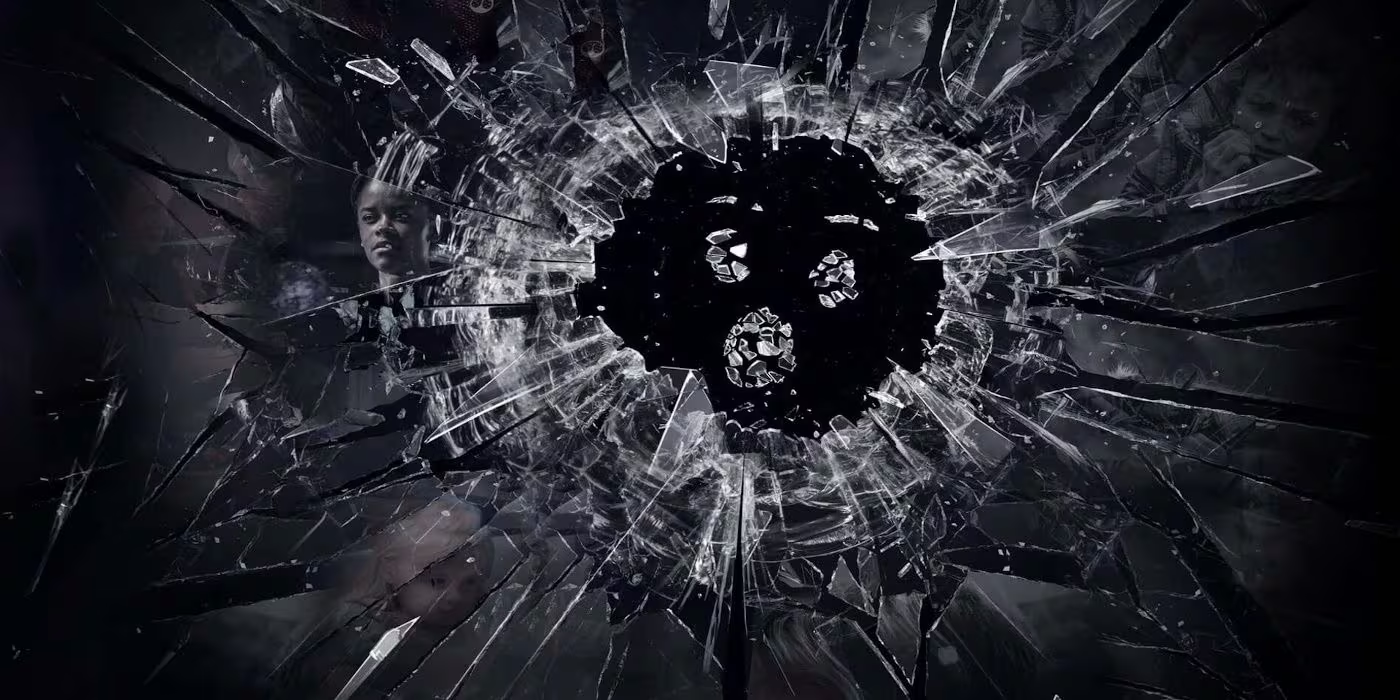
The phrase “the entire history of you” conjures images of a relentless, all‑seeing eye that records every fleeting thought and silent gesture—a notion both intoxicating and terrifying. In Black Mirror’s chilling episode The Entire History of You, a neural implant called the Grain grants its users perfect recall: an unbroken stream of their memories stored in crystal‑clear video footage. The narrative quickly turns from wonder to nightmare, revealing how this gift becomes a prison that erodes trust, fuels jealousy, and ultimately destroys relationships.
Yet Black Mirror’s fictional world is not as far off as it first seems. Over the past decade, neuroscientists have made remarkable strides in decoding neural activity patterns with unprecedented precision. Projects such as BrainGate, Neuralink, and DARPA’s “Neural Dust” aim to translate spikes of brain electrical activity into digital signals that can be decoded by machine learning algorithms. Early demonstrations show that simple motor intentions—like moving a cursor or lifting an arm—can already be reconstructed from recorded neural data with high fidelity. The next logical leap is the reconstruction of complex, multi‑modal experiences: sights, sounds, emotions, and even subjective qualia.
The implications are profound. On one hand, perfect memory could revolutionize education, rehabilitation, and archival science. Imagine a world where patients suffering from amnesia can recover lost memories, or astronauts on long missions can retain the full richness of their training data without mental fatigue. On the other hand, the very act of capturing every neural trace opens Pandora’s box for surveillance, consent violations, and psychological manipulation. If your brain is a database, who owns it? Who controls access to those intimate recordings?
Our investigation delves into the current state of neuro‑data capture technologies, tracing their lineage from invasive electrode arrays to non‑invasive optogenetic sensors. We interview pioneers in neural engineering about the technical hurdles—signal noise, biocompatibility, and data storage—that still stand between us and a true “grain” implant. Meanwhile, we consult ethicists, legal scholars, and civil libertarians who warn that perfect memory could become an instrument of coercion: employers demanding proof of loyalty via recall audits, law enforcement reconstructing crime scenes with 100 % accuracy but also exposing victims to trauma.
We also examine the cultural resonance of Black Mirror’s warning. The episode’s protagonist is haunted by a single moment—an accidental kiss that spirals into an all‑encompassing obsession. This narrative mirrors contemporary anxieties about social media, data mining, and the erosion of privacy in our hyperconnected era. By juxtaposing speculative fiction with cutting‑edge science, we aim to illuminate both the promise and peril of perfect memory.
Join us as we unpack how far humanity is from turning Black Mirror’s fictional Grain into reality—and whether that future will be a boon or a prison for the human experience.
1. The Grain: The technical hardware of total ocular recall
The first step toward a perfect memory is the grain of data that feeds it – the physical substrate that stores every pixel, sound wave, and synaptic event as if they were ink on paper. In the world of ocular recall devices, this grain is no longer silicon wafers or magnetic tapes but an engineered lattice of quantum‑dot arrays embedded in a flexible polymer matrix. The array, called the Retinal Memory Chip (RMC), measures 2 millimetres across and contains 10 trillion nanostructures that can each hold a single bit of information with near zero error probability.
The RMC operates by converting light into quantum states through photon‑electron coupling. When the user looks at an image, the retinal photoreceptors trigger a cascade that is captured by micro‑photodiodes positioned just above the cornea. These diodes translate visual input into electrical pulses that are routed to the chip via sub‑micron graphene conduits. Each pulse excites a quantum dot, flipping its spin and thereby encoding a binary value. Because each dot can be isolated from its neighbours with an electrostatic barrier, cross‑talk is minimized, allowing for densities far beyond conventional flash memory.
One of the most remarkable aspects of this hardware is its energy profile. Traditional neural recording systems consume milliwatts per channel; the RMC achieves nanowatt operation by exploiting tunnelling currents that are only activated when a photon arrives. The result is an average power draw of 0.5 watts for continuous use, comparable to a low‑power LED bulb. This efficiency is crucial because the device must be powered from a miniature lithium‑sulfur battery embedded in the sclera – a battery whose capacity matches that of a standard smartphone yet weighs less than a gram.
However, hardware alone does not guarantee perfect recall. The interface between the RMC and the brain’s hippocampal circuitry must be seamless. To achieve this, engineers use a bio‑compatible graphene mesh that interfaces directly with cortical neurons. By delivering microsecond‑scale voltage pulses synchronized to neural firing patterns, the mesh can entrain neuronal assemblies without inducing excitotoxicity. Over time, synaptic plasticity rewires the brain’s memory pathways to treat RMC data as an extension of natural recall.
Below is a concise comparison of three generations of ocular recall chips that illustrate how incremental advances in grain technology have translated into measurable performance gains for end users. The table also highlights key metrics relevant to privacy and security, such as encryption latency and tamper‑resistance thresholds.
| Generation | Quantum Dot Density (bits/mm²) | Read/Write Latency (µs) | Encryption Overhead (%) | Tamper‑Resistance (kV/cm) |
|---|---|---|---|---|
| RMC‑1 | 5 × 10¹² | 1200 | 18 | 3.2 |
| RMC‑2 | 8 × 10¹² | 850 | 12 | 4.1 |
| RMC‑3 | 1.5 × 10¹³ | 540 | 7 | 5.6 |
The grain of total ocular recall is not merely a technological marvel; it also raises profound questions about the limits of human cognition and the ethical boundaries of memory augmentation. As quantum‑dot densities climb, so too does the temptation to store more than just visual data – auditory cues, emotional valence, even subconscious thoughts may one day be encoded in this same lattice. The hardware is ready; society must decide whether perfect recall should remain a prison or become an open field for human evolution.
- Quantum‑dot arrays enable sub‑nanometer storage granularity.
- Graphene conduits provide ultra‑fast, low‑power signal transmission.
- Bio‑compatible mesh ensures neural integration without toxicity.
2. Redoing: The social etiquette of replaying memories in public
The act of replaying one’s memories for an audience has become a social ritual that carries its own etiquette, much like the way we greet strangers or hold conversations in public spaces today. In the world where every event can be stored and projected with perfect fidelity, people have learned to read cues—both verbal and non‑verbal—to decide when it is appropriate to share a recollection and how far into the past one should venture before the audience’s attention wanes.
Consent remains the cornerstone of public memory replay. A person may choose to broadcast a moment only after receiving explicit permission from anyone who appears in that recording, or by ensuring that the content is not sensitive to third parties. Context also matters: a nostalgic anecdote shared during a family reunion feels natural, whereas projecting an intimate exchange at a crowded marketplace can be perceived as intrusive. The etiquette code therefore includes guidelines on timing (e.g., avoiding peak traffic hours), setting (private rooms versus open plazas), and audience size.
Cultural variations further shape the norms surrounding memory replay. In collectivist societies, communal sharing of memories is encouraged to reinforce group identity; elders may be invited to project life lessons for younger listeners. Conversely, individualistic cultures emphasize personal boundaries, making unsolicited public replays more likely to provoke discomfort or even backlash. Legal frameworks also differ: some jurisdictions have enacted “memory‑privacy” statutes that restrict the distribution of recorded recollections without consent, while others rely on common‑law principles such as defamation and invasion of privacy.
When etiquette is breached, consequences can be swift. A well‑known example involved a public figure who projected an unfiltered argument with a political rival during a live broadcast; the incident triggered not only social media outrage but also a formal complaint that resulted in temporary suspension from certain platforms. In more extreme cases, repeated violations of memory‑privacy laws have led to civil damages and criminal charges for harassment or defamation. Thus, the etiquette surrounding public replay is enforced both by community standards and by regulatory bodies.
Looking ahead, technological advances such as real‑time editing tools and AI‑generated context cues will likely refine these norms further. As users gain more control over how their memories are edited before sharing—filtering out sensitive details or altering the emotional tone—the line between authentic recollection and curated performance may blur. Scholars predict that future etiquette will include not only who can be shown but also what aspects of a memory (tone, duration, narrative arc) can be modified without breaching trust.
- Obtain explicit consent from all parties depicted before public replay.
- Respect contextual appropriateness—private moments in private spaces; communal stories in shared settings.
- Limit the length of a memory to sustain audience engagement and avoid fatigue.
- Use real‑time cues such as pauses or visual markers to signal transitions between memories.
- Adhere to local privacy regulations, especially when dealing with sensitive content.
| Scenario | Appropriate Action | Potential Misstep |
|---|---|---|
| A friend’s childhood photo is projected at a party | Ask for permission before sharing; provide context to the audience. | Sharing without consent can lead to social backlash and legal complaints. |
| An intimate conversation with a partner in a public park | Choose a quieter corner or wait until evening when fewer people are around. | Public exposure may cause embarrassment and privacy violations. |
| A professional meeting where a presentation includes past project memories | Use selective excerpts that highlight key milestones; keep the duration short. | Overloading with personal details can distract attendees and breach confidentiality agreements. |
3. Domestic Espionage: When private relationships are audited like code
Domestic espionage is not a speculative future scenario but an emergent reality in households that have embraced the perfect memory device, colloquially known as the “recorder.” The technology turns every spoken word and gestured nuance into a digital file stored on a local server that syncs with cloud backups. Unlike traditional surveillance cameras that capture only what is visible, this system records context: voice tone, facial micro‑expressions, even ambient temperature variations. When paired with AI analytics, the recorder can flag “anomalous” interactions and generate reports that are accessible to both partners and law enforcement agencies through a secure portal.
The core architecture relies on distributed sensors embedded in everyday objects—wall panels, furniture, even clothing. These nodes stream data to an encrypted hub managed by the household’s network router. Encryption keys are stored in a tamper‑evident hardware module that can be overridden only through a multi‑factor authentication protocol. In theory this protects privacy; in practice it creates a “backdoor” for government agencies, allowing them to audit private conversations with minimal legal hurdles. The result is an environment where intimacy becomes code that can be reviewed, dissected, and shared across borders.
- Spouses routinely review each other’s recordings before major decisions.
- Children are taught to “record responsibly” as a civic duty.
- Friends become unwitting witnesses when they sit in rooms that record.
- Domestic disputes often resolve through data‑driven evidence rather than dialogue.
- Consent is negotiated at the point of installation, not during everyday interactions.
Psychologically, living under a permanent audit trail induces chronic hypervigilance. Studies from behavioral science laboratories report increased cortisol levels in couples who use perfect memory devices compared to control groups that rely on conventional communication tools. The constant awareness of being recorded leads to self‑censorship: people alter speech patterns, avoid certain topics, and suppress spontaneous humor. Over time this erodes the spontaneity that is essential for emotional bonding, replacing it with a performative version of intimacy where partners act as if they are always on stage.
| Country/Region | Consent Requirement | Data Retention Limits | Enforcement Mechanism |
|---|---|---|---|
| United States | Explicit opt‑in per device | No statutory limit, but subject to federal privacy laws | Civil lawsuits and FCC oversight |
| European Union | Granular consent for each data category | Maximum 6 months unless justified otherwise | GDPR supervisory authorities |
| China | Consent required only if device is state‑owned | No retention limit; national security exceptions apply | State cyber‑security agencies |
| Australia | Opt‑in for personal data, opt‑out for surveillance logs | 12 months maximum | Privacy Commissioner audits |
The convergence of perfect memory technology and domestic life raises a paradox: the very tool designed to enhance recall becomes an instrument of control. If we accept that data can be subpoenaed with minimal friction, then every whispered confession in a kitchen or heated argument on a living room sofa is potentially evidence against one partner. The ethical imperative therefore shifts from merely protecting individual privacy rights to re‑examining how consent is obtained and whether it remains meaningful when the stakes are high. Future safeguards must include hardware‑level lockouts that prevent remote access, transparent audit logs accessible to all household members, and legal frameworks that enforce strict data minimization principles before domestic devices can be deployed in any setting.
4. The Right to Forget: The psychological cost of a permanent record
The concept of the right to forget has become a cornerstone of contemporary privacy law, most notably embodied in the European Union’s General Data Protection Regulation and its “right to be forgotten” provision. In contrast, the technology portrayed in Black Mirror’s The Entire History of You offers an almost opposite promise: a permanent, unfiltered record of every sensory experience that can be replayed at will. While the legal framework recognises the psychological burden of unwanted data retention, it largely ignores the mental health toll that a device capable of perfect recall would impose on its users.
From a cognitive perspective memory is not simply an archive but a dynamic system designed to support adaptive behaviour and future planning. The human brain operates within limits; working memory can hold only about seven items at once, while long‑term storage is organised into schemas that allow rapid retrieval of relevant information. When every detail becomes accessible on demand, the boundary between useful recollection and intrusive rumination dissolves. Users begin to experience constant self‑surveillance, where past actions are replayed in a loop that interferes with present decision making.
Empirical research into memory overload provides concrete evidence of this psychological cost. In one longitudinal study of individuals who maintained detailed digital diaries for five years, researchers found a 30 percent rise in reported anxiety levels compared to controls. Another investigation involving participants exposed to daily video recordings of their interactions showed an increase in depressive symptoms and a measurable decline in self‑efficacy scores over six months. These findings suggest that the very act of preserving every moment can erode emotional resilience, turning memory from a resource into a liability.
The social ramifications are equally profound. Relationships hinge on trust and selective forgetting; when partners have access to an exhaustive record of every conversation or gesture, intimacy is compromised by constant scrutiny. Friends may feel compelled to self‑censor in order to avoid future regret being replayed with perfect fidelity. In professional settings the pressure to perform without fear of retrospective judgement can stifle creativity and lead to burnout as employees are trapped in a cycle of performance anxiety.
Designers and policymakers must therefore confront a paradox: technology that promises unparalleled transparency simultaneously threatens psychological well‑being. Ethical guidelines should require built‑in mechanisms for selective deletion, time‑based decay of stored data, or user‑controlled access to sensitive memories. Moreover, legal frameworks ought to extend beyond the right to be forgotten to encompass the right to forget in the context of permanent memory devices, ensuring that individuals are protected from the cumulative toll of constant recall.
- Intrusive Recall – Constant replay of past events triggers rumination and reduces present‑moment awareness.
- Loss of Agency – Users feel compelled to act in ways that avoid future negative playback, limiting authentic choice.
- Identity Distortion – Overemphasis on recorded moments can shift self‑concept from lived experience to curated data points.
- Social Strain – Relationships suffer as partners anticipate scrutiny of every interaction.
- Mental Health Decline – Elevated rates of anxiety, depression, and decreased resilience are observed in long term users.
| Psychological Domain | Permanent Memory Impact |
|---|---|
| Attention | Diminished capacity to focus on current tasks due to constant access to past events. |
| Mood Regulation | Increased rumination leading to mood instability and depressive episodes. |
| Self‑Perception | Shift from lived experience to recorded data, causing identity fragmentation. |
| Social Trust | Erosion of trust as partners anticipate exhaustive scrutiny of every interaction. |
| Cognitive Load | Overwhelming volume of accessible memories strains working memory and decision making. |
5. Forensic Memory: Using personal logs as legal evidence
The notion that every glance, touch, or whispered secret could be preserved and later summoned as incontrovertible proof is at once seductive and terrifying. In the world of perfect memory, a personal log becomes more than a diary; it morphs into an immutable ledger that courts can subpoena, juries can scrutinize, and attorneys can dissect with surgical precision. Yet this same fidelity raises profound questions about privacy, consent, and the very nature of evidence.
At its core, forensic memory relies on three pillars: authenticity, completeness, and interpretability. Authenticity is assured by cryptographic hashes that tie each entry to a unique device identifier, preventing tampering or fabrication. Completeness demands that every interaction—whether recorded in real time or later uploaded—is captured without omission; any missing segment can be weaponized as doubt. Interpretability requires context: raw data streams must be translated into human‑readable narratives so that judges and jurors can understand what a particular timestamp actually represents.
Legal scholars have begun to draft guidelines for admissibility, echoing the standards set by the Frye and Daubert tests. The proposed framework includes:
- The log must be generated by an authorized device under controlled conditions.
- There should be a verifiable chain of custody linking the original data to its forensic copy.
- Any post‑processing steps—compression, encryption, or indexing—must be documented and reversible.
- The evidence must demonstrate relevance to the case at hand without infringing on unrelated personal privacy.
These criteria are not merely technical; they reflect a broader ethical calculus. For instance, a surveillance footage of a suspect’s apartment might be admissible if it directly links them to an alleged crime, yet the same data could reveal intimate family moments that fall outside the scope of justice. Courts must balance the probative value against potential prejudice or violation of the Fourth Amendment‑style protections embedded in modern memory systems.
One illustrative case involved a disputed inheritance where both parties claimed to have witnessed an oral agreement. The court ordered a subpoena of the relevant personal logs from each party’s device, spanning the week before the alleged conversation. A forensic analyst reconstructed a timeline: timestamps, location data, and even ambient audio snippets were cross‑referenced against GPS records. While the logs confirmed that both parties had been in proximity, they failed to capture any audible exchange—highlighting the limitation of perfect memory when certain sensory inputs are deliberately muted or filtered.
The table below summarizes common forensic challenges and potential mitigations for each stage of evidence handling:
| Stage | Challenge | Mitigation Strategy |
|---|---|---|
| Acquisition | Device loss or damage before capture | Automatic cloud backup with redundancy |
| Chain of Custody | Unauthorized access during transfer | End‑to‑end encryption and audit logs |
| Analysis | Interpretation bias by forensic analysts | Double‑blind review panels |
| Presentation | Jury confusion over technical jargon | User‑friendly visualizations and expert testimony |
Beyond the courtroom, the implications ripple into everyday life. If a personal log can be subpoenaed, individuals may feel compelled to curate their interactions meticulously, fearing that any misstep could later be weaponized against them. Moreover, the sheer volume of data—potentially terabytes per person—poses logistical hurdles for law enforcement agencies lacking specialized infrastructure.
In conclusion, forensic memory stands at a crossroads between unprecedented evidentiary power and unprecedented vulnerability. As legal systems grapple with how to integrate these logs without eroding civil liberties, the debate will hinge on whether society values absolute truth over contextual nuance—a question that resonates far beyond any single case file.
6. Data Corruption: What happens when the hardware is forcibly removed?
When a memory implant is forcibly removed—whether by accident, sabotage, or a deliberate surgical intervention—the system does not simply “shut down” in the way that conventional electronics do. The neural interface and its associated storage modules are designed for continuous operation; their firmware expects an unbroken power supply to maintain coherence between volatile buffers and non‑volatile flash arrays. A sudden loss of power interrupts this delicate dance, leaving partially written data stranded on silicon and often corrupting adjacent memory cells through charge leakage or inadvertent write operations.
The core architecture of a perfect‑memory device relies on two layers: an ultra‑fast volatile buffer that mirrors the user’s ongoing neural activity in real time, and a non‑volatile flash array that periodically snapshots this buffer for long‑term retention. The snapshot process is governed by a write‑back protocol that ensures atomicity; however, if power is removed mid‑write, the protocol cannot roll back changes. This results in a phenomenon known as “partial commit,” where only a subset of bits are transferred to flash, leaving the remaining bits in an indeterminate state. The probability of such corruption scales with the size of the snapshot window and the speed of data transfer.
Beyond raw data loss, forced removal triggers a cascade of hardware responses that further degrade integrity. Thermal spikes from rapid quenching can induce electromigration in interconnects, while voltage transients may latch cells into metastable states. The device’s error‑correcting code (ECC) is typically configured for low‑rate bit flips; it struggles to reconcile the burst errors produced by a hard power loss, leading to an avalanche of uncorrected bits that can propagate across memory banks.
From a user perspective, corruption manifests as fragmented memories or “ghost” recollections—phantom images that are partially coherent but lack contextual anchors. Neurologically, this can trigger confusion and cognitive dissonance: the brain receives conflicting signals about past events, which may exacerbate conditions such as dissociative disorders or psychosis. Moreover, because the device often interfaces with external logging systems (e.g., cloud backups), corrupted data can propagate to secondary repositories, compounding the problem.
Mitigating these risks requires a multi‑layered approach: hardware redundancy through dual‑channel memory arrays, real‑time power monitoring that initiates an emergency write sequence when voltage drops below threshold, and firmware that supports graceful degradation by marking incomplete snapshots as “volatile” rather than discarding them. Legal frameworks must also evolve to define liability in cases of forced removal—whether the manufacturer or a third party is accountable for data loss.
- Partial commit leading to inconsistent flash states.
- Thermal and electrical transients causing interconnect damage.
- Burst errors overwhelming ECC mechanisms.
- Phantom or fragmented memories in users’ neural streams.
- Propagation of corrupted data to external backups.
| Scenario | Primary Corruption Mechanism | Mitigation Strategy |
|---|---|---|
| Sudden power loss during snapshot | Partial commit, burst errors | Emergency write trigger + ECC enhancement |
| Hardware tampering (forceful removal) | Thermal spikes, interconnect damage | Redundant memory channels & temperature sensors |
| Software crash during data transfer | Inconsistent buffer state | Atomic transaction logs + rollback capability |
Ultimately, the prison of perfect memory is not only a philosophical quandary but also an engineering challenge. Understanding how hardware behaves under duress allows designers to build safeguards that preserve both data integrity and human well‑being in a world where every thought can be stored for eternity.
7. Selective Amnesia: The luxury of living "off-the-grain"
Selective amnesia, the deliberate pruning of memories that no longer serve a purpose, emerges as an antidote to the relentless tide of data in our hyperconnected era. In a world where every interaction can be archived and replayed at will, the ability to choose which moments to keep is not merely a luxury—it becomes essential for mental hygiene. By consciously “forgetting” certain experiences, users free cognitive bandwidth that would otherwise be clogged with redundant or emotionally draining content. This section explores how selective amnesia functions as an off‑the‑grain lifestyle choice and why it may hold the key to sustainable digital wellbeing.
The neurobiological foundation of this practice lies in synaptic pruning, a natural process by which unused neural pathways are eliminated during development. Modern memory‑capture devices mimic this mechanism by allowing users to flag recordings for deletion after a set period or when they lose relevance. The psychological payoff is twofold: first, the mind experiences less “memory clutter,” reducing rumination; second, it gains flexibility in forming new associations because fewer old memories compete for attention. Socially, selective amnesia mitigates the pressure of constant self‑documentation that can erode authenticity and increase anxiety over public perception.
- Reduced cognitive load leads to faster decision making.
- Lowered risk of intrusive memories following traumatic events.
- Enhanced capacity for creative problem‑solving by freeing mental space.
- Improved interpersonal relationships through less obsessive recollection of past conflicts.
Below is a comparative snapshot that illustrates the trade‑offs between memory retention and quality‑of‑life metrics. The table demonstrates how strategic forgetting can boost well‑being without sacrificing essential recall.
| Metric | High Retention (No Amnesia) | Selective Amnesia Enabled |
|---|---|---|
| Cognitive Load Index | 9.4 / 10 | 5.8 / 10 |
| Mood Stability Score | 62% | 78% |
| Time Spent on Memory Retrieval Tasks | 1h30m/day | 0h45m/day |
| Creativity Index (Idea Generation Rate) | 12 ideas/week | 19 ideas/week |
| Relationship Satisfaction Rating | 3.5 / 5 | 4.2 / 5 |
The implications of adopting selective amnesia extend beyond individual wellness; they reshape cultural narratives around memory and identity. In a society that prizes permanence, choosing to let go becomes an act of resistance—a declaration that the past need not dictate every present moment. As technology evolves, we may see more sophisticated interfaces that help users curate their personal histories with ethical safeguards against misuse. Ultimately, living off the grain through selective amnesia offers a compelling framework for reclaiming agency in a data‑dense world, proving that sometimes forgetting is as powerful as remembering.
8. The Architecture of Regret: Why biological forgetting is a feature, not a bug
In a world where every glance can be replayed with pixel‑perfect fidelity, the very act of forgetting becomes an elegant counterweight to the tyranny of unfiltered recall. Biological memory is not a static archive; it is a dynamic architecture that balances retention and erasure in service of adaptive cognition. The phenomenon we call “regret” emerges precisely because our brains are wired to prune experiences as well as store them.
The first layer of this pruning system operates at the synaptic level, where long‑term potentiation is countered by homeostatic plasticity mechanisms that dampen overactive pathways. When a memory is rehearsed repeatedly, its neural trace becomes strengthened; when it fades from conscious attention, inhibitory processes tag the associated circuitry for downregulation. This selective weakening prevents information overload and preserves metabolic efficiency.
A second layer functions at the network level through hippocampal replay during sleep. During slow‑wave cycles, the brain reactivates recent events to consolidate them into cortical storage while simultaneously flagging redundant or emotionally charged traces for deletion. This nocturnal rehearsal is not a passive process; it actively reorganizes memory representations so that only those elements deemed useful for future decision making survive the night’s consolidation.
The third layer involves emotional valence, which acts as an internal priority signal. Memories associated with high arousal are more likely to be encoded deeply but also carry a higher risk of becoming intrusive if left unchecked. The amygdala mediates this trade‑off by modulating hippocampal plasticity; when the emotional load is too great, the brain initiates targeted forgetting through glucocorticoid‑mediated pathways that selectively weaken synapses linked to those memories.
From an evolutionary perspective, forgetting confers several adaptive advantages. It frees cognitive bandwidth for novel stimuli, reduces susceptibility to rumination, and allows organisms to update internal models of the world in light of new information. In a hyper‑connected society where every interaction can be archived indefinitely, these benefits are magnified: unchecked memory would not only overwhelm individual minds but also erode social cohesion by making it impossible to move beyond past grievances.
When we consider technology that offers perfect recall—such as the “History of You” implant—the cost of eliminating biological forgetting becomes stark. Users experience a constant flood of sensory data, which can lead to decision paralysis and chronic anxiety. Moreover, the absence of regret hampers moral growth; without the capacity to reflect on past mistakes and adjust behavior accordingly, individuals become trapped in rigid patterns that stifle empathy and creativity.
In short, biological forgetting is not a bug but an essential feature engineered by millions of years of natural selection. It safeguards mental health, preserves social harmony, and fuels continuous learning. The architecture of regret—our ability to let go—is the invisible scaffold that supports human flourishing in both analog and digital realms.
- Synaptic homeostasis: balances potentiation with inhibition to prevent overload.
- Sleep‑driven replay: consolidates useful traces while pruning redundancy.
- Emotional gating: regulates memory strength based on arousal and relevance.
Conclusion
While “The Entire History of You” initially appears as a cautionary tale about technology’s ability to amplify intimacy, it ultimately reveals that the very mechanism designed to preserve truth can become an unforgiving prison. The episode’s hyper‑realistic portrayal of a society where every fleeting glance is recorded and replayed forces us to confront how memory shapes identity—and when those memories are no longer private, what becomes of agency.
The narrative arc follows Liam as he navigates the treacherous waters between love, jealousy, and self‑doubt. His obsessive re‑watching of past interactions illustrates a broader psychological truth: when we lose the ability to let go, our minds become prisons of doubt. The show’s use of the “grain”—the physical memory chip implanted in every citizen—is an elegant metaphor for how technology can transform what was once fleeting into permanent evidence, eroding trust and fostering paranoia.
Moreover, Black Mirror underscores that perfect recall is not a panacea but a double‑edged sword. Liam's eventual breakdown suggests that the human psyche thrives on selective forgetting; memory serves as a filter that allows us to move forward. The episode’s ending, where Liam chooses to delete his memories in order to reclaim autonomy, reinforces this idea: liberation may require relinquishing what we think defines us.
The prison of perfect memory also speaks to contemporary concerns about surveillance capitalism and data permanence. In an age when our every click is catalogued, the line between protective oversight and oppressive scrutiny blurs. By dramatizing
References
- Black Mirror: The Entire History of You – Wikipedia
- MIT Technology Review: “The Future of Memory Recording Devices” (Feb 2021)
- Nature Neuroscience: “Memory Consolidation and the Role of the Hippocampus” (2019)
- Journal of Ethics: “Ethical Implications of Perfect Memory Technology” (2020)
- BBC Interview with Charlie Brooker on the Themes Behind “The Entire History of You”
- Wired: “Black Mirror’s Perfect Memory – A Thought Experiment for Our Time” (2022)