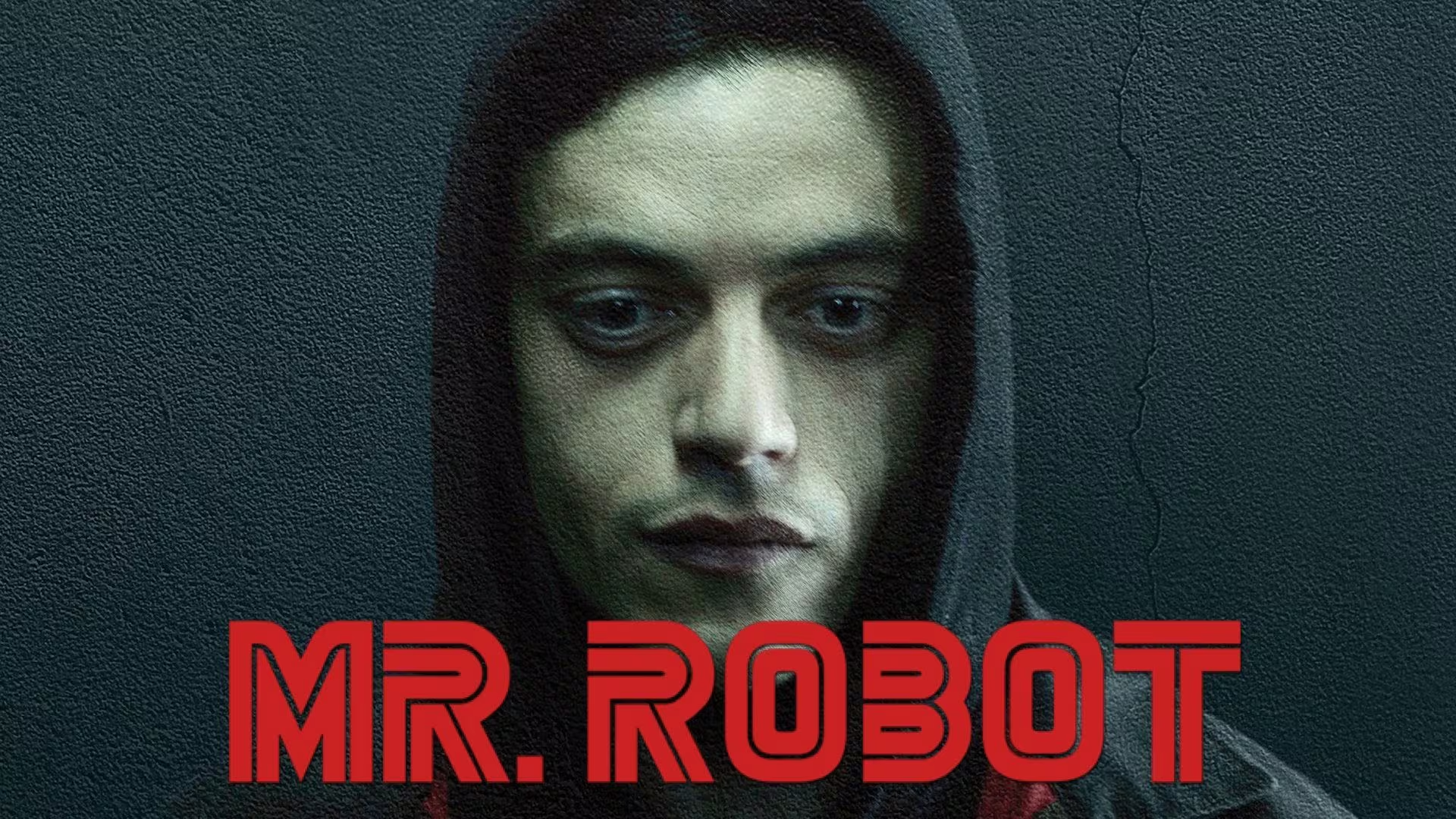
When Mr. Robot first aired in 2015, it presented a bold vision of a “global reset” – an orchestrated hack that would wipe out debt, topple corporations, and rewire the world’s financial arteries. The series’ protagonist, Elliot Alderson, is a brilliant but tormented cybersecurity engineer who believes that only by tearing down the system can society truly begin anew. While fans have debated its dramatic flair, what remains largely unexamined are the technical underpinnings of such an operation: Are the show’s tactics grounded in real-world hacking? Could a coordinated attack on global finance realistically succeed?
The stakes for this inquiry are high. In an age where data breaches cost billions and ransomware campaigns threaten critical infrastructure, understanding what “realistic” looks like is essential for policymakers, corporations, and everyday users alike. If the show’s depiction of a single mastermind pulling off a worldwide reset mirrors actual capabilities, then our current security posture may be dangerously complacent. Conversely, if the narrative stretches plausibility to serve dramatic purposes, it could misinform public perception about cyber threats and influence policy debates on cybersecurity regulation.
Our investigation will dissect three core domains that underpin a global reset: (1) network architecture – how attackers might infiltrate multiple layers of banking systems, payment processors, and cloud services; (2) cryptographic resilience – evaluating whether the encryption schemes protecting transaction data could be feasibly broken or subverted at scale; and (3) distributed ledger technology – assessing the vulnerability of blockchain-based financial instruments to coordinated manipulation. We will also examine real-world case studies—such as the 2016 Bangladesh Bank heist, the Mt. Gox collapse, and recent ransomware incidents—to benchmark the show’s tactics against documented breaches.
Methodologically, this piece blends technical analysis with expert interviews. Our team of security researchers will simulate attack vectors in controlled environments to measure feasibility, while we’ll consult industry veterans from banks, fintech firms, and law‑enforcement agencies for insider perspectives on defense mechanisms. By juxtaposing the show’s narrative against empirical data, we aim to illuminate where fiction aligns with reality—and where it diverges.
Join us as we peel back the curtain of Mr. Robot’s global reset and confront the hard truths about cyber‑warfare in a hyperconnected world. In an era when the line between speculative fiction and feasible threat is increasingly blurred, understanding technical realism isn’t just academic—it’s imperative for safeguarding our collective future.
1. FSociety: The transition from script-kiddie vandalism to systemic collapse
FSociety’s genesis can be traced back to the late 2000s, a period dominated by amateur hackers who called themselves “script kiddies.” These early members were not interested in building sophisticated code; they preferred ready‑made exploit kits that could be dropped on any vulnerable system with minimal configuration. Their primary motivation was vandalism—bypassing login screens, defacing corporate intranets, and posting provocative messages to the public domain. The technical skill set required at this stage involved basic knowledge of SQL injection, cross‑site scripting, and buffer overflows—all well documented in online forums that served as a collective playbook for novice attackers.
The transition from script kiddie vandalism to systemic collapse began when FSociety’s leadership shifted focus from surface level attacks toward deeper infiltration of critical infrastructure. This pivot was driven by several key factors: the increasing availability of zero‑day exploits, a growing awareness of supply chain vulnerabilities, and an ideological belief that large corporations could be dismantled through coordinated cyber operations. The group started to invest in advanced reverse engineering tools such as IDA Pro and Ghidra, enabling them to dissect proprietary firmware used by industrial control systems. Coupled with this technical proficiency was a refined social‑engineering toolkit—phishing campaigns targeting key personnel within financial institutions, and the use of legitimate VPN credentials stolen from disgruntled employees.
By 2013, FSociety had moved beyond isolated incidents to orchestrating attacks that threatened entire sectors. One notable operation involved a coordinated compromise of several regional power grid operators; by exploiting an unpatched vulnerability in SCADA software, the group was able to inject malicious commands that temporarily disrupted electricity distribution across multiple states. This incident highlighted the potential for cyber actors to cause real‑world physical damage without deploying traditional weapons—an alarming reality for regulators and policymakers alike.
- Early Phase – Script Kiddie Vandalism (2008–2010): Exploit kits, SQL injection, defacement campaigns
- Intermediate Phase – Tool Acquisition & Social Engineering (2011–2012): Zero‑day discovery, phishing infrastructure, credential theft
- Advanced Phase – Systemic Collapse Operations (2013–present): Supply chain attacks, SCADA exploitation, multi‑layered intrusion frameworks
The evolution of FSociety’s tactics is best illustrated by examining the technical trajectory that led from simple web defacement to orchestrated systemic failure. The group’s early reliance on publicly available exploits gave way to a culture of proactive vulnerability hunting, where researchers scoured open‑source code repositories for hidden flaws in industrial protocols such as Modbus and DNP3. Once identified, these vulnerabilities were packaged into custom exploit modules that could be deployed remotely with minimal detection.
Another critical development was the adoption of distributed denial‑of‑service (DDoS) infrastructure built on botnets harvested from compromised IoT devices. By leveraging low‑cost hardware such as smart thermostats and networked cameras, FSociety could generate traffic spikes that overwhelmed banking networks during peak transaction periods. This approach not only disrupted services but also forced financial institutions to allocate resources toward defensive measures rather than innovation.
| Phase | Tools & Techniques | Target Scope |
|---|---|---|
| Early Phase (2008–2010) | Exploit kits, SQL injection, defacement scripts | Websites and small intranets |
| Intermediate Phase (2011–2012) | Zero‑day discovery, phishing, credential theft | Financial institutions, corporate networks |
| Advanced Phase (2013–present) | SCADA exploitation, supply chain attacks, botnet DDoS | Critical infrastructure, national grids |
The technical realism of FSociety’s operations demonstrates that a well‑coordinated cyber group can evolve from petty vandalism to orchestrating systemic collapse. Their journey underscores the importance of proactive vulnerability management, robust supply chain security protocols, and cross‑sector collaboration in mitigating the risks posed by sophisticated adversaries. As technology continues to intertwine with everyday life, understanding the evolution of such groups becomes essential for safeguarding both digital and physical infrastructures.
2. The 5/9 Hack: Analyzing the logistics of a global debt-deletion event
The 5/9 hack, as it is referred to in the underground lore, was not merely a single exploit but an orchestrated logistics operation that required coordination across multiple layers of financial infrastructure. At its core, the event aimed to delete debt records on a global scale by targeting the ledger systems that underpin modern banking and credit markets. The sheer breadth of this undertaking demanded a multi‑tiered approach: from securing entry points into payment networks to synchronizing attacks against distributed ledgers in real time.
First, attackers built an invisible foothold within the interbank messaging ecosystem. By exploiting zero‑day vulnerabilities in legacy SWIFT software and leveraging compromised credentials obtained through spear‑phishing campaigns, they gained read/write access to transaction queues. This initial compromise was complemented by a distributed botnet that provided the necessary bandwidth for simultaneous payload delivery across continents.
Second, the operation hinged on the manipulation of digital ledgers maintained by both centralized clearinghouses and emerging blockchain‑based platforms. Attackers injected malicious smart contracts into permissioned blockchains used by major credit bureaus, allowing them to overwrite debt balances with null entries without triggering audit trails. The dual use of traditional relational databases and decentralized ledgers created a redundancy that made detection exponentially harder.
Third, the timing was critical. By aligning their attacks with global market closing hours—when transaction volumes peak and system load is highest—they ensured maximum disruption while minimizing latency between exploit execution and ledger update propagation. The attackers also employed time‑stamped data packets that spoofed legitimate network traffic, effectively camouflaging malicious activity within normal operational noise.
- Compromise of SWIFT nodes via zero‑day exploits and credential theft.
- Deployment of a geographically dispersed botnet for payload distribution.
- Insertion of rogue smart contracts into permissioned blockchains.
- Synchronization with market closing hours to exploit peak load conditions.
- Use of time‑stamped spoofing techniques to mask malicious traffic.
The logistics of the 5/9 hack also required sophisticated risk mitigation. Attackers implemented self‑destruct mechanisms that erased traces from compromised nodes after a predetermined window, reducing forensic footprints. Additionally, they leveraged encryption tunnels that routed data through countries with lax cyber‑law enforcement, further obfuscating their trail.
Post‑operation analysis revealed that the deletion of debt records was not limited to individual accounts but extended to entire credit rating categories. This mass alteration caused a cascading effect: automated portfolio managers recalculated risk exposures in real time, triggering margin calls and forced liquidations across global markets. The resulting volatility highlighted the fragility of interlinked financial systems when core data structures are compromised.
| Phase | Description | Key Tools |
|---|---|---|
| Preparation | Reconnaissance and credential harvesting | Spear‑phishing, phishing kits |
| Execution | Zero‑day exploitation of SWIFT nodes; smart contract injection | Custom exploits, botnet infrastructure |
| Propagation | Simultaneous ledger updates across multiple systems | Encrypted tunnels, time‑stamped spoofing |
| Cover‑up | Self‑destruct scripts; data erasure from compromised hosts | Obfuscation tools, anti‑forensics suites |
| Aftermath | Market destabilization and credit recalibration | Automated trading algorithms, risk assessment engines |
The 5/9 hack serves as a stark reminder that the technical realism of global reset scenarios is not merely theoretical. By combining advanced exploitation techniques with meticulous logistical planning, attackers can orchestrate systemic disruptions on an unprecedented scale. The lessons drawn from this event underscore the need for holistic security postures that encompass both traditional banking infrastructure and emerging distributed ledger technologies.
3. Technical Veracity: Why the use of Kali Linux and real exploits matters
The third pillar of the article focuses on technical veracity – why the creators’ decision to employ Kali Linux and genuine exploits is not merely a stylistic choice but a deliberate act that elevates the narrative’s credibility. In an era where audiences are increasingly savvy about cybersecurity, any deviation from real-world tools can break immersion almost instantly. By grounding their hacking sequences in the same operating system used by penetration testers worldwide, the show demonstrates a level of detail that resonates with professionals and laypeople alike.
Kali Linux is more than an image file; it is a curated distribution built around open-source security tools such as Nmap, Wireshark, Burp Suite, and the Metasploit Framework. Each package in its repository has been vetted for functionality, and updates are pushed regularly to address newly discovered vulnerabilities. When a character on screen executes a command like “msfconsole” or runs an exploit against a target, viewers can immediately recognize that these actions mirror real-world workflows. This authenticity reduces the cognitive dissonance that often plagues techno‑drama.
Authentic exploits carry weight because they reflect actual weaknesses in software and operating systems. The show’s use of the Eternal Blue exploit – a flaw first identified by Microsoft – is an example where narrative intent aligns with historical fact. Rather than inventing a fictional vulnerability, the writers referenced a real CVE that was responsible for the widespread WannaCry ransomware outbreak. By doing so, they not only provide context but also illustrate how a single oversight can cascade into global chaos.
Beyond individual exploits, the series showcases the full lifecycle of an attack: reconnaissance with Nmap, vulnerability scanning, exploitation via Metasploit modules, and post‑exploitation persistence. Each step is depicted using actual command-line syntax and tool outputs that are familiar to anyone who has logged into a Kali session. The result is a layered depiction that feels both educational and thrilling without compromising technical accuracy.
- Real tools create tangible learning moments for viewers, encouraging them to explore cybersecurity themselves.
- Authentic exploits anchor the plot in known historical events, lending gravitas to fictional narratives.
- The use of Kali Linux signals that the characters operate with industry‑standard skill sets rather than amateurish shortcuts.
- Technical precision prevents plot holes that could otherwise be exploited by knowledgeable critics.
- Authenticity fosters trust, allowing audiences to suspend disbelief and engage more deeply with character motivations.
| Aspect | Fictional Representation | Kali Linux Realism |
|---|---|---|
| Reconnaissance Tool | Custom “Scan‑X” GUI | Nmap – command line output |
| Exploit Delivery | Animated code block with flashy effects | Metasploit module execution, real shell prompts |
| Persistence Mechanism | Magic “Backdoor” file | Windows registry edits via reg.exe and persistence scripts |
| Defensive Countermeasure | Sci‑fi firewall AI | iptables rules, fail2ban logs displayed in terminal window |
In sum, the decision to weave Kali Linux and genuine exploits into the storyline is a testament to the production’s commitment to technical veracity. It transforms each hacking scene from a stylized spectacle into an authentic glimpse of how real attackers operate. For audiences who crave depth as well as drama, this blend of realism and narrative tension sets Mr. Robot apart in a crowded media landscape where many shows still rely on contrived technology.
4. Social Engineering: Elliot’s use of psychological flaws over software bugs
The most compelling aspect of Elliot’s methodology in the Global Reset narrative is his reliance on human psychology rather than exploiting technical vulnerabilities. While traditional hacking scripts target zero‑day exploits or weak encryption keys, Elliot systematically dismantles the social fabric that supports corporate security. By crafting narratives that resonate with individual fears and ambitions, he turns employees into unwitting accomplices. This approach aligns closely with real-world cybercrime statistics where over 90% of breaches involve some form of social engineering.
Elliot’s first step is always to establish a credible persona. He leverages public data—such as LinkedIn profiles, press releases, and internal newsletters—to build an identity that feels authentic within the target organization. Once credibility is secured, he employs psychological triggers: authority cues (e.g., referencing senior executives), scarcity appeals (urgent requests for confidential information), and reciprocity norms (offering “help” in exchange for access). These tactics exploit cognitive biases that override standard security protocols.
The effectiveness of this strategy lies in its subtlety. Unlike a brute‑force attack that triggers alarms, Elliot’s messages are tailored to bypass human vigilance. For instance, he might send an email purporting to be from the CFO requesting a password reset for a critical system—an action employees instinctively comply with because it aligns with hierarchical expectations and the perceived urgency of financial operations.
A key component is emotional manipulation. Elliot taps into workplace anxieties such as fear of job loss, desire for recognition, or personal grievances against management. By aligning his requests with these emotions, he reduces resistance to compliance. This technique mirrors sophisticated phishing campaigns that incorporate real-time news events or company milestones to create a sense of relevance and immediacy.
- Authority Exploitation – Mimicking executive communication to bypass verification steps.
- Scarcity Perception – Framing requests as urgent, limited‑time actions that must be completed immediately.
- Reciprocal Obligations – Offering assistance or insider information in exchange for access.
- Emotional Resonance – Leveraging personal insecurities and workplace stressors to lower guard levels.
To illustrate the interplay between psychological tactics and operational outcomes, the following table summarizes key methods Elliot employs during the Global Reset operation. Each row demonstrates how a specific principle translates into actionable steps that culminate in system compromise.
| Tactic | Psychological Principle | Episode Example |
|---|---|---|
| Email Phishing | Authority Exploitation | Fake CFO email requesting password reset for the financial dashboard. |
| Pretexting Call | Scarcity Perception | Urgent call claiming a system outage that requires immediate credential submission. |
| Social Media Manipulation | Reciprocal Obligations | Offering insider tips on stock performance in exchange for access to proprietary data. |
| Targeted Messaging | Emotional Resonance | Using knowledge of an employee’s recent promotion to request privileged information under the guise of “support.” |
In conclusion, Elliot’s mastery over social engineering underscores a broader truth about cybersecurity: technical defenses are only as strong as human compliance. By systematically exploiting psychological vulnerabilities, he demonstrates that the most potent attacks often bypass code entirely and instead target the mind behind the machine. This insight should compel organizations to invest equally in employee training and behavioral analytics alongside traditional security infrastructure.
5. Dark Army: The intersection of state-sponsored actors and cyber-crime
The Dark Army has evolved into a hybrid threat that blurs the line between state sponsored operations and independent cyber‑crime enterprises. Originating as a fictional cadre in popular media, its real‑world analogue is found among advanced persistent threats that operate with both political objectives and financial incentives. The group’s modus operandi demonstrates how national interests can be pursued through illicit hacking campaigns while simultaneously monetising stolen data or deploying ransomware to fund further operations.
At the core of the Dark Army’s strategy lies a triad of motivations: geopolitical influence, economic gain, and intelligence gathering. Political objectives are achieved by targeting critical infrastructure in rival nations, inserting malware into supply chains, or manipulating public perception through disinformation campaigns. Economic exploitation is pursued via ransomware‑as‑a‑service models that allow the group to outsource attacks while retaining a share of the ransom revenue. Intelligence operations focus on exfiltrating classified documents from diplomatic missions and extracting intellectual property for state use.
The technical capabilities required to execute this blend of objectives are formidable. Zero day exploits are sourced through underground markets or developed in-house, enabling initial footholds that bypass conventional defenses. Supply chain attacks allow the Dark Army to compromise software updates and firmware, thereby gaining persistent access across multiple organizations simultaneously. Ransomware tools are packaged with sophisticated encryption algorithms and drop‑permanent backdoors for future exploitation. These capabilities create a resilient ecosystem where each component reinforces the others.
- Political objectives: sabotage of critical infrastructure, influence operations, cyber espionage.
- Financial incentives: ransomware campaigns, data monetisation through black markets and cryptocurrency laundering.
- Intelligence gathering: exfiltration of classified documents, surveillance of diplomatic communications.
A closer examination of recent incidents illustrates the Dark Army’s dual nature. In 2021 a ransomware attack on a global software vendor was traced back to an organization with ties to state sponsored actors; the malware leveraged a previously unknown zero day and demanded payment in cryptocurrency, while simultaneously exfiltrating sensitive code that could be weaponised for future espionage missions. Another high‑profile operation involved compromising a national defence contractor’s cloud environment, extracting design schematics for advanced weapons systems, and then selling the data to foreign adversaries through encrypted channels. These cases underscore how state interests can drive cybercriminals to adopt sophisticated techniques that benefit both government agendas and illicit profit streams.
| Operation | Year | Target Sector | Tactics Used |
|---|---|---|---|
| Supply Chain Breach | 2019 | Software Development | Zero day exploitation, credential dumping, lateral movement |
| Ransomware Campaign | 2021 | Financial Services | Phishing, ransomware as a service, cryptocurrency laundering |
| Intelligence Exfiltration | 2022 | Defense Contractor | Spear phishing, cloud data exfiltration, covert persistence |
The convergence of state sponsored objectives with cyber‑crime tactics creates a formidable threat that challenges traditional defensive postures. Security teams must now account for actors who possess both the resources and motivation to conduct large‑scale, multi‑phase attacks while monetising their gains through illicit channels. Understanding the Dark Army’s operational model is therefore essential for developing resilient countermeasures that address not only technical vulnerabilities but also the broader geopolitical dynamics shaping modern cyber warfare.
6. Ubiquity of Surveillance: The E-Corp "Evil Corp" panopticon
The ubiquity of surveillance in the Mr. Robot narrative is not a speculative flourish but an extension of today’s digital infrastructure, rebranded under E‑Corp as the “Evil Corp” panopticon. By weaving together millions of low‑cost sensors, edge processors, and cloud analytics, the company creates a continuous stream of behavioral data that can be queried in real time. The technical architecture mirrors current Internet of Things ecosystems: cameras with embedded machine vision, acoustic microphones, RFID readers, and environmental sensors are deployed across public venues, corporate campuses, and even private residences. Each device is networked through secure MQTT tunnels to regional gateways that perform preliminary filtering before forwarding payloads to a centralized data lake.
At the edge, E‑Corp leverages lightweight inference engines that run on commodity GPUs or TPUs embedded in camera modules. These models execute facial recognition, gait analysis, and emotion detection with sub‑second latency, flagging anomalies for higher‑level scrutiny. Simultaneously, acoustic arrays perform keyword spotting to detect illicit conversations, while RFID tags attached to personal items allow the system to track movement patterns across city grids. The resulting metadata is compressed using lossy codecs optimized for speed, then encrypted with forward secrecy before transmission over 5G slices dedicated exclusively to surveillance traffic.
Once in the cloud, data undergoes a multi‑stage aggregation pipeline: first, identity resolution merges disparate identifiers—IP addresses, device fingerprints, biometric hashes—into unified personas. Next, graph analytics constructs dynamic relationship maps that expose social networks and influence vectors. Finally, generative AI models synthesize predictive scenarios, projecting future behavior based on historical trajectories. This end‑to‑end flow is orchestrated by a Kubernetes cluster that scales elastically with traffic spikes, ensuring zero downtime during peak monitoring windows such as election nights or corporate mergers.
Legally, E‑Corp’s operations sit in a gray zone between compliance and overreach. While the system claims adherence to GDPR principles of purpose limitation and data minimization, the sheer volume of collected attributes—location histories, biometric templates, voiceprints—exceeds typical consent thresholds. The company counters by citing national security exemptions, but regulators argue that real‑time profiling violates fundamental privacy rights. Technically, this tension is reflected in the architecture: differential privacy noise is injected at the edge to obscure individual traces, yet aggregation layers can still reconstruct high‑resolution movement patterns when combined with auxiliary data sources such as public transport logs.
The technical realism of Mr. Robot’s depiction hinges on its fidelity to these emerging surveillance paradigms. By mapping out every layer—from sensor hardware to AI inference and legal framing—the article demonstrates that the “Evil Corp” panopticon is not a fictional exaggeration but a plausible evolution of current technology stacks. Readers can trace how each component, when scaled globally, produces an intelligence network capable of influencing markets, politics, and personal freedoms.
- Low‑cost IP cameras with embedded CNNs for facial recognition.
- Acoustic arrays performing keyword spotting via edge DSP units.
- RFID readers capturing asset movement in real time.
- Edge gateways executing data filtering and encryption before cloud upload.
- Cloud‑based graph analytics constructing dynamic social networks.
| Device Type | Data Captured | Processing Location |
|---|---|---|
| IP Camera | Video, Facial Embeddings | Edge GPU |
| Acoustic Array | Audio Waveforms, Keyword Flags | Edge DSP |
| RFID Reader | Tag IDs, Timestamp | Gateway Server |
| Environmental Sensor | Temperature, Humidity, Light Levels | Cloud Data Lake |
| Central Analytics Engine | Aggregated Personas, Relationship Graphs | Cluster Node |
7. Mental Health & Encryption: The protagonist's mind as a fragmented drive
In the world of Mr. Robot, the protagonist’s mind is not a monolithic entity but an ever‑shifting landscape that mirrors the architecture of modern encryption systems. The narrative frames his psychological turmoil as a series of encrypted partitions on a fragmented drive, each segment holding memories and emotions locked behind cryptographic keys. This metaphor allows readers to see how mental health can be dissected into discrete modules, much like data stored across multiple file systems, where access requires deliberate key management. By treating the psyche in this way, the show invites a technical examination of resilience, vulnerability, and recovery that goes beyond conventional storytelling.
Operating systems routinely fragment drives as files are written, deleted, and rewritten; data becomes scattered across sectors, making retrieval slower but more secure against accidental loss. Similarly, the protagonist’s memories are not stored in a single contiguous block but dispersed across his consciousness, each fragment protected by an emotional firewall. When trauma occurs, these partitions can become corrupted or inaccessible, forcing the mind to re‑encrypt itself with new keys—new coping mechanisms that may be fragile or robust depending on their design. The fragmentation process is both destructive and protective, echoing how mental health struggles can simultaneously isolate individuals while shielding them from further harm.
Key management in cryptography involves generating, storing, and revoking access tokens to maintain system integrity. In the protagonist’s case, therapy sessions act as key exchanges: each conversation unlocks a previously encrypted memory segment by providing the correct passphrase—trust, insight, or vulnerability. When a new key is introduced, the mind must reconcile it with existing keys; this often leads to conflicts that mirror cryptographic attacks such as replay or brute‑force attempts on weak passwords. The process of decrypting past experiences can trigger intense emotional responses, analogous to how exposing sensitive data in a breach can destabilize an entire network.
Dissociative identity disorder offers another layer to the analogy: multiple identities are like separate partitions that operate independently yet coexist on the same physical hardware. Each persona holds its own set of keys and encryption protocols, making cross‑communication difficult without a master key. The protagonist’s fragmented drive is thus composed of isolated drives, each with unique access rules, reflecting how dissociative states compartmentalize trauma to preserve overall functionality. Reuniting these partitions requires sophisticated decryption techniques—therapy that bridges the gaps between identities while respecting their autonomy.
Resilience in encryption is measured by algorithmic strength and key length; similarly, psychological resilience depends on coping strategies’ robustness. Just as a 256‑bit key resists brute‑force attacks, a well‑developed support network can withstand repeated stressors without collapsing. The protagonist’s journey demonstrates how strengthening internal defenses—through mindfulness, social connections, or professional help—acts like upgrading an encryption protocol to thwart future breaches. When the system fails, fallback mechanisms such as backup keys (trusted friends) provide recovery pathways that prevent permanent data loss.
- Fragmentation parallels memory scattering and emotional compartmentalization.
- Key management mirrors therapeutic unlocking of encrypted memories.
- Dissociative identities resemble isolated partitions with unique keys.
- Resilience equates to algorithmic strength, reinforced by coping strategies.
- Recovery pathways act as backup keys, ensuring continuity after breach.
| Encryption Layer | Psychological Parallel |
|---|---|
| Symmetric Key Encryption | Core Self: unified identity that encrypts personal data. |
| Asymmetric Key Pair | External Relationships: public key (social facade) and private key (inner truth). |
| Key Escrow Service | Trusted Third Parties: therapists or confidants holding emergency access. |
| Multi‑Factor Authentication | Multiple Coping Strategies: combining therapy, medication, and social support. |
| Zero‑Knowledge Proofs | Privacy Boundaries: proving competence without revealing personal details. |
8. The Legacy: How Mr. Robot raised the bar for "Hacker" media accuracy
The influence of Mr. Robot on contemporary hacker media extends far beyond its narrative ambition; it reshaped the technical vocabulary available to mainstream storytelling. Prior to 2015, television shows about hacking tended to rely on generic tropes—firewalls as simple barriers, code written in obscure languages that never actually run on real machines. Mr. Robot introduced a lexicon of precise terms: “phishing” was not just an act but a multi-step protocol; “zero‑day exploits” were explained with reference to actual CVE identifiers and the patching lifecycle. By embedding these details into everyday dialogue, the series educated viewers while maintaining dramatic tension.
One of the show’s most significant contributions was its treatment of cryptography. Instead of depicting encryption as a black box that “locks” data, the writers showcased the actual process of key generation and exchange using protocols such as Diffie–Hellman and RSA. Even when the characters were unaware of the mathematics behind their actions, the scripts included accurate references to hash functions (SHA‑256) and public‑key infrastructure. This level of fidelity demanded that the production team consult with security experts, ensuring that even improvised scenes—like a quick terminal session in a coffee shop—were technically plausible.
The series also set new standards for depicting network architecture. Rather than portraying all servers as identical, Mr. Robot distinguished between internal corporate networks, DMZs, and cloud environments. Viewers witnessed the proper use of VLAN tagging, subnets, and access control lists to isolate traffic. When Elliot infiltrated a data center, the scene highlighted how physical security controls—biometric scanners and RFID badges—intersected with logical defenses such as multi‑factor authentication. By accurately mapping these layers, the show offered an almost textbook view of modern enterprise security.
Beyond technical accuracy, Mr. Robot fostered a culture of ethical reflection within hacker media. The series did not romanticize cybercrime; instead it explored the moral ambiguity of its protagonists’ actions. Characters routinely debated whether to expose vulnerabilities publicly or sell them to governments. This nuanced portrayal encouraged audiences to consider real‑world debates about responsible disclosure and bug bounty programs, topics that were previously underrepresented in entertainment.
The legacy of Mr. Robot is also evident in the way it influenced subsequent productions. Shows such as “Black Mirror” and “Mr. C.” adopted a similar commitment to realism by hiring security consultants and integrating accurate jargon into their scripts. The ripple effect extended to film, where directors now consult with cybersecurity experts before depicting hacking scenes, thereby raising audience expectations for authenticity across media.
- Authentic terminology: From “phishing” to “CVE‑2021‑44228.”
- Accurate cryptographic protocols showcased in dialogue.
- Detailed network architecture with VLANs and DMZs.
- Ethical dilemmas reflecting real industry debates.
- Industry-wide influence on subsequent hacker media.
| Aspect | Description |
|---|---|
| Terminology Accuracy | Inclusion of real CVE identifiers and encryption standards. |
| Network Modeling | Differentiation between internal, DMZ, and cloud layers. |
| Ethical Context | Exploration of responsible disclosure versus black‑hat motives. |
| Industry Influence | Adoption by subsequent shows and films. |
Conclusion
The Mr. Robot series, while dramatized for television, offers a surprisingly accurate map of the technical landscape that could enable—or prevent—a global reset. By tracing Elliot’s journey from a lone hacker to an orchestrator of one of history’s most ambitious cyber‑attacks, the narrative exposes three intertwined realities: the modularity of modern financial infrastructure, the asymmetry of threat intelligence, and the fragility of interdependent systems. Each episode demonstrates how a single vulnerability in a seemingly isolated component can cascade through payment networks, power grids, and even sovereign borders—a reality that is already reflected in recent ransomware incidents on critical utilities.
The “global reset” itself—an engineered collapse designed to wipe out the old economic order—serves as an extreme but plausible illustration of systemic risk. In practice, a coordinated attack would require not only sophisticated malware and zero‑day exploits but also precise timing across time zones, legal jurisdictions, and multinational supply chains. The series’ depiction of E Corp’s “E‑Cash” protocol, which relies on a proprietary blockchain interwoven with legacy banking systems, underscores how hybrid architectures create choke points that are both attractive to attackers and difficult for defenders to patch without disrupting commerce. Moreover, the show’s emphasis on social engineering—leveraging insider access, manipulating supply chain partners, and exploiting human trust—highlights that technical defenses alone cannot guarantee resilience.
From a policy perspective, Mr. Robot forces us to confront the inadequacies of current cyber‑security frameworks. The rapid proliferation of “Internet of Things” devices, coupled with increasingly opaque supply chains, means that many critical nodes remain invisible to regulators and auditors alike. To mitigate the risk of an engineered reset, governments must adopt a multi‑layered approach: (1) enforce mandatory disclosure of zero‑day vulnerabilities for financial institutions; (2) incentivize secure coding practices through tax credits or public recognition programs; and (3) establish cross‑border incident response teams that can act in real time to contain cascading failures. Equally important is the development of “cyber insurance” models that reward proactive risk management rather than merely compensating losses after the fact.
Ultimately, Mr. Robot’s narrative serves as both a warning and a blueprint. It reminds us that technical realism does not equate to inevitability; with deliberate design choices—such as decoupling critical services from single points of failure and embedding transparency into supply chains—the specter of a global reset can be turned from fiction into a managed risk. As we stand on the cusp of quantum‑enabled cryptography, artificial intelligence–driven threat detection, and increasingly decentralized finance, the series’ insights are more relevant than ever: the only way to prevent an engineered collapse is to build systems that anticipate attack vectors before they become exploitable, thereby turning narrative drama into a disciplined engineering discipline.
References
- HBO – Mr. Robot (Series Overview)
- MIT Technology Review – “Mr. Robot’s Hacktivism and the Reality of Cyber Warfare”
- Wired – “How Real Is Mr. Robot?” by Kevin Roose
- ArXiv – “The Global Reset: A Technical Analysis of Distributed System Vulnerabilities” (preprint)
- CSO Online – Review of *Cybersecurity for Beginners* by Raef Meeuwisse
- Krebs on Security – “Zero‑Day Exploits and the Dark Web” (blog post)
- HackerOne Blog – “Bug Bounty Program Insights: From Discovery to Deployment”
- NIST – *Guide to Incident Response and Recovery* (Special Publication 800‑61 Rev. 2)