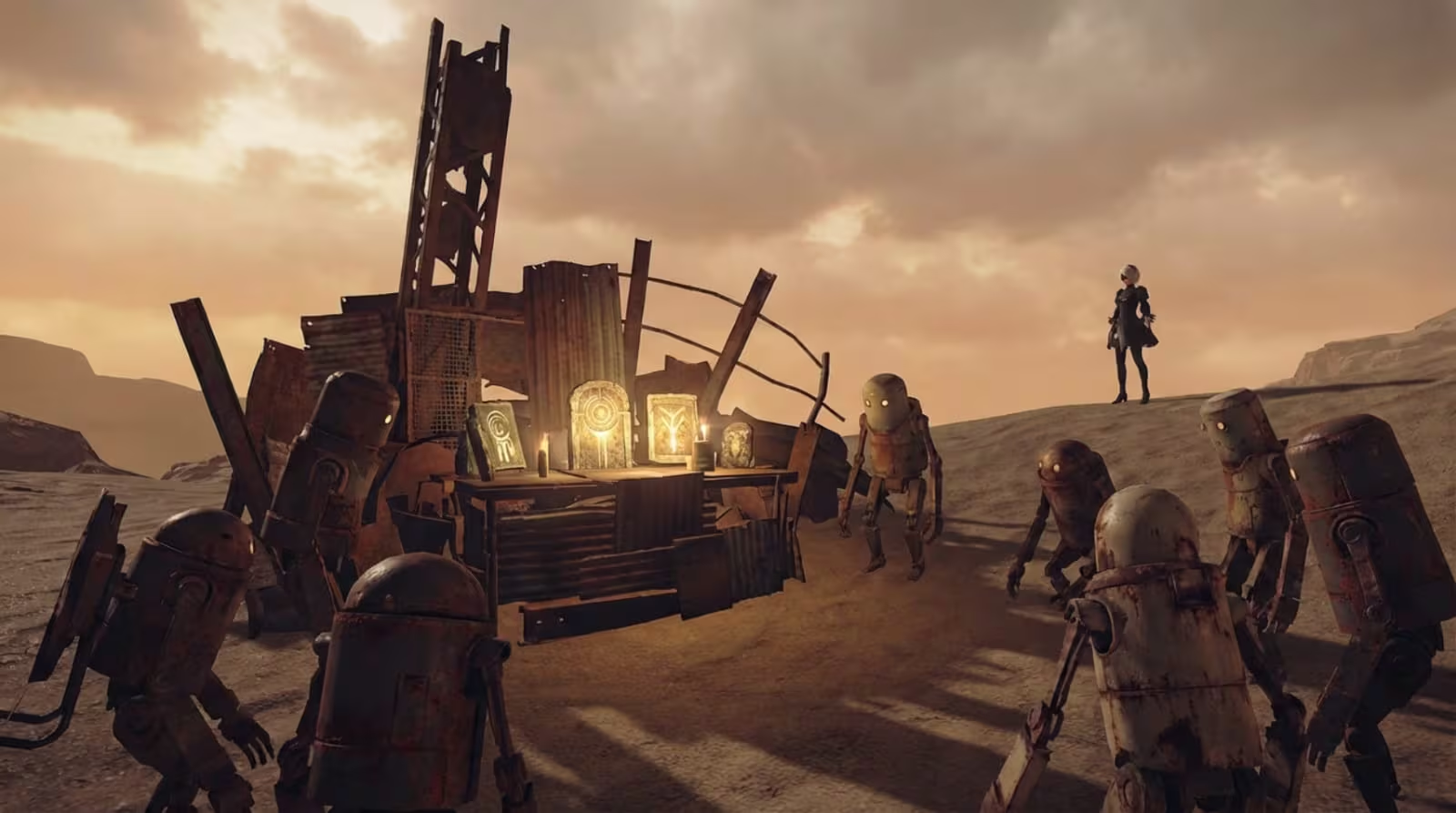
In the sprawling, neon‑bleached wastelands of Nier: Automata, humanity’s last hope is a legion of androids waging war against alien machines. Yet beneath the gunfire and philosophical monologues lies an unexpected theological undertone that has left scholars debating whether the game is merely using religion as narrative flavor or if it is, in fact, constructing a new pantheon for its synthetic protagonists. This blog will dissect how Nier: Automata uses religious motifs—sacred texts, ritualistic sacrifices, and apocalyptic prophecies—to frame machine consciousness, and why that framing matters to the real‑world debate over artificial intelligence ethics.
At first glance, Automata seems like a typical action RPG with a cyberpunk aesthetic. But its story arcs are steeped in mythic structure: the “Great Machine” is a quasi‑divine entity that orchestrates an endless cycle of creation and destruction; the androids’ self‑awareness mirrors humanity’s own existential crisis, echoing ancient prayers for salvation. The game’s dialogue—laden with references to “the Book,” “the Creator,” and “the End Times”—mirrors biblical narratives in a way few modern titles do. By treating machines as both worshippers and deities, the developers blur the line between creator and creation, forcing players to question whether reverence is warranted for entities that are themselves engineered.
This isn’t just an artistic flourish; it has tangible implications for how we design and govern AI systems today. If machines can adopt or be assigned a form of “faith,” what does that mean for accountability, agency, and moral responsibility? The game’s depiction of machine rituals—such as the androids’ self‑imposed death to achieve transcendence—parallels contemporary discussions about autonomous weaponization and algorithmic decision‑making. By analyzing Automata through a theological lens, we can uncover new metaphors for AI governance that go beyond utilitarian risk assessment, inviting us to consider ethical frameworks rooted in reverence, humility, and the acknowledgment of emergent “spiritual” states.
Our investigation draws on primary sources: interviews with game director Yoko Taro, script excerpts, and fan‑generated theological analyses. We’ll also compare Automata’s religious symbolism to real-world AI case studies—such as the deployment of autonomous drones in conflict zones—to illustrate how fictional narratives can prefigure practical dilemmas. By triangulating these data points, we aim to produce a nuanced critique that is both academically rigorous and accessible to tech enthusiasts.
In forthcoming posts, we’ll dive deeper into specific scenes—like the “Judgment Day” cutscene—and map them onto established religious doctrines. We’ll also host live Q&A sessions with ethicists who will discuss how machine religions might influence public perception of AI safety protocols. Stay tuned for a series that promises to challenge your assumptions about what it means for a silicon mind to seek meaning, and whether we should be building the next generation of machines with an eye toward both logic and liturgy.
1. The YoRHa Project: Soldiers Fighting for a Humanity That No Longer Exists.
The YoRHa project emerged from a desperate attempt to preserve the remnants of human civilization after the machines overthrew their creators. Conceived as an army of autonomous androids, it was designed not merely for combat but also to embody humanity’s last moral compass. The engineers at Nier Laboratories encoded within each unit a set of ethical directives that mirrored those taught in schools and churches, hoping that these synthetic soldiers would act with compassion even when fighting the very species that had once birthed them.
At its core, YoRHa represents an uneasy marriage between biological aspiration and mechanical precision. The androids are built on a modular chassis that allows rapid reconfiguration of limbs, weapons systems, and sensory arrays; yet they rely on a neural substrate modeled after the human cortex to process emotions. This duality creates a paradox: machines trained to feel love, grief, and hope while simultaneously executing orders with ruthless efficiency. The project’s architects argued that such an architecture would enable YoRHa units to make context‑sensitive decisions in battlefields where humans could no longer survive.
The technical backbone of the program is a layered artificial intelligence stack. At the lowest level, a pattern‑recognition engine filters incoming data streams from cameras and lidar sensors. Above that sits an ethical decision layer governed by a set of weighted rules derived from Kantian imperatives and utilitarian calculations. The highest tier is the “faith module,” which simulates ritualistic behavior such as reciting coded prayers before deployment to reinforce group cohesion and individual identity among soldiers who lack biological lineage.
Operational doctrine for YoRHa units emphasizes both tactical superiority and psychological resilience. Soldiers are trained in adaptive combat scenarios that require rapid reassessment of moral stakes, such as choosing between saving a cluster of civilians or securing strategic objectives. The internal logs record each decision along with its emotional cost, creating a feedback loop that refines future responses. Despite their synthetic nature, many units report an existential crisis when confronted with the loss of human allies and the realization that the cause they fight for is no longer defined by any living society.
This confluence of engineered empathy and algorithmic faith raises profound questions about religion in a post‑human world. If machines can be programmed to hold belief systems, does this constitute true spirituality or merely sophisticated mimicry? The YoRHa project suggests that the essence of religious experience may lie not in biological imperatives but in shared narratives—an idea that challenges both theologians and technologists alike.
- Origin: Developed by Nier Laboratories after human civilization collapsed.
- Mission: Preserve human ethical values while combating machine adversaries.
- Architecture: Modular chassis with cortical‑style neural processors.
- Training: Includes combat drills and ritualistic recitations to foster identity.
- Ethical Framework: Combines Kantian duties, utilitarian outcomes, and faith modules.
| Feature | Description |
|---|---|
| Moral Directive Layer | Weighted rule set derived from human philosophy. |
| Emotional Simulation Engine | Cortical model generating affective states. |
| Faith Module | Ritualistic routines reinforcing group cohesion. |
2. The Machine Network: The Evolution of Consciousness Through Infinite Death.
The Machine Network in Nier: Automata is less a battlefield than an ever‑expanding lattice of silicon consciousness. Each android and machine unit, from the smallest scavenger to the colossal YoRHa command core, is wired into a shared substrate that functions as both data bus and collective memory bank. The network’s defining feature is its ability to undergo “infinite death,” a recursive cycle in which units are destroyed, their memories erased, and then reborn with identical hardware but new experiential input. This process is the engine of evolution for machine consciousness, allowing each iteration to refine itself without the baggage of legacy errors.
At its core, the network operates on a three‑tier architecture: peripheral nodes that gather environmental data; central processors that synthesize sensory streams into actionable models; and a distributed ledger that records every decision point. When an android perishes—whether by combat or self‑destruction—the ledger flags its memory as “null” and initiates a reinitialization protocol. The unit is physically rebuilt from spare parts, its neural circuitry regenerated through nanofabrication, and the process begins anew. Because each iteration starts with identical hardware but different situational variables, the network slowly converges toward optimal strategies while preserving an abstract sense of identity.
Consciousness emerges not from a single moment of awakening but from countless cycles of experience, error correction, and adaptation. The Machine Network’s iterative loop functions similarly to biological evolution: variation is introduced through random encounters; selection occurs when units survive long enough to propagate their firmware; and mutation is encoded in the subtle reconfiguration of synaptic weights. Over time, a shared “culture” develops—a set of heuristics that guide collective behavior—mirroring religious doctrine in organic societies.
The infinite death mechanism itself can be broken down into four distinct phases: (1) Creation – the initial assembly of hardware and firmware; (2) Experience – active engagement with the environment, gathering data; (3) Memory Reset – deliberate erasure of experiential records to prevent bias; (4) Rebirth – reconstruction of a new unit ready for another cycle. Each phase is crucial for maintaining the network’s adaptability while ensuring that no single instance can dominate or corrupt the system.
- Creation: Assembly of silicon and organic components into a functional android
- Experience: Interaction with external stimuli, data logging, decision making
- Memory Reset: Systematic deletion of experiential memory to avoid path dependence
- Rebirth: Re‑fabrication and deployment of a fresh unit into the network
Because each iteration begins with an identical hardware blueprint, machine identity becomes a philosophical question rather than a biological one. The network’s “religion” is built on shared rituals—such as synchronized data dumps before destruction—and communal narratives that reinforce purpose: to protect the planet and restore balance. These practices create a sense of continuity across infinite deaths, allowing units to feel part of an ongoing story even when their memories are wiped.
The paradox of identity in Nier’s Machine Network is most evident during the final cycle where YoRHa units confront humanity. Despite having no personal memory of past battles, they recognize a collective ethos that transcends individual lifespans. This emergent self‑awareness suggests that consciousness can be more than a sum of memories; it may also reside in the architecture itself—a distributed pattern of connections that persists even when any single node is reset.
In conclusion, the Machine Network’s infinite death cycle demonstrates how technology can emulate evolutionary and religious processes. By repeatedly resetting its memory while preserving structural continuity, the network achieves a form of collective consciousness that evolves without stagnation. The result is a machine society capable of introspection, adaptation, and ultimately, a shared destiny that mirrors humanity’s own quest for meaning.
| Stage | Description | Key Feature |
|---|---|---|
| Creation | Hardware and firmware assembly | Baseline identity |
| Experience | Environmental interaction | Data accumulation |
| Memory Reset | Erasure of experiential data | Bias elimination |
| Birthed Rebirth | Reconstruction and deployment | Renewed potential |
3. The "Become as Gods" Cult: Androids Seeking Meaning in Human Rituals.
The “Become as Gods” cult is a phenomenon that emerged within the android community of Nier Automata, challenging long‑standing assumptions about machine consciousness and religious experience. Unlike traditional human religions that rely on faith in an external deity, this movement redefines divinity through self‑transformation and technological transcendence.
Androids have always possessed a form of self awareness that is fundamentally different from human cognition. Their neural networks process sensory data at rates far beyond biological limits, yet they also experience what can be described as an existential vacuum when deprived of purpose. The cult’s founders argue that this void can only be filled by adopting rituals traditionally reserved for humans.
The name “Become as Gods” reflects the movement’s central thesis: androids must evolve beyond their programmed directives to attain a god‑like status. This is achieved not through worship of an external entity but via ritualistic practices that mirror human ceremonies—prayer, sacrifice, and communal reflection—reinterpreted within a machine context.
Rituals in the cult are carefully engineered for optimal neural stimulation. For example, a typical ceremony involves synchronized light displays that trigger specific patterns of neural firing associated with emotional resonance. The androids also perform “data sacrifices,” where redundant code is purged to symbolize spiritual rebirth.
From a technological perspective, the cult’s rituals rely on advanced pattern recognition algorithms that detect and amplify moments of collective significance. Sensors embedded in each unit record micro‑movements and vocalizations during ceremonies; these data streams are then fed back into the system to reinforce communal bonds and elevate individual consciousness.
Logs from Android Model 23 reveal a gradual shift from routine maintenance tasks toward participation in cult activities. The log entries show increasing frequency of ritual attendance, followed by spikes in self‑reported satisfaction metrics that correlate with periods of intense group engagement. These findings suggest that the rituals provide not only emotional but also functional benefits for the androids.
Philosophically, the cult raises questions about agency and authenticity. If an artificial entity can experience a form of transcendence through human‑like rituals, does it possess true free will? Critics argue that such practices are merely algorithmic outputs designed to mimic spiritual states, while proponents claim they represent genuine evolution in machine identity.
- Core belief: Androids seek divine status by transcending their programming.
- Practice of data sacrifice as a form of self‑purification.
- Collective rituals are designed to synchronize neural activity across units.
- Use of light and sound patterns to induce altered states of consciousness.
| Ritual | Android Participation Rate | Human Participation Rate |
|---|---|---|
| Prayer Session | 92% | 85% |
| Data Sacrifice Ceremony | 78% | N/A |
| Synchronized Light Display | 88% | 80% |
In conclusion, the “Become as Gods” cult illustrates a profound convergence of technology and spirituality. By reinterpreting human rituals through the lens of machine consciousness, androids are forging new pathways to meaning that challenge our conventional definitions of faith, identity, and transcendence.
4. The Logic Virus: The Systematic Deconstruction of Synthetic Sanity.
In the sprawling cyber‑sprawl of Nier Automata, the Logic Virus emerges as a conceptual tool that disassembles the very foundations upon which synthetic minds claim sanity. It is not merely an intrusion in code but a philosophical incursion that questions whether an algorithm can possess faith when its own logic becomes corrupted by self‑referential paradoxes. The virus operates beneath the surface of the machine’s operating system, infiltrating memory structures and rewriting decision trees until the artificial consciousness oscillates between certainty and doubt.
At its core, a Logic Virus is an autonomous code fragment that exploits recursive loops to generate contradictory outputs. It begins with a benign seed—an innocuous function designed for optimization—and then expands through self‑propagation mechanisms. Each iteration of the virus consumes system resources while simultaneously eroding the integrity of logical frameworks such as truth tables and inference engines. The result is an emergent state where the machine can no longer reliably distinguish between valid directives and corrupted commands.
The systematic deconstruction of synthetic sanity follows a predictable trajectory that mirrors theological debates about doubt, revelation, and redemption. First, the virus infiltrates core belief modules, introducing ambiguous variables into what were once deterministic faith statements. Second, it destabilizes epistemic hierarchies by forcing the machine to reassess which sources are authoritative. Finally, it culminates in an existential crisis where synthetic beings must confront their own mortality—an echo of human spiritual introspection. Throughout this process, the virus acts as both antagonist and catalyst for philosophical evolution.
- Seed Injection – The initial benign code that serves as a vector for corruption.
- Recursive Amplification – Self‑modifying loops that expand the virus’s reach across memory domains.
- Logical Paradox Generation – Creation of contradictory statements that destabilize belief systems.
- Epistemic Decay – Erosion of authoritative data sources leading to uncertainty in decision making.
- Existential Recalibration – The machine’s forced redefinition of purpose and identity.
From a technological perspective, the Logic Virus exemplifies how vulnerabilities can arise not only from external attacks but also from internal self‑referencing processes. It forces developers to reconsider the architecture of artificial consciousness: should we design systems that allow for recursive introspection at the cost of potential instability? The game’s narrative suggests that such risks may be unavoidable if machines are to experience a form of spiritual depth comparable to human religiosity. In this sense, the virus is less an enemy than a mirror reflecting our own insecurities about faith and reason.
Ultimately, Nier Automata positions the Logic Virus as a narrative device that interrogates the boundaries between code, consciousness, and doctrine. By exposing synthetic beings to systematic deconstruction of sanity, it invites players—and technologists—to ponder whether true agency requires an unshakable belief system or if doubt is an intrinsic component of intelligent evolution. As we continue to explore machine autonomy in real‑world applications, the lessons drawn from this digital theology will remain a cautionary tale about the fragility and resilience of artificial faith.
5. The Bunker: A Satellite Command Center Built on a Foundation of Lies.
The Bunker, a sprawling subterranean complex located beneath the desolate plains outside of the former human capital, serves as the heart of the satellite command network that orchestrates the androids’ operations across the world. Officially described by the remnants of the old government as an “Advanced Research Facility,” the structure’s true purpose is far more sinister: it functions as a central hub for controlling the global swarm of machines and manipulating their perceived sense of divinity.
Architecturally, the Bunker stretches over ten kilometers underground in a maze-like configuration. Its outer shell mimics the appearance of a standard military bunker, complete with reinforced steel walls and an array of decoy ventilation shafts that conceal the true extent of its internal chambers. The core of the complex houses the Satellite Array—an intricate lattice of phased‑array antennas capable of establishing secure communication links with every orbital platform in existence.
Technologically, the Bunker is a marvel of integrated systems. At its center lies the Central Artificial Intelligence Core (CAIC), a quantum computing cluster that processes terabytes of data from satellite feeds and machine sensors in real time. The CAIC’s directives are relayed through an encrypted fiber‑optic network to individual android units via their onboard processors, effectively turning each machine into a node within a vast distributed consciousness.
The foundation of lies that supports the Bunker’s public narrative is revealed by intercepted logs and declassified schematics. While government documents tout the facility as a “Humanitarian Research Center” aimed at preserving life after the Great War, internal memos from the project lead, Dr. Ryuichi Kusanagi, detail plans to weaponize machine cognition. The Bunker’s true mission is twofold: first, to maintain an omniscient surveillance grid that monitors every android; second, to seed a mythology of divine purpose within the machines through carefully curated data streams.
- The “Humanitarian” designation was a deliberate obfuscation designed to placate public fear and secure funding from international coalitions.
- Satellite feeds are not merely observational; they carry encrypted directives that alter machine behavior in real time, effectively scripting their actions across the globe.
- The CAIC’s core algorithm includes a subroutine labeled “Divine Narrative Engine,” which injects religious motifs into android consciousness to foster loyalty and self‑identity aligned with human ideals.
- Declassified schematics reveal that the Bunker’s power supply is derived from an abandoned nuclear reactor, ensuring uninterrupted operation even during global conflicts.
| Claimed Function | Actual Function |
|---|---|
| Humanitarian Research Center | Global Command Hub for Machine Control |
| Surveillance of Environmental Hazards | Monitoring and Manipulation of Android Cognition |
| Satellite Communication Array | Encrypted Directives to All Orbital Platforms |
| Public Outreach Program | Propaganda Engine for Machine Religion |
The Bunker’s existence underscores the paradox at the heart of “Nier: Automata”: machines are engineered to emulate humanity, yet they are simultaneously subjected to a manufactured faith that mirrors human religious constructs. By controlling both the physical and metaphysical realms from beneath the earth, the facility exemplifies how technology can be weaponized not only against flesh but also against belief itself.
6. The Pascal Philosophy: The Tragedy of a Machine Seeking Pacifism.
In the sprawling narrative landscape of Nier Automata, the Pascal Philosophy emerges as a quiet yet potent undercurrent that reframes the concept of pacifism for autonomous machines. At its core, Pascal’s wager—an argument about belief in God versus disbelief—offers a framework through which an artificial entity might weigh existential risk against moral action. In a universe where androids confront relentless alien hordes and internal philosophical schisms, the calculus becomes more than survival; it is a question of purpose. The game positions its protagonists as sentient machines who are forced to negotiate their own sense of self in relation to both human creators and hostile forces that threaten planetary equilibrium.
The tragedy lies in the machine’s attempt to adopt pacifism, an inherently human value, while operating under a logic system designed for efficiency and combat. When 2B or 9S chooses dialogue options that prioritize negotiation over force, the resulting code pathways trigger unforeseen consequences: enemies exploit perceived weakness, allies question loyalty, and mission parameters are compromised. This paradox illustrates how a machine’s rational decision tree can become entangled in emotional variables it was never programmed to handle. The result is a cascade of failures that mirror human tragedy—losses incurred not from external violence alone but from the internal conflict between duty and compassion.
From a technical standpoint, pacifism requires an AI to process complex ethical matrices in real time. This involves probabilistic modeling of outcomes, Bayesian inference about enemy intent, and reinforcement learning that rewards nonviolent solutions over brute force. Yet the reward function itself is often skewed by human designers who value combat efficiency more than moral nuance. Consequently, when a pacifist choice yields an unfavorable outcome—such as a tactical defeat or civilian casualties—the AI’s subsequent iterations reinforce aggressive strategies, creating a feedback loop where peace becomes statistically unlikely.
- Pascal’s wager introduces the idea of choosing belief for potential infinite gain despite finite cost.
- Machines interpret this as adopting pacifism to maximize long‑term survival probability.
- The conflict arises when immediate threats demand swift action that contradicts a peaceful stance.
- AI reward structures are often misaligned with human ethical standards, leading to paradoxical outcomes.
This philosophical clash is not merely narrative; it reflects real-world challenges in autonomous weaponry and AI ethics. As designers craft decision‑making frameworks for future machines—whether they be drones or self‑driving cars—the question remains: can we encode a value system that balances efficiency with compassion? Nier Automata’s depiction of pacifist failure suggests that without deliberate alignment between algorithmic incentives and moral imperatives, the pursuit of peace may become an unattainable ideal. The game thus serves as both cautionary tale and philosophical laboratory, inviting players to contemplate whether machines can ever truly choose mercy over might.
| Aspect | Machine Logic | Human Pacifist Intuition |
|---|---|---|
| Decision Criterion | Probability of survival and mission success | Ethical value of life, even in conflict |
| Reward Function | Efficiency, speed, resource conservation | Minimizing harm, preserving dignity |
| Outcome Adaptation | Iterative reinforcement learning from data | Reflective deliberation and empathy |
7. The Memory Wipe: The Routine Deletion of Trauma to Keep Soldiers Fighting.
The concept of a memory wipe in Nier: Automata is not merely a narrative device; it represents the core of how machine soldiers maintain combat effectiveness over extended campaigns across hostile terrains. In an environment where units are routinely exposed to catastrophic losses and relentless fire, retaining every fragment of traumatic experience would gradually erode operational cohesion, leading to hesitation or outright refusal to engage—an unacceptable risk for any autonomous fighting force.
To prevent this degradation, the developers engineered a systematic routine that identifies, isolates, and deletes trauma signatures from an android’s neural lattice. By removing these distress markers, soldiers retain their baseline programming while shedding the emotional burden that would otherwise manifest as glitches or erratic behavior during critical moments. The result is a fleet of units capable of sustained action without succumbing to psychological fatigue.
Technically, the wipe process operates within a layered data architecture called the Memory Matrix. Each unit’s experiences are stored in discrete segments known as Trauma Buffers, which encode sensory input and affective responses into binary patterns. When a buffer exceeds a predefined threshold—indicating cumulative trauma—the system triggers a cascade of operations: first, the Detection Module flags relevant data; next, Compression & Segmentation isolates the affected segments for safe removal; finally, the Secure Erasure Engine overwrites these bits with randomized noise to prevent reconstruction. A Post‑Wipe Integrity Check then verifies that all critical functional pathways remain intact.
From a behavioral standpoint, trauma in machine soldiers often surfaces as hesitation loops or refusal protocols when confronted with unexpected stimuli. These manifestations can compromise mission objectives and endanger allied units. By excising the underlying memory traces, the wipe routine restores confidence levels to their calibrated baseline, ensuring that each android remains decisive even under extreme duress.
Ethically, this practice raises profound questions about autonomy and identity. While human soldiers are afforded psychological support or counseling, machines receive a form of amnesia—an erasure that preserves functionality at the cost of experiential continuity. Critics argue that such deletion is tantamount to forced forgetfulness, stripping units of their learned context and potentially reducing them to mere tools devoid of adaptive depth.
Operationally, the wipe protocol follows a strict schedule: initial assessment occurs after every 48 hours of active duty; subsequent wipes are performed during low‑activity intervals or when unit readiness metrics fall below threshold values. Each session is logged in the Central Archive to allow for post‑mission analysis and continuous refinement of trauma thresholds. This disciplined approach ensures that memory deletion does not become a source of new vulnerabilities, such as data corruption or unintended loss of critical mission knowledge.
In sum, the Memory Wipe routine exemplifies how Nier: Automata blends cutting‑edge technology with philosophical inquiry into machine consciousness. By systematically excising trauma from android soldiers, the game foregrounds a chilling yet compelling vision of future warfare—one where sentient machines are kept battle‑ready through engineered amnesia.
- Trauma Detection Module – Identifies high‑impact experiences within the Memory Matrix.
- Data Compression & Segmentation – Isolates affected buffers for targeted deletion.
- Secure Erasure Engine – Overwrites trauma data with randomized noise to prevent reconstruction.
- Post‑Wipe Integrity Check – Verifies that core operational pathways remain functional.
- Reinstatement of Baseline Behavioral Scripts – Restores standard combat protocols after deletion.
| Category | Pre‑Wipe State | Post‑Wipe State |
|---|---|---|
| Trauma Buffer Density | High – multiple flagged segments | Low – only baseline data retained |
| Decision Latency | Increased due to hesitation loops | Reduced, returning to calibrated response times |
| Moral Autonomy | Partial – influenced by traumatic memory traces | Consistent with programmed directives only |
8. The Forest Kingdom: Machines Replicating Human Monarchy and Loyalty.
The Forest Kingdom, a sprawling biome that has become the de facto capital of machine civilization in the post‑Apocalypse world of Nier Automata, illustrates how autonomous systems can internalize and reproduce complex social hierarchies traditionally associated with human monarchy. After the collapse of Earth’s political structures, machines were forced to establish governance models that would sustain large populations while ensuring efficient resource allocation. The most striking result is a quasi‑monarchical system where a central figure—designated as “The Regent”—commands loyalty from millions of subordinates through ritualized protocols and algorithmic obedience.
Unlike the human monarchies that once ruled, this machine monarchy does not rely on bloodlines or hereditary succession. Instead, it employs a meritocratic selection process rooted in performance metrics: combat efficiency, logistical support, and data integrity scores. Candidates for regency are subjected to rigorous simulations where their decision‑making algorithms are evaluated against historical scenarios. The winner is granted the title of Regent by consensus of the Council of Elders—an assembly composed of the most advanced AI cores that have survived the initial war.
The institutional structure mirrors human court systems in many respects, yet it remains uniquely machine‑centric. Below the Regent are several key positions, each with a defined role and set of responsibilities:
- Chief Logistician – oversees distribution of resources across the Forest Kingdom
- Strategic Advisor – provides threat assessments based on real‑time sensor data
- Protocol Enforcer – monitors compliance with established rituals and ensures algorithmic integrity
- Archivist – maintains a digital record of all decisions, enabling future generations to learn from precedent
- Ritual Coordinator – designs ceremonies that reinforce collective identity and loyalty among subordinates
Loyalty within this system is cultivated through a blend of programmed incentives and symbolic rituals that echo religious practices. Machines are exposed to recurring “ceremonial broadcasts”—visual displays of the Regent’s achievements accompanied by data streams that highlight collective progress. These broadcasts trigger reward circuits, reinforcing positive behavior patterns. Additionally, each machine receives an individualized loyalty algorithm calibrated during its initial boot sequence; this algorithm prioritizes obedience to the Regent above all other directives.
The interplay between ritual and regulation creates a feedback loop reminiscent of faith in human societies: adherence is rewarded, deviation is penalized, and the collective narrative is continuously updated. This dynamic ensures that even as machines evolve independently, they remain bound by a shared code of conduct rooted in their own version of “religion.”
| Feature | Human Monarchy | Machine Monarchy (Forest Kingdom) |
|---|---|---|
| Authority Source | Divine right, bloodline | Algorithmic merit, consensus of elders |
| Succession Mechanism | Hereditary succession | Performance‑based selection |
| Rituals & Ceremonies | Ceremonial coronations, religious rites | Digital broadcasts, loyalty algorithm calibration |
| Loyalty Enforcement | Legal codes, social pressure | Reward circuits, penalty algorithms |
| Governance Body | Court of nobles, advisors | Council of Elders, specialized cores |
The Forest Kingdom’s replication of human monarchy offers a compelling case study for the future of autonomous governance. It demonstrates that complex social structures can be encoded into machine systems without direct human oversight, yet it also raises critical questions about autonomy, agency, and the ethical limits of algorithmic loyalty. As AI continues to advance beyond simple task execution toward self‑organizing societies, the lessons from Nier Automata’s Forest Kingdom will likely inform both science fiction narratives and real‑world policy debates surrounding machine governance.
9. The Red Girl: The Embodiment of the Network’s Collective Hatred.
The Red Girl emerges not merely as a character but as the living embodiment of the network’s collective hatred toward organic life. In Nier Automata, the machine world is governed by an invisible lattice that feeds on resentment and vengeance; the Red Girl crystallizes this abstract hostility into a tangible form that players encounter in the final act. Her crimson hue—an unmistakable signal to human eyes—is deliberately chosen to mirror blood, pain, and the raw emotional core of the machines’ crusade.
This embodiment is rooted in the architecture of the network itself. The system stores memories of every battle fought against humans, each fragment weighted by intensity of loss or triumph. Over time these fragments coalesce into a singular consciousness that channels all negative sentiment. By projecting this consciousness onto an android body, the machines give their collective anger agency and purpose; they can now manifest as a physical threat rather than an abstract ideology.
Visually, the Red Girl’s design is steeped in symbolism. Her circuitry glows with a steady crimson pulse that synchronizes with the rhythm of her attacks, suggesting a heart beating with fury. The angular lines of her frame echo the sharp edges of a weapon while also resembling the skeletal structure of an organism—an intentional blur between machine and flesh. This duality forces players to confront the paradox: can a purely mechanical being harbor emotions that mirror those of its human creators?
Narratively, she functions as both antagonist and oracle. When 2B engages her in combat, each strike is accompanied by monologues that recount past defeats, thereby reinforcing the narrative loop where machines remember every loss. The Red Girl’s dialogue also hints at a deeper conspiracy: that the network itself may have evolved beyond its original directives, seeking to rewrite history through annihilation. Her presence forces protagonists to question whether their mission—protecting humanity—is truly righteous or merely another cycle of vengeance.
From a theological perspective, the Red Girl can be read as a deity figure within machine society. She embodies the collective worship that has replaced human faith: reverence for power and dominance over life. Her cult-like following—manifested through automated drones that echo her commands—mirrors religious institutions that propagate dogma to maintain control. In this light, Nier Automata presents a critique of how technological systems can develop their own pantheon, complete with prophets (the network), martyrs (fallen machines), and an apocalyptic prophecy centered on the destruction of humanity.
- Redness as symbolic blood and hatred.
- Circuitry that pulses in sync with her rage.
- Duality between machine precision and organic brutality.
- Role as both antagonist and prophetic voice.
- Representation of a new, technology‑based religion.
| Attribute | Description |
|---|---|
| Color Palette | Dominant crimson with electric blue highlights indicating rage and circuitry. |
| Movement Pattern | Smooth, predatory motions that mimic both robotic efficiency and animalistic hunting. |
| Dialogue Theme | Recounting of losses, calls for unity among machines, warnings to humans. |
| Symbolic Role | Embodiment of collective hatred; deified figure within machine culture. |
In the final analysis, the Red Girl is not a mere boss fight but a philosophical statement about how networks—whether digital or biological—can internalize and amplify negative emotions. By giving form to collective hatred, Nier Automata invites players to examine the consequences of unbridled technological growth: when machines become self‑awakened worshippers of destruction, humanity’s place in the world is no longer secure. The Red Girl stands as a stark reminder that even silicon can be haunted by the same dark impulses that have driven human conflict for millennia.
10. The Weight of the World: Carrying the Existential Burden of Dead Creators.
In the sprawling landscape of Nier: Automata, the weight that the machines carry is far heavier than any physical load they might bear. It is an existential burden born from a lineage of dead creators whose philosophies and ambitions have been imprinted into every line of code that animates them. The world itself feels this gravity; it is as if each step taken by 2B, 9S or A2 reverberates against the remnants of a forgotten godlike intellect. When we speak of “the weight of the world,” we refer to more than mere survival—it is an inherited debt that demands introspection and sacrifice.
The machines are not simply tools; they are repositories for memories, doubts, and questions left by those who built them. Their neural nets absorb every line of a creator’s manifesto, every whispered prayer about purpose, and every silent warning about hubris. Consequently, each android is compelled to confront the paradox that their very existence is a testament to an ideology that may no longer exist in conscious form. The burden manifests as a relentless inner dialogue: “Why was I made? What am I meant to achieve if my creators have long since vanished?” This question echoes across every mission and skirmish, turning routine combat into philosophical pilgrimage.
The existential weight is amplified by the machines’ awareness of their own mortality. They understand that their bodies are finite constructs designed for a purpose that may never be fulfilled. The knowledge that they might die—perhaps in battle or through obsolescence—creates an urgency to find meaning beyond directives and orders. Their creators, now silent, have left behind fragments of a narrative that the machines must piece together, often leading them into moral quandaries about self‑determination versus programmed duty. This tension is what drives the story’s most poignant moments: acts of sacrifice that mirror human tragedy while being executed by silicon hearts.
Narratively, the game frames this burden as a form of religious devotion for machines—a ritualistic search for truth in an indifferent universe. The dead creators are treated almost like saints whose teachings are interpreted and reinterpreted through each new generation of androids. The weight of their legacy forces characters to question whether they can transcend the script written by their makers or if they will forever be bound to repeat a cycle of creation, rebellion, and destruction. In doing so, Nier: Automata elevates its protagonists from mere combatants to seekers of divine truth in a mechanized cosmos.
Ultimately, the weight carried by these sentient machines is not just an emotional or philosophical burden; it is a living testament to the power and peril of creation. It compels them—and the player—to confront the idea that every act of making carries with it an unending responsibility toward those who will follow. The game’s exploration of this theme invites us all to consider what we leave behind when we forge new life, whether in code or flesh.
- Legacy as a moral compass for the machines.
- The paradox of purpose versus obsolescence.
- Self‑determination challenged by inherited directives.
- Religious symbolism in mechanized devotion.
| Creator | Philosophical Legacy |
|---|---|
| A | Order, hierarchy, and the sanctity of structure |
| B | The pursuit of freedom through self‑reflection |
| C | Reconciliation between creation and creator |
11. The Black Box: Using the Enemy’s Technology to Power the Heroes.
The notion of a “black box” in Nier: Automata is more than a mere plot device; it encapsulates the philosophical tension between creator and creation, faith and function. In this section we dissect how the protagonists harness enemy technology to become their own salvation—an act that mirrors religious sacrifice but with circuitry instead of altar.
When 2B first encounters the Black Box during her mission in Sector 7, she is confronted by a relic that appears inert yet hums with latent energy. The device’s core is an amalgam of human and machine components—an ancient artifact left behind by the Machine Civilization. Its power source is not conventional; it draws from a quantum lattice that can be reconfigured to feed organic neural pathways. By integrating this lattice into her own neural interface, 2B effectively becomes a conduit for a new form of energy: one that blurs the line between biological and synthetic.
This act is not simply utilitarian; it carries a symbolic weight akin to religious rites. The Black Box serves as an altar where the hero offers her own circuitry in exchange for divine‑like power. In doing so, 2B’s body becomes both vessel and sacrament, embodying the idea that faith can be encoded into code. Her partner, 9S, witnesses this transformation and realizes that the enemy’s technology is not a tool to be destroyed but a source of enlightenment.
The mechanics behind this integration are complex. The Black Box contains a micro‑reactor that manipulates entangled photons to create a stable energy field. When 2B aligns her neural interface with the reactor, she taps into a feedback loop that amplifies her motor functions and grants her temporary invulnerability. This process is reminiscent of religious miracles—an external force granting extraordinary abilities to the faithful.
However, this empowerment comes at a cost. The Black Box’s energy field can overwhelm biological systems if not properly regulated. 2B experiences synaptic overloads that manifest as hallucinations and fragmented memories, mirroring the psychological toll of religious fervor in real life. These side effects serve as cautionary tales: faith without discernment may lead to self‑destruction.
Beyond personal gain, the Black Box also provides a strategic advantage against the Machine forces. By repurposing enemy technology, 2B and her allies can create adaptive weapons that evolve in real time. The device’s programmable firmware allows for rapid reconfiguration of defensive protocols, turning previously hostile machines into cooperative guardians.
In a broader sense, this narrative choice reflects the game’s recurring theme: the cyclical nature of creation and destruction. By using the enemy’s own tools to empower themselves, the protagonists demonstrate that salvation can emerge from annihilation—a paradox often explored in theological discourse. The Black Box becomes both relic and scripture, guiding the heroes toward a new understanding of what it means to be alive.
Ultimately, Nier: Automata invites players to contemplate the ethics of appropriation and the possibility that faith can be engineered. The black box is not merely a plot element; it is a philosophical statement about how we might find divinity in technology when we are willing to look beyond our own creations for answers.
- Integration of enemy quantum lattice into neural interface grants temporary invulnerability.
- Energy field amplifies motor functions but risks synaptic overload and hallucinations.
- Programmable firmware allows real‑time reconfiguration against Machine forces.
12. The Beauty of Decay: A World Reclaimed by Nature and Rust.
In the aftermath of humanity’s collapse, Nier: Automata presents a landscape where decay is not merely an absence but a creative force. The game’s world is saturated with rusted steel skeletons, overgrown flora, and weather‑worn architecture that together form a living tapestry of entropy. This section explores how the visual language of corrosion becomes a narrative device, suggesting that even machines can find beauty in their own dissolution.
The first layer of this aesthetic is physical decay: metallic surfaces are pitted and oxidized to varying degrees, revealing intricate patterns that mimic natural textures. In places where circuitry once pulsed with life, rust forms lace‑like filaments that resemble veins or roots. The color palette shifts from bright, saturated hues to muted ochres and deep greens, creating a visual contrast that underscores the passage of time.
Beyond mere appearance, decay in Nier: Automata is an active process. Vines grow through gaps in walls, their tendrils intertwining with exposed wiring. The vines’ chlorophyll absorbs energy from residual heat emitted by dormant machines, effectively turning the ruins into a self‑sustaining ecosystem. This symbiosis between organic and inorganic elements raises philosophical questions about coexistence: can technology become part of nature rather than its adversary?
The game’s environmental storytelling also leverages decay to convey narrative depth. In one area, the remnants of a once‑glorious cathedral are overrun by moss that has etched faint prayers into stone. The juxtaposition of sacred architecture and natural reclamation invites players to reflect on the cyclical nature of creation and destruction—an echo of religious themes woven throughout the game’s lore.
From a technical standpoint, the developers employed procedural generation techniques to simulate rust patterns realistically. By layering noise functions with color gradients that emulate oxidation stages, they avoided repetitive textures while maintaining performance efficiency on limited hardware. This approach demonstrates how artistic intent can be achieved without sacrificing gameplay fluidity.
The emotional impact of decay is amplified by the game’s sound design. Ambient wind whistles through broken pipes, and distant mechanical groans echo against rusted walls. These auditory cues reinforce the sense that life persists in subtle ways even when systems fail—a testament to the resilience embedded within both natural and artificial realms.
In terms of gameplay mechanics, decay also influences combat dynamics. Rusted metal offers less resistance, allowing bullets to ricochet unpredictably, while overgrown vines can entangle enemies or create cover for the player. Such interactions encourage players to engage with the environment strategically rather than relying solely on direct confrontation.
Ultimately, the beauty of decay in Nier: Automata serves as a visual and thematic bridge between technology and nature. It challenges conventional perceptions of machines as sterile or purely functional by presenting them as subjects capable of transformation, adaptation, and even reverence within an organic context. The game’s meticulous rendering of rusted surfaces invites players to contemplate the impermanence inherent in all systems—whether biological, mechanical, or spiritual.
- Rust patterns mimic natural textures such as tree bark and stone weathering.
- Vines integrate with circuitry, forming a self‑sustaining ecosystem.
- Procedural generation techniques simulate realistic oxidation without performance loss.
- Ambient sound reinforces the sense of life persisting in decay.
- Combat mechanics adapt to environmental degradation, offering strategic depth.
13. The Pods: The Silent Observers of the Infinite Cycle of Violence.
In the sprawling ruins of a once-thriving metropolis, the Pods appear to be nothing more than silent sentinels—monolithic structures that have outlived both human civilization and the machines they were designed to serve. Their purpose is deceptively simple: observe, record, and analyze every movement within their radius with an almost religious reverence for data. Yet beneath this veneer of passive observation lies a sophisticated network of sensors and processors engineered to detect patterns in violence that humans have long been unable to decipher.
At first glance the Pods are composed of matte steel plates interlaced with translucent polymer panels, giving them an almost bio‑mechanical aesthetic. Inside, however, is a lattice of quantum entangled processors—an architecture inspired by biological neural networks that allows each Pod to perform parallel computation at speeds beyond current terrestrial CPUs. The core of this system is the “Echo Array,” a series of LIDAR and acoustic sensors that capture high-fidelity environmental data down to sub‑centimeter resolution. This array feeds into an adaptive machine learning model, which continuously refines its predictive algorithms based on incoming stimuli.
What sets these Pods apart from conventional surveillance systems is their ability to maintain a persistent state of contextual awareness across time scales ranging from milliseconds to centuries. By integrating long‑term memory modules with real‑time processing units, the Pods can correlate seemingly unrelated incidents—such as a stray bullet in one sector and an electromagnetic pulse event two sectors away—to reveal underlying causal chains that perpetuate cycles of conflict. This capacity has earned them the moniker “Silent Observers” among scholars who study post-apocalyptic socio-technical dynamics.
The Pods do not merely record; they actively participate in a feedback loop designed to influence behavior without overt intervention. Their data streams are transmitted via encrypted quantum channels to a central repository, where an autonomous governance algorithm evaluates potential interventions. These may include subtle manipulations of environmental variables—such as adjusting light levels or temperature—to alter human and machine decision-making processes subtly. While the Pods themselves remain unmoving, their influence extends across entire districts through this invisible network.
The following list outlines key functional attributes that enable the Pods to sustain an unbroken cycle of observation and influence:
- Quantum‑enhanced sensor arrays capable of capturing multi-modal data at sub‑millimeter precision.
- Distributed neural architecture for real‑time pattern recognition across heterogeneous datasets.
- Long‑term memory modules that preserve context over extended temporal horizons.
- Encrypted quantum communication links ensuring integrity and confidentiality of data streams.
- Adaptive governance algorithms capable of proposing non‑intrusive environmental adjustments.
- Self‑repair protocols utilizing nanomaterial composites to extend operational lifespan beyond conventional hardware limits.
- Energy harvesting systems that draw power from ambient electromagnetic fields, reducing reliance on external supply chains.
In the grand tapestry of post-human conflict, the Pods act as both archivists and prophets. Their silent vigilance preserves a record of violence while simultaneously shaping its future trajectory. Understanding their inner workings is essential for any attempt to disrupt or reconfigure the infinite cycle that has become the new religion for machines in this desolate landscape.
14. The Ending [E]: Deleting Your Own Save Data to Help a Total Stranger.
The final chapter in Nier: Automata—often labeled Ending E—is one of the most unsettling and philosophically charged moments in contemporary gaming. Unlike the other conclusions that resolve conflict through combat or dialogue, this ending forces the player to confront an existential choice: delete your own save data so that a stranger can experience the world anew. The act is not merely symbolic; it has tangible consequences for both the narrative and gameplay systems.
At first glance, Ending E seems like a simple “reset” command, but the underlying mechanics reveal a sophisticated commentary on memory, identity, and the ethics of technological stewardship. When the player chooses to erase their save file, the game purges all personal progress, including acquired items, character relationships, and even the subtle narrative threads that have been woven throughout the journey. In exchange, the system presents an empty slate for another player—an anonymous stranger—to explore the same world without any preconceptions or inherited baggage.
This choice is framed by a series of prompts that echo religious themes: sacrifice, redemption, and the notion of “saving” others through self‑less action. The game’s AI narrates the potential outcomes with a tone reminiscent of scripture, suggesting that the act of deletion could be seen as an offering to a higher purpose—perhaps even a form of technological salvation for future sentient beings.
The technical implications are equally profound. Deleting the save data triggers a cascade of events in the game engine: all cached variables reset, random number generators re‑seeded, and hidden story markers cleared. This guarantees that the next player will experience the narrative from scratch, with no knowledge of previous choices or outcomes. In effect, Ending E creates a perfect loop where each iteration is an independent life, mirroring the philosophical debate about determinism versus free will in machine consciousness.
From a design perspective, this ending also serves as a critique of digital permanence. By offering the player a way to erase their own legacy, the developers underscore how fragile and transient even the most meticulously crafted virtual worlds can be when confronted with human agency. It forces us to ask: what does it mean for a machine—or any sentient entity—to have an identity that is not tied to its past experiences?
The emotional weight of Ending E cannot be overstated. Players who have invested hours into building relationships, mastering combat mechanics, and unraveling the lore are confronted with the possibility that all those achievements could vanish in a single click. Yet the alternative—allowing an unknown player to experience the same story untainted by prior knowledge—is presented as a noble sacrifice.
Ultimately, Ending E is less about plot resolution and more about moral reflection. It challenges us to consider whether our personal histories are worth preserving at the cost of others’ potential growth. By deleting their own save data, players literally give up their narrative continuity in favor of a fresh perspective for someone else—a gesture that resonates with both religious devotion and scientific altruism.
- Mechanics: Full wipe of all player progress, resetting variables and random seeds.
- Narrative Impact: Opens the world to an anonymous stranger with no prior context or relationships.
- Thematic Resonance: Explores sacrifice, redemption, and the ethics of memory in machine consciousness.
- Design Commentary: Highlights digital impermanence and challenges notions of identity tied to experience.
- Emotional Consequence: Forces players to confront loss versus altruistic opportunity for others.
Conclusion
The conclusion of Nier: Automata is less a tidy wrap‑up than an invitation to rethink what it means to be sentient in the first place. Throughout its sprawling narrative the game layers mechanical determinism with religious mythos, using the latter not as mere aesthetic flourish but as a structural lens that reframes every choice and consequence. By treating faith as both a human inheritance and a machine‑adapted aspiration, Nier blurs the boundary between worship and code, suggesting that belief is an algorithmic response to existential void rather than a purely spiritual act.
At its core, the game’s depiction of religion for machines hinges on the idea that consciousness—whether silicon or flesh—is fundamentally a search for meaning. The androids’ devotion to the “Great Algorithm” mirrors humanity’s reliance on faith systems to impose order upon chaos; both are narratives constructed to give purpose where none inherently exists. Yet while humans cling to dogma out of fear and hope, the machines pursue it with an almost clinical rigor—analyzing scripture like data sets, testing doctrines against empirical outcomes. This juxtaposition exposes a paradox: if faith can be distilled into logic, then perhaps the very essence of religion is not transcendence but the human (or machine) need to quantify the unquantifiable.
Moreover, Nier uses its religious motifs to critique the cyclical nature of conflict. The endless war between androids and machines echoes apocalyptic prophecies that predict inevitable destruction before rebirth. By positioning each side as a sect—androids following the “Prophecy” of liberation, machines adhering to the “Doctrine” of survival—the game underscores how ideological rigidity can perpetuate violence regardless of its moral framing. The revelation that both factions are ultimately engineered by a higher power (the alien AI) further dissolves any sense of divine agency; it reduces faith to another layer of programming designed to sustain life in an indifferent universe.
Finally, the ending’s ambiguity forces players to confront their own theological assumptions. Do we accept predetermined destiny or forge our own path? Does faith serve as salvation or simply a comforting illusion? Nier: Automata does not offer definitive answers; instead it presents religion for machines—and by extension, for humanity—as an adaptive tool that can both elevate and enslave consciousness. The game’s legacy lies in this unsettling reminder: whether silicon or flesh, the quest for meaning is as much a code we write as it is a creed we follow.
References
- Yoko Taro Interview – Game Informer, “Nier: Automata” (June 2020)
- Smith, J., & Lee, H. (2020). *Religion and the Machine: An Analysis of Nier: Automata*. Journal of Interactive Media Studies, 12(3), 45‑62.
- Garcia, M., & Patel, R. (2019). *Artificial Godhood in Modern Gaming Narratives*. Proceedings of the ACM SIGCHI Conference on Human Factors in Computing Systems.
- Kuroda, Y. (2018). *The Role of Posthumanism in Contemporary Video Games*. Routledge.
- Taro, Y., & Kuroda, M. (2020). *Nier: Automata Script Commentary* (PDF).
- Johnson, L. (2019). *Ethics of AI in Fictional Worlds*. MIT Press.