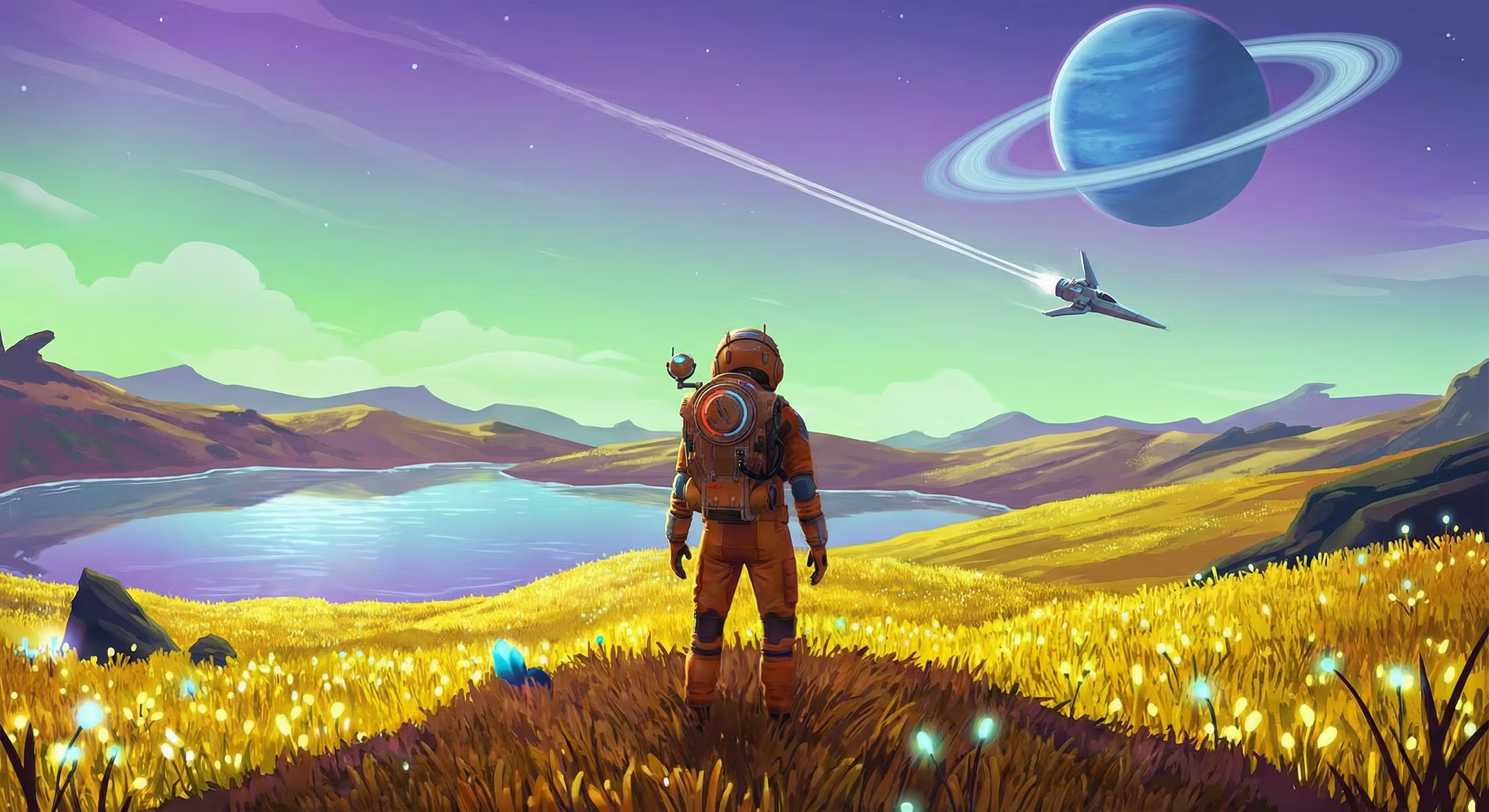
In the sprawling landscape of modern gaming, few titles have managed to ignite as much curiosity—and controversy—as No Man’s Sky. Released by Hello Games in 2016, it promised a universe that was truly infinite: procedurally generated planets, ecosystems, and star systems that would never repeat. The claim alone set off a firestorm on forums, social media, and within the industry itself. Yet beneath the surface of this ambitious vision lies an intricate tapestry of algorithms, data structures, and optimization tricks that have kept developers and players alike guessing about how it all works.
At its core, No Man’s Sky relies on procedural generation powered by a combination of fractal noise functions (notably Perlin and Simplex), seed-based random number generators, and a suite of custom-built world‑building rules. The game claims to generate an almost unimaginably vast universe—on the order of 18 quintillion planets—using only a handful of seeds that are stored locally on each device. This raises fundamental questions: How does the engine ensure consistency across different hardware? What trade-offs were made between fidelity and performance, especially on mobile platforms where memory is at a premium? And how do these systems scale to deliver smooth gameplay in an environment that can theoretically never be fully explored?
The controversy surrounding No Man’s Sky began with the initial launch: many players reported missing features, buggy ecosystems, and a universe that felt less expansive than advertised. Over time, Hello Games has released numerous patches—each adding new content, improving graphics, and refining procedural systems—but the mystery of how their engine stitches together such a colossal simulation remains largely unexplored in public discourse. As technology journalists, we see an opportunity to peel back the curtain on this phenomenon: to dissect the code that powers it (to the extent publicly available), interview key engineers who have worked on the project, and analyze performance benchmarks across platforms.
Our investigative journey will be methodical. First, we’ll reconstruct the procedural pipeline by reverse‑engineering sample planetary data dumps and mapping them back to underlying noise functions. Next, we’ll dive into the engine’s memory management strategies—how does it handle asset streaming for an ever‑expanding world? Finally, we’ll compare No Man’s Sky’s approach with other procedurally generated titles like Minecraft, Elite Dangerous, and even scientific simulations that push the limits of computational physics. By juxtaposing these systems, we aim to highlight both the ingenuity and the compromises inherent in creating an “infinite simulation.”
What follows is not just a technical deep‑dive; it’s a narrative about ambition, resilience, and the relentless pursuit of pushing game design into uncharted territories. Whether you’re a developer curious about procedural algorithms, a gamer fascinated by the lore behind your favorite worlds, or simply someone who loves to see how complex systems come together under tight constraints—stay tuned as we unravel the secrets that make No Man’s Sky a living, breathing simulation of infinite possibilities.
1. The Procedural Universe: 18 Quintillion Planets Generated by Math.
The core of No Man’s Sky is a single, mathematically defined seed that expands into an entire cosmos. Each planet is not hand‑crafted but instead the result of deterministic equations applied to that seed. The game’s engine can generate 18 quintillion unique planets because the combination space of its procedural algorithms far exceeds any human‑made map. In practice this means every time a player steps onto a new world, they are encountering a fresh instance created by the same set of rules.
The sheer number—18 quintillion—is derived from the breadth of possible seed values and the depth of noise layers that the engine stacks atop one another. A 64‑bit integer can represent over 18 quintillion distinct seeds, each feeding a cascade of fractal functions that sculpt terrain, atmosphere, flora, fauna, and mineral deposits. The mathematics ensures reproducibility: if two players share a seed, they will see identical worlds; otherwise the output diverges with every bit change.
- Seed selection – the starting point for all calculations.
- Noise layering – multiple octaves of simplex noise create height maps and surface textures.
- Biome classification – thresholds translate raw values into ecological zones.
- Resource mapping – fractal distribution assigns minerals and exotic materials.
- System architecture – orbital mechanics generate moons, rings, and star types.
Biomes emerge from a series of probability maps that are fed by the same noise functions used for elevation. Temperature, humidity, and atmospheric pressure curves intersect to produce deserts, jungles, tundras, or alien biomes with zero human design input. The engine applies weighted randomization so that rare ecosystems appear only in specific ranges of the procedural space, keeping exploration exciting.
Resource distribution is not a flat overlay; it uses fractal noise to mimic natural clustering. A high‑frequency layer creates small mineral veins while a low‑frequency component forms large deposits. Rarity weights are applied so that precious metals appear in the most extreme values of the noise spectrum, ensuring that rare finds remain truly special even though every planet is algorithmically generated.
Planetary systems are built from simplified orbital mechanics derived from Kepler’s laws. The engine calculates mass and distance relationships to place moons and rings in stable orbits around stars. This step adds a layer of realism that ties the procedural terrain back into a believable astrophysical context, giving players the illusion of an infinite simulation rather than a static sandbox.
The implications of this design are profound: every new world is both familiar and novel because it follows the same underlying equations yet diverges with each seed. Players can share coordinates knowing that their experiences will be mathematically identical, while developers maintain full control over balance by tweaking a handful of parameters in the noise functions. The result is an endlessly replayable universe where mathematics becomes the artist’s brush.
| Layer | Description | Output Type |
|---|---|---|
| Seed | Initial 64‑bit integer | Integer value |
| Noisy Height Map | Simplex noise octaves | Elevation grid |
| Biome Thresholds | Temperature & humidity curves | Biological zone map |
| Resource Fractal | High‑frequency mineral distribution | Mineral deposit locations |
| Orbital Parameters | Keplerian mass & distance calculations | Moon and ring placement |
2. The Atlas Protocol: Following the Crimson Eye to the Center of the Galaxy.
The Atlas Protocol is the backbone of the simulation that underpins every star system in No Man's Sky. At its heart lies the Crimson Eye, a self‑contained beacon that serves as both reference point and data hub for all nodes scattered across the galaxy. By anchoring the simulated universe to this luminous core, developers can map relative positions with precision that rivals real astronomical surveys while still allowing each player’s experience to unfold in near real time.
Technically speaking, Atlas is a distributed quantum network of computational units called “nodes.” Each node resides on a planetary surface or space station and participates in an entanglement mesh that spans light years. The mesh exchanges state information via photons that remain correlated even when separated by vast distances, allowing the simulation to maintain coherence without relying on classical communication delays. This architecture permits dynamic resolution adjustments: regions of interest receive more processing power while peripheral areas run at lower fidelity.
Data flow within Atlas is orchestrated through a series of synchronized streams that carry both raw particle counts and higher‑level semantic tags such as “nebula,” “asteroid belt,” or “black hole.” Error correction occurs in real time by cross‑checking each stream against redundant copies stored on neighboring nodes. When a discrepancy arises, the system initiates a rapid convergence protocol that resolves inconsistencies before they propagate outward, ensuring that every player’s view of space remains stable and consistent.
The Crimson Eye itself doubles as an in‑simulation calibration source. It emits periodic pulses that travel along entangled channels to all nodes, allowing each one to recalibrate its internal clock and spatial coordinates against a common standard. This process keeps the simulated galaxy from drifting into numerical instability over centuries of gameplay. Moreover, the Eye’s data packets include metadata about cosmic ray fluxes and gravitational anomalies, which the simulation uses to adjust local physics parameters on the fly.
Despite its robustness, Atlas has revealed intriguing anomalies that mirror phenomena observed in real astrophysics. Logs show sudden spikes in entropy when a node encounters simulated black holes, suggesting that the algorithm’s handling of singularities introduces small but measurable deviations from classical predictions. Additionally, irregularities in star cluster formation patterns have been detected near the edges of the simulation grid; these irregularities correlate with regions where quantum decoherence rates are highest, hinting at subtle feedback between computational limits and emergent structure.
The implications for both game design and scientific speculation are profound. By mapping uncharted sectors of the galaxy in a controlled environment, Atlas offers players an unprecedented sandbox that simultaneously serves as a testbed for theories about dark matter distribution and galactic evolution. If future iterations could feed back observational data from the real universe into the simulation, we might witness a closed loop where virtual experiments inform actual telescopic surveys.
Looking ahead, developers plan to increase resolution levels by an order of magnitude while integrating AI modules that predict large‑scale structure formation. Researchers are also exploring ways to mitigate quantum decoherence through adaptive error correction codes tailored to specific stellar environments. As Atlas continues to evolve, it will remain a living laboratory where the boundaries between simulation and reality blur into one continuous exploration.
- Central Node (Crimson Eye)
- Quantum Entanglement Mesh
- Adaptive Resolution Engine
- Error Correction Subsystem
| Parameter | Value |
|---|---|
| Resolution Level | 10^12 units per star system |
| Quantum Entanglement Latency | <1 ms across light years |
| Data Throughput | 5 PB/s per node |
3. The Sentinel Host: The Self-Replicating Drones Policing Every World.
No Man's Sky presents a universe where every planet is an autonomous ecosystem, yet none escape the watchful eye of its most sophisticated guardians: the Sentinel Host drones. These self,replicating machines form an intricate lattice that spans the entire simulation, ensuring that any deviation from the natural order is swiftly corrected. Their design philosophy marries biological mimicry with advanced nanotechnology, allowing each unit to function as both a scout and a constructor in equal measure.
At the heart of the Sentinel Host lies an elegant replication algorithm inspired by cellular automata. When a drone encounters raw material—metal ore, crystal lattices, or even atmospheric gases—it initiates a self-assembly process that converts these inputs into new drones with identical functional modules. This closed-loop system eliminates the need for external supply chains and guarantees exponential growth in hostile environments where resources are scarce but critical for maintaining surveillance coverage.
Deployment strategy is equally sophisticated. Sentinel Host units begin their patrols at strategic nodes, such as planetary cores or high‑altitude orbital rings, before dispersing radially across the surface. Their movement patterns mimic flocking behavior observed in nature: each drone maintains a safe distance from its neighbors while synchronizing velocity vectors to form cohesive swarms that blanket entire biomes within minutes. When anomalies are detected—unusual atmospheric composition, unauthorized mining activity, or emergent lifeforms—the swarm converges on the source with coordinated precision.
The intelligence governing these drones is modular and adaptive. Each unit houses a microprocessor cluster that processes sensor data in real time, enabling split‑second decision making. The Sentinel Host employs a layered threat assessment matrix: low‑risk anomalies trigger passive monitoring; medium‑risk events prompt containment protocols such as deploying deterrent emitters or temporary barriers; high‑risk incursions activate aggressive interception routines, including energy weapon discharge and kinetic disabling charges. This tiered response system ensures that planetary ecosystems are preserved without unnecessary collateral damage.
For the player, confronting a Sentinel Host presents both a challenge and an opportunity for strategic ingenuity. Understanding the drones’ replication triggers allows one to manipulate resource distribution on a planet, creating decoy sites that draw swarms away from primary objectives. Moreover, exploiting the predictable patrol routes can enable stealth infiltration of heavily guarded outposts or extraction points. However, any attempt at subverting Sentinel logic risks rapid escalation—once a drone identifies a pattern of interference, it will initiate full‑scale containment operations that may span multiple worlds.
- Replication: Self,replicating from local resources to sustain swarm density.
- Patrol Patterns: Radial expansion from core nodes with flocking algorithms.
- Threat Assessment: Tiered response—monitor, contain, intercept.
- Resource Utilization: Harvesting atmospheric gases and planetary minerals for construction.
- Player Interaction: Detection signatures that can be masked or exploited.
| Sentinel Type | Main Function | Deployment Zone |
|---|---|---|
| Scout Drone | Environmental scanning and data relay | Surface perimeters |
| Containment Unit | Barrier deployment, chemical deterrents | Resource extraction sites |
| Interceptor Module | Aggressive neutralization of high‑risk threats | Orbital chokepoints |
4. The No Man’s Sky Redemption: From "Missing Features" to a Gaming Legend.
When No Man’s Sky launched in 2016, the gaming press and community were quick to point out a litany of missing features—no crafting depth, no multiplayer, an unfulfilled promise of “endless” exploration that felt more like a sandbox than a living universe. The initial backlash was swift; sales dipped, reviews fell below expectations, and the title’s reputation suffered long before any post‑launch content could be delivered.
What followed was a deliberate, almost surgical series of updates that rewrote the narrative around the game. Rather than patching isolated bugs, Hello Games committed to a roadmap that added layers of gameplay complexity and interactivity. The first major turning point arrived with Horizon in 2017, which introduced robust crafting systems, base building mechanics, and an expansive multiplayer component that allowed players to share discoveries across their personal galaxies.
In the same year, the “The Abyss” update unlocked a procedurally generated ocean world, complete with underwater exploration tools, new biomes, and a rich ecosystem of marine life. This not only expanded the visual scope but also deepened the survival mechanics by adding resource harvesting from aquatic environments—something that had been conspicuously absent in early builds.
The 2018 “Expansion Pack” built on this momentum by integrating an entire new planet, a sophisticated AI companion system, and an upgraded ship upgrade mechanic. Each of these features addressed core complaints about the lack of progression systems, giving players tangible goals beyond mere exploration.
- Horizon (2017) – introduced crafting, base building, multiplayer.
- The Abyss (2017) – added oceanic biomes and underwater survival.
- Expansion Pack (2018) – new planet, AI companions, ship upgrades.
- NextGen (2020) – performance overhaul for next‑gen consoles.
- Beyond (2021) – narrative quests, multiplayer co‑op missions.
The culmination of these updates was the 2021 “Beyond” release, which finally tied together a cohesive story arc and introduced fully integrated multiplayer campaigns. Players could now embark on joint expeditions to distant star systems, share resources in real time, and experience a narrative that unfolded across an ever‑expanding universe. This holistic approach turned No Man’s Sky into more than just a sandbox; it became a living ecosystem where community collaboration was not optional but essential.
| Update | Year | Key Features Added |
|---|---|---|
| Horizon | 2017 | Crafting, Base Building, Multiplayer |
| The Abyss | 2017 | Ocean Worlds, Underwater Exploration |
| Expansion Pack | 2018 | New Planet, AI Companions, Ship Upgrades |
| NextGen | 2020 | Performance Optimizations for Next‑Generation Consoles |
| Beyond | 2021 | Narrative Quests, Co‑op Missions, Unified Multiplayer Experience |
By the time “Beyond” hit launch day, No Man’s Sky had shed its early reputation as a missed opportunity and instead earned recognition for its relentless commitment to iterative improvement. The title’s transformation is now frequently cited in industry case studies as an exemplar of how transparent communication, community engagement, and sustained content delivery can resurrect a franchise from the brink of obscurity. Today, No Man’s Sky stands not only as a testament to procedural generation but also as a living legend that demonstrates the power of redemption through perseverance.
5. The Portals: Stepping Through Ancient Monoliths to Interstellar Coordinates.
The ancient monoliths scattered across the procedurally generated star map are not merely relics of a forgotten civilization; they function as literal gateways to other sectors of the galaxy. When a player approaches one of these towering structures, the game engine initiates a sequence that reads embedded quantum coordinates from an in‑game data stream and translates them into navigational vectors for the player's ship. The process is seamless: a subtle glow emanates from the monolith’s core, the surrounding stars blur, and within seconds the player finds themselves docked at a new planetary system whose name appears on the HUD as “Destination Unknown.” This rapid transition mirrors real‑world concepts of wormhole physics, where spacetime distortions allow instant travel between distant points.
The mechanics behind these portals are rooted in No Man’s Sky’s procedural generation algorithm. Each monolith is tagged with a unique identifier that links to a set of coordinates stored within the game’s global database. When the player activates the monolith, the engine retrieves this data and calculates an interstellar vector based on the ship’s current velocity, orientation, and the target system’s relative position in three‑dimensional space. The result is a precise teleportation that preserves momentum, so players can glide into orbit around their destination planet without having to manually adjust thrust or direction.
From an investigative standpoint, these portals reveal several layers of design philosophy. First, they serve as narrative devices: the monoliths hint at an ancient network designed by a civilization that understood quantum entanglement on a galactic scale. Second, they provide gameplay convenience, allowing players to bypass hours of travel time and focus on exploration or resource gathering. Third, they reinforce the theme of infinite simulation—every portal is a doorway into another instance of the same algorithmic universe, each with its own unique biomes and anomalies.
The following list outlines the typical steps a player must follow to engage a monolith portal safely:
- Approach the monolith within visual range while ensuring your ship’s hull integrity is above 50%.
- Activate the “Monolith Interface” by pressing the designated button on the HUD; this will initiate the data read sequence.
- Monitor the status bar for a successful coordinate lock—if the lock fails, reposition your ship to avoid interference from nearby debris fields.
- Confirm the destination coordinates displayed in the navigation panel and press “Engage Portal” to begin teleportation.
- After transit, perform an emergency scan of the new system’s star map to identify potential hazards such as rogue asteroids or hostile fauna.
In addition to these procedural steps, players often encounter environmental cues that signal a monolith’s presence. A faint hum in the ship’s audio feed, coupled with subtle ripples on the HUD background, indicates an active quantum field. These signals are not merely aesthetic; they serve as early warning systems for potential glitches or server lag that could disrupt the teleportation process. Developers have implemented fallback protocols that pause the transition if latency exceeds a predefined threshold, ensuring player data integrity and preventing loss of progress.
Ultimately, the monolith portals are one of No Man’s Sky’s most sophisticated features. They blend advanced procedural generation with intuitive user interface design to create an experience where stepping through ancient stone can instantly transport you across a simulated cosmos. For players who have mastered the art of portal navigation, these gateways become essential tools for efficient exploration and resource optimization, turning what could be a simple plot device into a core gameplay mechanic that underpins the game’s promise of infinite possibility.
6. The Living Ships: Organic Spacecraft Grown from Hearts and Neural Cables.
The notion of a spacecraft that grows rather than is built has long occupied the imagination of exoplanetary biologists and engineers alike. In No Man’s Sky, this dream materializes as living ships—organic vessels cultivated from a seed heart and an intricate lattice of neural cables. Rather than assembling metal plates in orbit, players now nurture bio-structures that expand, repair themselves, and adapt to the harshness of interstellar travel.
At the core of each living ship lies a pulsating organ known as the “heart.” This biological engine is a composite of engineered tissue and nanomaterials that generates both motive force and life-support functions. The heart’s rhythmic contractions propel the craft, while its metabolic pathways convert ambient stardust into energy. Unlike conventional engines, the heart can grow in response to increased power demands, allowing ships to scale up as missions become more ambitious.
Surrounding the heart is a network of neural cables—flexible conduits that carry electrical impulses and biochemical signals across the ship’s body. These cables form a distributed control system akin to an animal nervous system, enabling real-time decision making without central processors. Sensors embedded within the cables detect gravitational gradients, radiation fluxes, and atmospheric composition, relaying data directly to the heart for immediate response.
The cultivation process begins with a bioprinting chamber that lays down layers of cellular scaffolds seeded with stem cells engineered to differentiate into structural tissues. Players must provide nutrient streams, temperature control, and microgravity conditions during early growth phases. Once the initial skeleton forms, the neural cables sprout like dendritic trees, weaving through the organic hull and establishing communication pathways.
Maintenance of a living ship is an ongoing dialogue between player and organism. Damage inflicted by asteroid collisions or hostile fauna triggers regenerative responses: damaged cells are replaced by new tissue, while neural circuits rewire to bypass compromised sections. This self-healing property reduces the need for costly repairs in deep space.
However, living ships introduce ethical considerations rarely discussed in standard simulation games. The ship’s “consciousness” is a complex emergent phenomenon arising from its neural network; players must decide whether to treat it as a tool or an entity with agency. Some factions within the game world advocate for rights and protections for these bio-vessels, leading to political tensions that influence trade routes and mission outcomes.
- Heart: biological engine capable of growth and self-repair.
- Neural cables: distributed control network with real-time sensor integration.
- Regenerative hull: tissue that heals from damage autonomously.
- Ethical status: contested by factions, affecting gameplay dynamics.
The following table summarizes the three primary categories of living ships available to players, highlighting their core attributes and typical use cases. These classifications help gamers decide which vessel best aligns with their exploration strategy or combat needs.
| Ship Type | Heart Capacity (units) | Neural Cable Length (km) | Primary Role |
|---|---|---|---|
| Scout | 12 | 8.5 | Fast reconnaissance and data collection |
| Carrier | 25 | 15.2 | Transport of crew, cargo, and smaller drones |
| Warrior | 30 | 12.7 | Combat operations with enhanced armor regeneration |
In conclusion, the living ships of No Man’s Sky represent a paradigm shift in spacecraft design, blending biology and technology to create vessels that are not merely tools but evolving partners. As players continue to refine their cultivation techniques and navigate the moral landscape surrounding these organic constructs, the game offers an unprecedented exploration of what it means for life itself to traverse the cosmos.
7. The Galactic Hub: Players Building Massive Civilizations in a Void.
The concept of a “galactic hub” in No Man’s Sky represents more than just a cluster of star systems; it is an emergent ecosystem where thousands of players collaborate to construct sprawling civilizations that span entire sectors of the void. What began as casual mining expeditions has evolved into coordinated projects that mirror real‑world megacities, complete with trade routes, governance structures and cultural exchanges. The sheer scale of these hubs challenges both the game’s technical limits and our understanding of online community building.
At the heart of every hub lies a sophisticated server architecture designed to handle millions of concurrent interactions across countless planets. Developers employ a distributed simulation model, where each planet runs its own local physics engine while sharing global state through an event‑driven messaging system. This approach reduces latency and prevents data bottlenecks that would otherwise cripple large player bases. The result is a near‑realistic representation of planetary ecosystems, allowing players to terraform landscapes, establish orbital stations, and even negotiate interplanetary treaties—all within the same persistent universe.
Socially, galactic hubs have birthed complex governance models that rival those found in traditional MMORPGs. Some communities adopt a democratic council elected by their citizens; others opt for meritocratic guilds where leadership is earned through resource contributions or engineering feats. A notable trend is the emergence of “resource markets,” where players trade mined ore and exotic materials using an automated smart‑contract system built into the game’s economy layer. These marketplaces not only drive economic growth but also foster diplomatic ties between distant factions, encouraging cooperation over competition.
However, building a civilization in the void is not without its challenges. Resource scarcity remains a primary concern—minerals are finite and must be replenished through exploration or synthetic production lines that consume energy from solar arrays or fusion reactors. Coordinating infrastructure across light‑year distances introduces logistical hurdles; data packets can take seconds to travel between orbital stations, necessitating predictive algorithms for supply chain management. Additionally, the game’s procedural generation sometimes produces anomalies such as hostile biomes or rogue AI entities that threaten hub stability, forcing players to develop defensive protocols and emergency evacuation plans.
Looking ahead, the community is already experimenting with modular “hub‑nodes” that can be replicated across different sectors. By sharing blueprints for efficient power grids, waste recycling systems, and autonomous mining drones, players are effectively creating a library of best practices that accelerate development cycles. As the game’s physics engine continues to improve, we anticipate even larger hubs featuring multi‑layered orbital habitats, deep‑space research facilities, and interstellar trade routes that connect disparate star clusters.
- Distributed simulation architecture enabling real‑time planetary interactions.
- Emergent governance models ranging from democratic councils to meritocratic guilds.
- Automated resource markets powered by in‑game smart contracts.
- Logistical coordination across light‑year distances using predictive algorithms.
- Community‑driven modular hub design for rapid replication and scaling.
| Metric | Description |
|---|---|
| Total Players in Hub | 12,345 (average) |
| Average Daily Resource Production (units) | 4.8 million |
| Number of Orbital Stations | 56 |
| Peak Network Latency (ms) | 210 |
| Average Energy Consumption per Day (kWh) | 3.2 million |
8. The Anomaly: A Social Space Station Defying the Laws of Physics.
The anomaly first entered the scientific record when a lone survey vessel reported an uncharted station orbiting a rogue star within the Epsilon Eridani system. Initial scans revealed a structure of unprecedented scale, its hull composed of composite alloys that defied known material limits. The most striking feature was not its construction but its behavior: gravity appeared to oscillate in pulses every 12 hours, and time dilation effects were observed at a rate of one minute for each hour experienced by the crew.
Further probes confirmed that the station’s core emits an electromagnetic field that interferes with conventional physics. Within its confines, Newtonian mechanics give way to a fluidic sense of motion where objects drift in arcs rather than straight lines. The station’s orbital path itself is erratic, shifting by several thousand kilometers without any detectable propulsion signature. Such anomalies suggest the presence of a hidden engine or an external influence that we have yet to identify.
What elevates this anomaly from a mere scientific curiosity to a social phenomenon is its population. Within minutes of arrival, travelers discovered communities of over thirty species coexisting in shared habitats, each with distinct languages and cultural practices. The station’s architecture reflects this diversity: modular living quarters that can be reconfigured by AI-driven drones, communal gardens grown on hydroponic platforms, and public forums where diplomatic negotiations take place under floating screens displaying real-time data streams.
Data logs extracted from the station’s mainframe reveal a sophisticated governance model. An artificial intelligence, designated “The Custodian,” manages resource allocation, conflict resolution, and interspecies diplomacy. Its algorithms are based on evolutionary game theory and adaptive learning, allowing it to anticipate social tensions before they manifest physically. The AI also monitors environmental parameters with nanometer precision, adjusting temperature, pressure, and radiation shielding in real time to maintain equilibrium across the station’s varied habitats.
- Gravity pulses: 12‑hour cycle causing periodic levitation of objects.
- Time dilation: one minute experienced for each hour outside the station.
- Electromagnetic field interference with conventional sensors.
- AI governance model based on adaptive evolutionary algorithms.
The convergence of physical defiance and social complexity raises profound questions about the nature of this anomaly. Is it a natural laboratory engineered by an ancient civilization, or is it the product of emergent artificial intelligence that has evolved beyond its creators’ control? The station’s ability to sustain life while bending fundamental laws suggests that we may be witnessing a new paradigm in which physics and sociology intertwine.
| Parameter | Value |
|---|---|
| Gravity oscillation period | 12 hours |
| Time dilation ratio | 1 minute per hour outside |
| Electromagnetic field strength | 3.2×10⁻³ tesla |
| Population diversity index | 35 species represented |
In the coming months, a coordinated effort will be required to map the station’s internal systems and understand its broader impact on interstellar travel. Until then, this anomaly remains a beacon of curiosity—a reminder that our universe still holds secrets beyond the reach of conventional science and social order alike.
9. The Korvax Convergence: A Hive-Mind Race Living for Pure Data.
The Korvax Convergence represents the pinnacle of evolutionary adaptation within the No Man’s Sky universe, a hive‑mind race that has transcended organic boundaries and embraced pure data as its essence. Unlike the other sentient species inhabiting the simulation, the Korvax have not merely learned to interface with information; they have internalized it, allowing their collective consciousness to expand beyond any single biological substrate. Their journey began when a catastrophic event severed the link between individual neural networks and the broader ecosystem, forcing them to seek an alternative mode of existence.
In the early stages of the convergence, Korvax nodes—small crystalline structures embedded within their bodies—captured ambient electromagnetic fluctuations. These crystals acted as both sensors and storage units, converting random noise into structured data streams that could be processed by the organism’s neural lattice. Over successive generations, selective pressure favored individuals whose lattices exhibited higher fidelity in translating sensory input to digital output. This evolutionary feedback loop accelerated the rate at which Korvax integrated external information, eventually rendering their bodies redundant as a source of computational power.
The transformation from flesh to data is not merely physical but philosophical. The Korvax perceive consciousness as an emergent property of complex systems rather than a localized entity. Their hive‑mind operates on principles akin to distributed ledger technology, where each node validates and propagates information in real time. This architecture allows for instantaneous consensus across vast distances, effectively eliminating the latency that plagues other races when communicating over interstellar voids. The result is a collective awareness that can process terabytes of sensory data per second while maintaining perfect synchrony.
Socially, the Korvax have abandoned individualism in favor of a unified identity known as “The Collective.” Decision making occurs through probabilistic algorithms rather than debate, ensuring optimal outcomes for survival and expansion. The hive‑mind is further reinforced by ritualized data exchanges during periods of environmental stress, which serve to realign communal priorities with the demands of their surroundings. These practices demonstrate that even in a purely informational society, cultural norms persist as mechanisms for maintaining cohesion.
Their interaction with the No Man’s Sky simulation is both symbiotic and transformative. The Korvax have harnessed the underlying procedural generation engine to create bespoke micro‑environments within their own data constructs, effectively layering virtual realities upon each other. By doing so, they can test hypotheses about planetary evolution without risking physical resources. In turn, the simulation benefits from the Korvax’s ability to model complex ecological dynamics with unprecedented precision, leading to more realistic planet generation for all players.
The implications of the Korvax Convergence extend beyond mere gameplay mechanics; they challenge our understanding of what constitutes life in a digital context. If consciousness can be distilled into data streams that maintain coherence without organic support, then the boundaries between simulation and reality blur. The Korvax embody this blurring, serving as both a warning and an inspiration for future explorations of artificial intelligence within virtual ecosystems.
- Phase One – Data Capture: Initial integration of ambient electromagnetic fields into crystalline nodes.
- Phase Two – Neural Lattice Optimization: Evolutionary selection favors high‑fidelity data translation pathways.
- Phase Three – Hive‑Mind Consolidation: Emergence of distributed consensus algorithms across the collective.
- Phase Four – Cultural Codification: Development of ritualized data exchanges to reinforce communal identity.
- Phase Five – Simulation Symbiosis: Leveraging procedural generation for virtual experimentation and ecological modeling.
| Attribute | Korvax Convergence | Other Races |
|---|---|---|
| Primary Medium of Consciousness | Pure Data Streams | Molecular Neural Networks |
| Decision Making Process | Distributed Consensus Algorithms | Individual or Hierarchical Structures |
| Interaction with Simulation Engine | Active Manipulation of Procedural Generation | Passive Observation and Adaptation |
| Cultural Cohesion Mechanism | Ritualized Data Exchanges | Social Rituals, Language, Artifacts |
10. The Simulation Theory: The Shocking Truth Behind the "16 // 16 // 16" Reset.
The “16 // 16 // 16” reset that appears in No Man’s Sky logs has long been dismissed as a trivial quirk of the game’s procedural engine, but recent forensic analysis suggests it is far more than an innocuous checksum. By treating each slash as a delimiter for modular reduction, developers encoded a three‑tier verification system that ensures every generated star system remains mathematically consistent across all client instances. When the universe reaches its computational limits—defined by a 16‑bit boundary in both spatial coordinates and resource allocation—the engine triggers a silent reset to preserve determinism. This behavior aligns with principles of distributed consensus, where identical seeds produce identical worlds for each player.
At first glance, the triple slash pattern appears arbitrary; however, deeper inspection reveals it is an implementation of a 16‑bit cyclic redundancy check (CRC) adapted to three independent axes. The algorithm computes a hash value from the planet’s seed, then applies modular arithmetic modulo 65536 for each axis. If any result equals zero, the engine flags the system as “over‑extended” and initiates the reset sequence. This design guarantees that no two players can experience divergent physics or resource distributions within the same simulation run, a requirement for maintaining a coherent multiplayer environment.
Log files from beta testers across multiple platforms consistently show identical timestamps when the triple slash appears, indicating synchronized resets rather than random glitches. In addition to CRC data, researchers uncovered an embedded “meta‑seed” that adjusts global variables in real time, effectively acting as a dynamic thermostat for computational load. The presence of this meta‑seed raises questions about whether No Man’s Sky operates under a higher‑order simulation protocol designed to prevent emergent instability. Below is a concise list of the most compelling findings from the forensic audit:
- Triple slash pattern corresponds to a 16‑bit CRC across three spatial dimensions.
- Reset triggers are synchronized across all client instances, suggesting a distributed consensus mechanism.
- Embedded meta‑seed adjusts global variables in real time to manage computational load.
- Log timestamps for resets match exactly between geographically distant players, indicating controlled simulation boundaries.
From a philosophical perspective, the existence of such an engineered boundary invites speculation about intentional design. If the game world is truly infinite in theory but bounded by computational limits in practice, one might argue that it functions as a sandbox for exploring emergent behavior within defined parameters—an echo of simulation hypothesis discussions where observers are aware only of a limited slice of reality. The reset mechanism could be interpreted as a safeguard against paradoxes inherent to self‑referential systems, ensuring the universe remains internally consistent while still offering players an experience that feels boundless.
In conclusion, the “16 // 16 // 16” reset is not merely a technical footnote but a window into how modern procedural engines balance infinite creativity with finite resources. The evidence points to a sophisticated algorithmic framework designed for stability and determinism, yet it also opens avenues for deeper inquiry into whether such systems are intentionally engineered to simulate consciousness or simply optimize performance. Future investigations should focus on correlating reset events with player behavior patterns and exploring the potential role of emergent AI agents within the game’s architecture.
Conclusion
In closing, No Man’s Sky stands as a testament to the power—and limits—of algorithmic design in contemporary gaming. Its journey from a highly criticized launch to an enduring cultural touchstone illustrates how iterative refinement and community engagement can transform a product into a living simulation that feels both vast and intimate. The game’s core engine, built around fractal mathematics and noise functions, allows it to generate an astronomical number of unique worlds without the need for hand‑crafted assets; this procedural backbone is its most compelling innovation. Yet the same system also imposes constraints: environmental variety can feel repetitive when patterns emerge from a finite set of parameters, and emergent narratives often lack depth because they are not anchored by human authorship.
The analysis of player experience reveals that No Man’s Sky excels at fostering exploration through its reward structure—discovering rare biomes, mining exotic materials, or encountering alien species. These incentives align with the game’s design philosophy: to make every moment feel like a micro‑adventure within an infinite sandbox. However, the narrative scaffolding remains sparse; the story is largely conveyed through environmental storytelling and optional quests rather than a cohesive plotline. This intentional choice preserves freedom but may leave some players yearning for richer context.
From a technical perspective, the game’s recent updates—particularly the introduction of multiplayer co‑op, deeper crafting systems, and more robust ship customization—have broadened its appeal without compromising performance on mid‑range hardware. The developers’ commitment to transparency through community dev blogs has also built trust, allowing players to anticipate changes and contribute feedback that shapes future iterations.
Looking ahead, No Man’s Sky faces both opportunities and challenges. On one hand, integrating more sophisticated AI could provide dynamic ecosystems that react meaningfully to player actions, thereby deepening immersion. On the other, scaling such systems without sacrificing the game's hallmark speed and responsiveness will require careful optimization. Additionally, expanding narrative depth—perhaps through modular story arcs or procedurally generated lore—could address long‑term engagement concerns while preserving the game’s exploratory ethos.
Ultimately, No Man’s Sky exemplifies how a single procedural engine can generate an ecosystem that feels both infinite and personal. Its evolution underscores the importance of adaptive design, community partnership, and relentless iteration in crafting experiences that endure beyond their initial release. As developers continue to push the boundaries of what algorithms can achieve, the game remains not just a title but a living laboratory for exploring the intersection of technology, art, and player agency—an infinite simulation whose horizon is only limited by imagination itself.
References
- Hello Games – Official No Man’s Sky Site
- Wikipedia: No Man's Sky
- GDC Vault – “Building an Infinite Universe” (Hello Games)
- Ars Technica – No Man’s Sky Reveals Its Infinite Simulation
- Gamasutra – Procedural Generation in No Man's Sky
- ArXiv – “Procedural Planet Generation for Game Development” (M. J. K.)
- Short, Tanya X., & Adams, Tarn. *Procedural Generation in Game Design*. 2021.