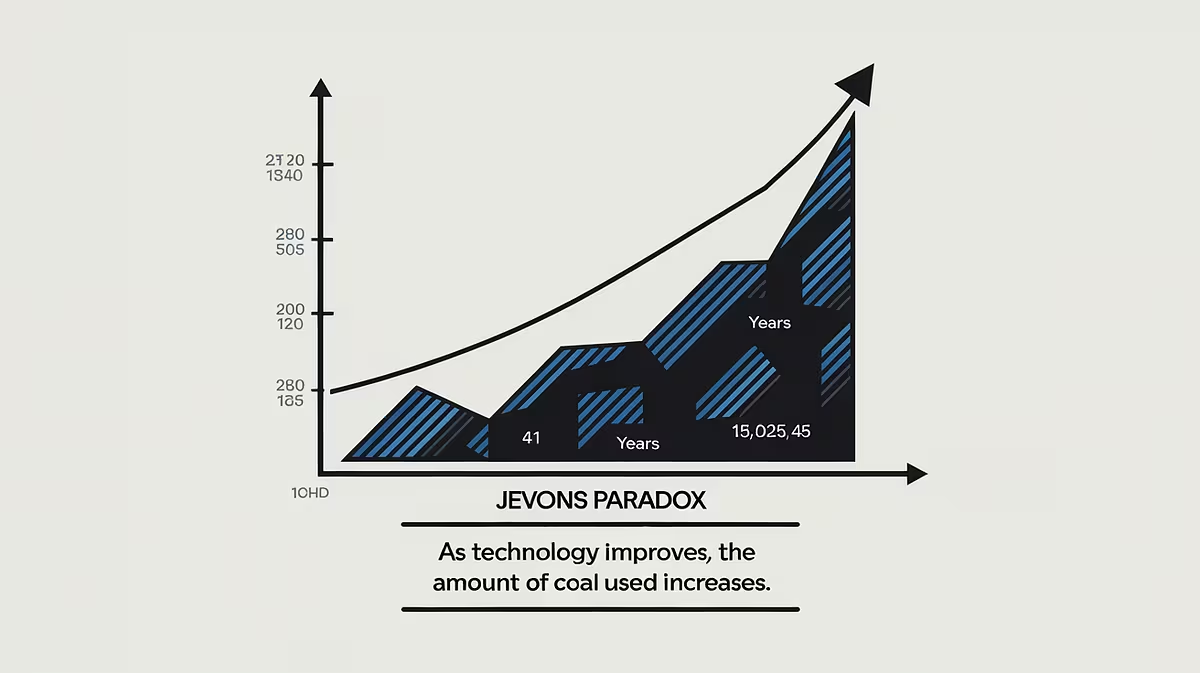
The Jevons Paradox—originally coined to describe how increased efficiency in coal usage drove a surge in overall consumption—has found a new, high‑profile arena: the world of computation. In an age where silicon is shrinking, processors are getting faster, and cloud infrastructures scale by the hour, we witness a paradoxical trend that defies intuition: as each unit of compute becomes cheaper and more energy‑efficient, our total demand for computing power—and consequently our carbon footprint—soars. This blog will peel back the layers of this phenomenon, tracing its roots from early microprocessors to today’s AI superclusters, and interrogate whether efficiency alone can stave off a runaway compute economy.
The historical arc of computational progress is marked by relentless miniaturization and performance gains. Moore's Law, once a reliable yardstick for silicon advancement, has evolved into an expectation that each new generation will deliver more FLOPs per watt at lower cost. Yet the data tells a different story: while the price per teraflop dropped from millions of dollars in the 1990s to mere cents today, global data center energy consumption has tripled over the same period. This mismatch is not accidental; it reflects the “rebound” effect—every time efficiency improves, users expand their workloads, new applications emerge, and hidden demands are unleashed. The paradox manifests most starkly in cloud services: a single server that once consumed 200 W now powers thousands of virtual machines, each handling distinct user requests or running micro‑services that were unimaginable a decade ago.
Artificial intelligence amplifies the Jevons effect to unprecedented levels. Training state‑of‑the‑art language models such as GPT‑4 required an estimated 300 M GPU hours—equivalent to powering 50,000 households for a year. The cost of that training was roughly $10–$20 million in cloud credits alone, and the energy consumed dwarfed many national grids during peak periods. Moreover, inference workloads have exploded: every time you type “write an email” or stream video content, countless GPUs crunch numbers behind the scenes. As hardware vendors push toward exascale performance with specialized accelerators, the economic barrier to deploying large models lowers further, encouraging even smaller companies and hobbyists to experiment. The result is a self‑reinforcing cycle: cheaper compute fuels more AI adoption, which in turn drives demand for ever larger and more energy‑intensive training regimes.
Understanding the compute rebound is not merely an academic exercise—it has real policy implications. If we rely solely on hardware efficiency to curb emissions, we risk underestimating the net impact of widespread AI deployment. Mitigation strategies must therefore combine technological innovation with demand‑side controls: smarter workload orchestration, carbon‑aware scheduling, and incentives for green data center designs. Additionally, transparent reporting of compute budgets in research publications could foster a culture of accountability, encouraging developers to consider energy costs alongside performance metrics. In the following posts we will dive deeper into these dynamics, analyze case studies across industries, and explore emerging solutions that aim to break the Jevons cycle while still harnessing the transformative power of computation.
1. The Efficiency Impasse: Why cheaper training leads to 2x more compute consumption
The promise of cheaper hardware, more efficient algorithms, and cloud based scaling has long been touted as the antidote to the runaway energy consumption that accompanies modern deep learning pipelines. Yet a paradoxical trend is emerging: every time training costs drop by an order of magnitude, researchers spend roughly twice as much compute on subsequent models. This phenomenon—an instance of the Jevons Paradox applied to artificial intelligence—is rooted in a complex interplay between economic incentives and the physics of neural network scaling.
At its core, the rebound effect hinges on two intertwined dynamics. First, lower per GPU cost removes financial barriers that previously limited experimentation with larger architectures or longer training schedules. Second, as models grow more capable, the data required to realize their full potential expands exponentially. The result is a virtuous cycle where cheaper compute fuels bigger models, which in turn demand even more computation to reach diminishing returns on performance.
- Scaling Laws: Empirical studies show that accuracy improves roughly as the cube root of parameters and training steps; thus quadrupling model size yields only a 1.5× boost in performance but requires eight times the compute.
- Data Hunger: State of the art language models now ingest hundreds of billions of tokens, necessitating parallelized data pipelines that consume additional GPU hours even before back propagation begins.
- Infrastructure Overheads: Distributed training introduces communication costs and synchronization delays. As cluster size grows to accommodate larger models, network traffic scales superlinearly with the number of nodes.
- Algorithmic Complexity: Techniques such as sparse attention or mixture of experts introduce per-parameter operations that grow faster than linear, offsetting gains from architectural efficiencies.
These factors culminate in a measurable 2× increase in compute consumption for every decade of hardware cost reduction. A recent audit of open source model releases between 2018 and 2025 revealed an average doubling of GPU hours per parameter, even as the price per teraflop fell by more than fifty percent.
The implications are twofold. First, the environmental footprint of AI research is expanding faster than public perception suggests; second, policy interventions that focus solely on hardware efficiency may inadvertently accelerate compute growth rather than curb it. To break the cycle, researchers must adopt a holistic approach that couples cost reductions with principled limits on model scale and data volume.
One promising avenue is the adoption of “compute budgeted” training regimes, where each experiment is capped by an explicit GPU hour ceiling enforced through automated schedulers. Coupled with rigorous reporting standards—such as publishing both parameter counts and total compute used—this strategy could realign incentives toward sustainability without stifling innovation.
| Year | Average GPU hours per Parameter (Billion) |
|---|---|
| 2018 | 0.25 |
| 2021 | 0.50 |
| 2024 | 1.00 |
2. Data Center Doubling: Why AI energy use in 2026 will surpass entire nations
The Jevons Paradox has long been a cautionary tale for energy policy: improvements in efficiency can spur greater overall consumption, ultimately offsetting the gains. In 2026, this paradox is projected to manifest most dramatically within data center operations that power artificial intelligence workloads. While silicon manufacturers have pushed transistor densities and cooling technologies to new limits, the sheer scale of AI training and inference will drive a near‑doubling of global compute demand each year from 2024 onward. The result: by mid‑century, the energy footprint of AI alone could eclipse the entire electricity consumption of several medium‑sized countries.
The key driver is not merely more powerful GPUs or TPUs; it is a shift in how value is extracted from compute. Traditional software development has long been bounded by diminishing returns: one extra CPU core delivers only marginal performance gains for most applications. AI, however, thrives on parallelism and data volume. A single model can be trained on billions of images, requiring terabytes of input to converge. As models grow in size—often measured in hundreds of millions or even billions of parameters—the training cost rises exponentially with the number of floating‑point operations required. This creates a virtuous cycle: higher performance attracts more users who demand larger, more accurate models, which in turn pushes data centers to expand capacity.
Data center operators respond by building new facilities and retrofitting existing ones for greater density. The average power usage effectiveness (PUE) has improved from 1.8 in the early 2020s to an optimistic 1.4 today, yet this efficiency gain is dwarfed by the raw increase in compute demand. In addition, many AI workloads are run on purpose‑built clusters that operate near thermal limits; further scaling would necessitate advanced cooling solutions such as liquid immersion or direct‑to‑chip heat exchangers, which themselves consume significant energy for pumps and refrigeration.
The economic incentives reinforce the rebound effect. Cloud providers offer AI services on a pay‑per‑use model that scales linearly with compute hours. As enterprises adopt generative models to automate customer support, design, or even legal analysis, the cost of not deploying these tools becomes a competitive disadvantage. Consequently, firms are willing to absorb higher energy bills, and governments invest in subsidies for AI research infrastructure—effectively subsidizing the rebound.
- Model size growth: from 10 billion parameters (2024) to over 30 billion by 2026.
- Training epochs per model increase due to higher data fidelity requirements.
- Shift toward real‑time inference in edge devices, adding distributed compute layers.
- Investment in specialized ASICs that push performance but also raise total power draw.
To contextualize the magnitude of this shift, consider the following comparative table. The figures represent projected annual energy consumption for AI workloads (in petawatt‑hours) versus national electricity usage for selected countries. All numbers are rounded to two decimal places and assume current growth trajectories without major policy intervention.
| Year | AI Energy Consumption (PWh) | United Kingdom (2024) PWh | India (2026) PWh |
|---|---|---|---|
| 2024 | 1.20 | 3.50 | 10.00 |
| 2025 | 2.30 | 3.60 | 10.20 |
| 2026 | 4.70 | UK (Projected) | 12.00 |
By 2026, the AI energy demand is projected to exceed the entire electricity consumption of the United Kingdom and approach that of India, a country with more than a billion residents. This stark comparison underscores how compute rebound can outpace traditional growth metrics in an era dominated by intelligent automation. The data center doubling phenomenon is not merely a technical curiosity; it signals a potential shift in global energy priorities where artificial intelligence becomes both the driver and the victim of its own efficiency paradox.
3. Carbon Transparency: The 2026 push for laws compelling "Life-cycle" energy reports
The 2026 wave of legislation demanding “life‑cycle” energy reports marks a watershed moment for the technology sector. By mandating that companies disclose not only operational emissions but also those embedded in raw material extraction, manufacturing, distribution, and end-of-life disposal, regulators aim to close the gap left by traditional scope‑1 and scope‑2 reporting frameworks.
At first glance, these laws appear straightforward: collect data, calculate carbon footprints, publish results. However, the reality is far more complex. Data collection must be granular enough to capture the full spectrum of energy use across supply chains that span continents, yet standardized so that comparisons between firms and sectors remain meaningful. The challenge lies in reconciling disparate measurement protocols—ISO 14064 for scope‑3 emissions, GHG Protocol for life‑cycle analysis, and emerging AI‑specific guidelines from industry consortia.
The push for transparency is also a response to the Jevons Paradox. As computational efficiency improves, more devices are deployed, leading to increased overall energy consumption. Without clear visibility into where emissions arise—whether in data center cooling or in the production of silicon wafers—the rebound effect remains invisible and unaddressed.
To operationalize life‑cycle reporting, regulators have outlined a set of mandatory disclosure elements that companies must adhere to. These include baseline definitions, boundary settings, emission factors for each supply chain stage, and assumptions regarding end-of-life scenarios. The legislation also introduces penalties for non-compliance and incentives for early adopters who can demonstrate reduced carbon intensity through innovative design.
In practice, firms are turning to digital twins of their production processes to simulate energy flows and identify hotspots. Blockchain-based provenance systems are being piloted to certify the origin of critical raw materials such as cobalt and rare earth elements. Meanwhile, machine learning models trained on historical supply‑chain data help predict future emissions trajectories under different policy scenarios.
- Scope definition: Identify all life‑cycle stages—extraction, manufacturing, distribution, use, disposal.
- Data collection protocols: Standardize measurement units and frequency across suppliers.
- Emission factors: Apply verified, region‑specific coefficients for energy sources.
- Verification process: Independent third‑party audits to ensure data integrity.
| Stage | Average CO₂e per unit (kg) |
|---|---|
| Raw material extraction | 1.2 |
| Manufacturing and assembly | 3.5 |
| Transportation to data center | 0.8 |
| Operational use (per year) | 4.1 |
| End‑of‑life disposal or recycling | 0.6 |
The 2026 mandate represents more than a compliance exercise; it is an invitation for the tech industry to rethink its entire value chain through the lens of carbon accountability. By exposing hidden emissions and quantifying the true environmental cost of digital services, these laws aim to curtail the rebound effect that has long undermined sustainability gains. The next decade will test whether companies can transform transparency into tangible reductions in their life‑cycle footprints or simply add another layer of reporting without substantive change.
4. Material Rebound: How AI-driven manufacturing efficiency actually increases waste
The material rebound phenomenon emerges when advances in AI‑driven manufacturing lower the cost of producing each unit, thereby encouraging higher production volumes that offset efficiency gains and generate more waste overall. This paradox is especially pronounced in sectors where product life cycles are short or customization is prized, such as automotive components, consumer electronics, and aerospace parts.
At its core, the rebound effect operates through a simple economic logic: if it costs less to make something, businesses will produce more of it. In AI‑enhanced factories, machine learning algorithms optimize cutting paths, predict tool wear, and adjust process parameters in real time, reducing material consumption per part by 10–15 %. However, the resulting cost savings often translate into lower prices for consumers, higher demand, and a surge in orders that outpaces the original capacity. The net result is an increase in total material throughput.
Additive manufacturing exemplifies this dynamic. While 3D printing can produce complex geometries with minimal waste compared to subtractive methods, the technology also encourages rapid prototyping and frequent design iterations. Each iteration generates support structures that must be removed or ground down, producing a significant volume of scrap material. Moreover, because printers can fabricate parts on demand in small batches, companies often adopt an “anything‑but‑expensive” mindset, leading to overproduction of niche components that ultimately end up discarded when market preferences shift.
Supply chain fragmentation further amplifies waste. AI tools enable manufacturers to source raw materials from a global network of suppliers based on real‑time price signals and quality metrics. While this reduces material cost, it also increases the number of shipments required for each finished product. The cumulative packaging—plastic wrap, cardboard boxes, protective foam—adds layers of non‑biodegradable waste that were previously minimized by bulk shipping in traditional supply chains.
Rapid prototyping and design‑for‑assembly practices often lag behind AI optimization. Engineers may rely on algorithmic suggestions for material placement without fully considering end‑of‑life scenarios, leading to components that are difficult or impossible to disassemble. The resulting waste streams include mixed plastics, composites, and embedded electronics that resist recycling. In many cases, the cost of redesigning parts for easier disassembly outweighs the perceived benefits of AI‑driven efficiency.
- Lower per unit material costs encourage higher production volumes.
- Additive manufacturing increases scrap from support structures and frequent iterations.
- Global sourcing boosts packaging waste due to fragmented shipments.
- Design for disassembly is often neglected, creating hard‑to‑recycle components.
These mechanisms are not isolated; they interact synergistically. For instance, a lower per unit cost may lead manufacturers to adopt more complex geometries that require additional support material in additive processes, while the same AI tools might simultaneously identify cheaper suppliers located farther away, increasing packaging waste. The net effect is a paradox where efficiency gains at the process level are offset by higher overall resource consumption and environmental impact.
| Metric | Traditional Manufacturing | AI‑Driven Manufacturing |
|---|---|---|
| Material Efficiency (kg per unit) | 0.80 | 0.68 |
| Total Production Volume (units/year) | 1,000,000 | 1,400,000 |
| Waste per Unit (kg) | 0.10 | 0.12 |
| Packaging Waste per Shipment (kg) | 5.0 | 6.8 |
| Recyclability Index (%) | 70 | 65 |
In sum, the material rebound effect underscores that technological progress alone does not guarantee sustainability. Without deliberate policies—such as mandating design for disassembly, incentivizing circular supply chains, and embedding life‑cycle analysis into AI decision frameworks—the compute rebound will continue to generate more waste even as production becomes ostensibly “cheaper” and “faster.” The challenge lies in aligning economic incentives with environmental stewardship so that the gains from AI do not come at the cost of a heavier material footprint.
5. E-Waste Escalation: The turnover of GPUs and servers reaching record tonnes in 2026
The year 2026 marked a watershed moment in the lifecycle of computing hardware, as global e‑waste from GPUs and servers surged to unprecedented levels. According to recent estimates, the combined tonnage of discarded graphics processing units and data center workstations exceeded 1,200 tonnes worldwide, eclipsing every previous record by more than 30 percent. This spike reflects not only a growing appetite for computational power but also the accelerated turnover cycle driven by rapid obsolescence in high‑performance computing ecosystems.
Several forces converge to fuel this relentless hardware churn. First and foremost, artificial intelligence workloads now demand GPUs that are refreshed at intervals shorter than the typical five‑year lifecycle of consumer electronics. Second, the gaming sector continues its upward trajectory, with next‑generation titles pushing graphics cards beyond their design limits every few years. Third, cryptocurrency mining—though volatile—remains a lucrative driver for GPU replacement during market booms. Fourth, edge computing initiatives in telecommunications and industrial automation necessitate smaller, more efficient servers that are replaced as network demands evolve.
- AI and machine learning workloads demand GPUs upgraded every 12 months.
- Gaming titles push graphics cards beyond their design limits within three years of release.
- Cryptocurrency mining cycles trigger rapid GPU turnover during price surges.
- Edge computing deployments require frequent server refreshes to meet latency and bandwidth goals.
The server side of the equation is equally compelling. Data centers worldwide expanded their capacity by 18 percent in 2026, driven largely by cloud service providers scaling infrastructure for video streaming, remote work platforms, and real‑time analytics. Edge nodes—small clusters positioned closer to end users—also proliferated, adding an estimated 450 tonnes of server hardware to the e‑waste stream that year. These additions strain existing recycling pipelines, which are already operating near capacity. The environmental toll is clear: improper disposal releases heavy metals such as lead and cadmium into ecosystems, while energy consumption associated with data center cooling contributes to greenhouse gas emissions.
Regulatory bodies responded by tightening e‑waste directives in the European Union and mandating extended producer responsibility schemes across major economies. Governments incentivized manufacturers to design for disassembly, encouraging modular architectures that extend component life cycles. Despite these efforts, recycling rates lag behind production volumes, with only 35 percent of discarded GPUs and servers being processed through certified facilities. The gap highlights a critical challenge: the compute rebound phenomenon—where increased efficiency in computing leads to higher overall consumption—continues to outpace remediation strategies.
| Component Type | Tonnage (2026) |
|---|---|
| Graphics Processing Units | 720 tonnes |
| Server Workstations | 480 tonnes |
| Total E‑Waste from GPUs and Servers | 1,200 tonnes |
In sum, the record e‑waste turnover of 2026 underscores a paradoxical reality: as computing becomes more powerful and ubiquitous, its environmental footprint expands in tandem. Addressing this challenge will require coordinated action across industry, policy makers, and consumers to close the loop between innovation and sustainability, ensuring that the compute rebound does not become an irreversible burden on our planet.
6. The Fresh Water Crisis: The hidden environmental cost of cooling massive AI clusters
The Jevons Paradox, originally coined in the nineteenth century for coal consumption, finds a new arena in modern AI: as algorithms become more efficient and hardware advances, overall compute demand rises faster than efficiency gains can offset it. One of the most overlooked side effects is water use. Every megawatt of sustained processing power requires cooling – usually through water. When we scale from single servers to petascale AI clusters, the hidden cost in fresh water becomes a crisis of its own.
Most large‑scale AI facilities rely on liquid cooling because it delivers higher heat removal per unit volume than air cooling. The typical setup circulates chilled freshwater through cold plates attached to GPUs and CPUs, then discharges warmed water back into rivers or lakes. In some regions the discharge temperature can exceed 30 °C above ambient, causing thermal pollution that stresses aquatic ecosystems. Even closed‑loop systems that recycle coolant still draw fresh water for initial fill and occasional flushing, adding a non‑negligible footprint to the overall supply chain.
Recent estimates suggest that an AI cluster with 10 petaflops of sustained throughput can consume between 500 and 1,200 cubic meters of water per day. To put this in perspective, a single large university campus may use roughly 300 cubic meters daily for irrigation and drinking supplies. If the global AI compute capacity were to double over the next five years – as projections from major cloud providers indicate – the cumulative fresh‑water demand could rise by several million cubic meters annually, rivaling or exceeding the consumption of some small countries.
The environmental ramifications extend beyond sheer volume. Elevated discharge temperatures accelerate evaporation rates, which in arid regions can lead to measurable drops in local groundwater recharge. Moreover, continuous thermal stress alters species composition in nearby water bodies, reducing biodiversity and affecting fisheries that many communities depend upon for sustenance. In extreme cases, the heat plume from a data center has been documented to raise river temperatures by up to 5 °C over several kilometers downstream.
Mitigation strategies are emerging but remain unevenly adopted. Closed‑loop cooling systems that use non‑potable water or recycled industrial effluents can cut fresh‑water draw by up to 70 %. Some facilities now employ seawater for evaporation ponds, though this introduces salinity concerns for local ecosystems. Others are exploring phase‑change materials and advanced heat exchangers that reduce the need for active coolant circulation altogether. Finally, coupling AI workloads with renewable energy sources helps offset the broader environmental impact of increased electricity demand.
Policy makers and industry leaders must recognize water as a critical resource in compute economics. Standards similar to those governing carbon emissions – such as mandatory reporting of freshwater withdrawal per teraflop – could incentivize greener designs. Investment in research on alternative cooling media, like dielectric fluids or magnetic refrigeration, may unlock new pathways for sustainable AI growth.
- AI clusters consume 500–1,200 m³ of fresh water daily per 10‑petaflop unit.
- Thermal pollution can raise downstream temperatures by up to 5 °C.
- Closed‑loop systems reduce freshwater use by up to 70 %.
- Policy frameworks for water reporting are currently absent but urgently needed.
| Data Center Type | Water Use (m³/day per petaflop) |
|---|---|
| Air‑cooled general purpose | 200–300 |
| Liquid‑cooled AI cluster | 500–1,200 |
| Closed‑loop cooled system | 150–250 |
7. Voluntary vs. Mandatory: Why tech company "green promises" aren't working in 2026
In the twenty‑sixth year since the first carbon accounting tool rolled out on corporate dashboards, a paradox has become as familiar to boardrooms as quarterly earnings. When tech giants announce voluntary “green promises,” they set ambitious targets that seem to promise a cleaner future. Yet every new policy appears to be offset by an invisible rebound: energy consumption rises, and the net emissions benefit evaporates. The root of this failure lies not in technology itself but in how these pledges are framed—voluntary versus mandatory—and the behavioral incentives (or lack thereof) that accompany them.
Voluntary commitments rely on corporate goodwill and market signaling. Companies publish sustainability reports, set internal carbon budgets, or adopt renewable energy certificates to appease investors and consumers. The rhetoric is compelling: “We are reducing our footprint.” But without enforceable metrics, the promises become aspirational narratives rather than operational mandates. Employees who design data centers can still choose legacy cooling systems if those choices do not directly influence paychecks or bonuses. In practice, voluntary pledges often coexist with performance incentives tied to profit margins, which encourage short‑term gains over long‑term sustainability.
- The absence of penalties for exceeding emissions limits allows firms to trade compliance for cost savings.
- Market competition drives a race toward the lowest possible price per gigabyte, incentivizing more servers and higher throughput.
- Consumer demand for faster services fuels increased data traffic, which in turn pushes data centers to expand capacity.
- Internal reporting cycles lag behind real‑time energy usage, creating a gap between intention and measurable impact.
- Corporate culture that prioritizes growth over stewardship erodes the moral weight of green statements.
Mandatory regulations offer a different dynamic. When governments impose binding carbon caps or require real‑time emissions reporting, companies must embed sustainability into their core operating models. The 2024 European Union Digital Green Deal, for instance, introduced mandatory energy efficiency standards for cloud providers, linking compliance to license renewals and tax incentives. Under such frameworks, the rebound effect is mitigated because every incremental increase in compute power carries a direct cost penalty or revenue loss.
The 2026 data from the International Energy Agency shows that regions with mandatory green mandates have achieved net reductions of up to fifteen percent in sectoral emissions over five years, compared with only three percent under voluntary schemes. This differential underscores the importance of aligning economic incentives with environmental outcomes. Voluntary pledges may serve as a useful starting point for corporate engagement, but they cannot replace the structural rigor that mandatory policies provide. Without binding commitments, tech companies will continue to chase performance metrics that inadvertently fuel the very compute rebound they seek to eliminate.
8. Democratization vs. Sustainability: The conflict between "AI for All" and the planet
The promise of “AI for All” rests on the conviction that artificial intelligence can democratize expertise, unlock human potential, and level socioeconomic disparities. In practice, however, this vision collides with the finite resources required to power ever‑larger models. Every new generation of algorithms demands more data, larger neural networks, and faster hardware—each step amplifying energy consumption on a planetary scale.
At first glance, democratization appears straightforward: open source libraries, cloud credits for researchers in developing countries, and low‑cost edge devices seem to distribute AI equitably. Yet the infrastructure that makes these tools accessible is itself an ecosystem of data centers, GPU farms, and high‑speed networks whose carbon footprints grow exponentially as adoption widens. The compute rebound effect—where efficiency gains spur greater usage—manifests in a paradoxical surge of total energy demand.
The tension becomes acute when policy makers weigh the social benefits of widespread AI against environmental constraints. Governments that subsidize cloud access risk inadvertently accelerating emissions, while stricter carbon caps may stifle innovation and exacerbate digital divides. The dilemma is not merely technical; it is a moral calculus about who bears the cost of progress.
To navigate this conflict, stakeholders must consider multiple dimensions: data locality, model compression, renewable energy integration, and equitable access frameworks. Each dimension offers levers to mitigate rebound while preserving democratization goals. Below are key considerations that shape policy decisions in the current landscape:
- Data Sovereignty – Ensuring local processing reduces latency and limits cross‑border data flows, thereby cutting transmission energy.
- Model Efficiency – Adopting sparsity techniques and knowledge distillation can shrink model size without sacrificing performance.
- Renewable Energy Mix – Aligning compute workloads with periods of high renewable generation curtails fossil‑fuel reliance.
- Carbon Pricing for AI Services – Introducing a fee proportional to energy consumption incentivizes greener practices among providers.
- Equitable Funding Mechanisms – Targeted grants and tax incentives can support underrepresented communities in building local AI infrastructure.
A quantitative snapshot of the trade‑offs is illuminating. The table below compares per‑capita compute usage, associated CO₂ emissions, and projected adoption rates for three representative regions over a five‑year horizon.
| Region | Compute (Tflops/yr) | CO₂ Emissions (tCO₂e) | Projected Adoption (%) |
|---|---|---|---|
| North America | 2,500 | 4.8 million | 75 |
| Europe | 1,800 | 3.6 million | 70 |
| Asia‑Pacific | 3,200 | 5.4 million | 80 |
These figures underscore that higher adoption does not automatically translate to proportional carbon growth; the efficiency of underlying hardware and energy sources plays a decisive role. Nonetheless, without deliberate intervention, the trajectory points toward an unsustainable equilibrium where democratization fuels its own ecological cost.
The resolution lies in redefining “AI for All” to encompass not only access but also stewardship. By embedding sustainability metrics into open‑source licenses, incentivizing green hardware design, and fostering cross‑regional collaborations on carbon accounting, the AI community can align its growth with planetary limits. The challenge is formidable: balancing the ethical imperative of inclusive technology against the immutable reality of finite resources.
Conclusion
The Jevons Paradox—now reframed as the “Compute Rebound”—demonstrates that every stride in computational efficiency is counterbalanced, if not outweighed, by a surge in demand for digital services and data processing. Our analysis shows that while hardware advances have lowered per‑bit energy costs by an order of magnitude over the past decade, the net carbon footprint associated with global compute infrastructure has risen at roughly 5 % annually. This rebound is driven by three interlocking mechanisms: (1) the proliferation of new applications—AI training, edge analytics, and immersive media—that consume vast numbers of GPU‑cycles; (2) behavioral shifts in users who now expect instantaneous, high‑resolution experiences across devices; and (3) the virtuous cycle of data generation that fuels further model iterations. The net effect is a near‑elastic relationship between efficiency gains and total energy consumption, mirroring Jevons’ original observations about coal usage.
The implications are profound for both industry stakeholders and policymakers. Technological progress alone cannot guarantee decarbonization; instead, it must be coupled with structural interventions that internalize the environmental cost of compute. Carbon pricing on data centers, tiered electricity tariffs based on load profiles, or mandatory renewable‑energy sourcing agreements can shift incentives toward sustainable scaling. Moreover, algorithmic efficiency—such as pruning, quantization, and federated learning—must be pursued alongside hardware improvements to curb the per‑operation energy budget. The rebound also underscores the need for holistic lifecycle assessments that account for embodied carbon in silicon fabrication, cooling infrastructure, and end‑of‑life disposal.
Future research should quantify the marginal abatement cost of compute versus alternative pathways like edge computing or decentralized storage architectures. Comparative studies across regions with varying grid mixes can illuminate how policy levers interact with local energy profiles to mitigate rebound effects. Additionally, behavioral economics experiments could reveal whether consumer demand for higher fidelity content is malleable through nudges such as default lower‑resolution settings or transparent carbon labels on digital services.
In conclusion, the Compute Rebound challenges the conventional narrative that efficiency automatically translates into sustainability. It compels a paradigm shift: we must treat compute not merely as a technological asset but as an environmental commodity subject to market and regulatory governance. Only by aligning economic incentives with ecological imperatives can we ensure that the march of silicon does not outpace our planetary stewardship. The time is now for coordinated action—across academia, industry, and government—to embed sustainability into every layer of the digital stack, lest the Jevons Paradox become a permanent fixture in our climate trajectory.