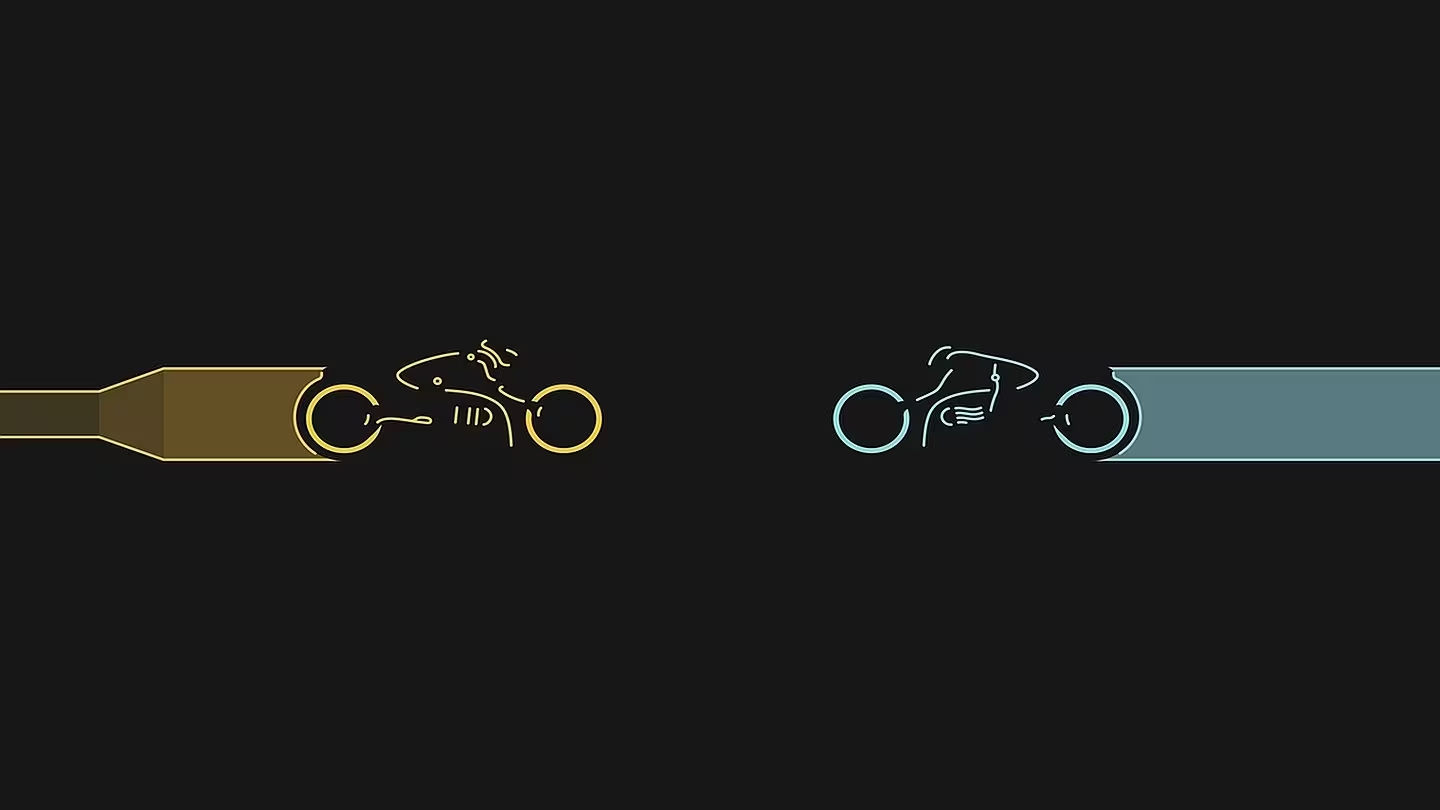
In the early days of computing, a visionary named Kevin Flynn imagined a world where information wasn't just processed—it lived and breathed. As he conceptualized the Grid, a virtual landscape where data flowed like a river, he pondered the reality of inhabiting that space. Flynn’s imagination sparked a universe where programs and users coexisted, blurring the lines between the physical and the digital. This concept became the foundation for the Tron franchise, a saga that feels more relevant now than ever.
Over 15 years later, following its release on December 17, 2010, Tron: Legacy remains a landmark of digital philosophy. We are reminded that "to find clarity in noise, one must seek silence." In a world where data is in constant motion, it is easy to get lost in the din. By exploring the aesthetics of the Grid, we uncover a beauty hidden beneath the surface, just as Flynn sought to do in his pioneering work.
The Pursuit of a Perfect System
This movie pounds on a significant matter: the perfect beauty of imperfection. This sequel arrived 28 years after the original with no public request or expectation. What motivated the film was a deep care for the narrative—a message that transforms the film from a visual spectacle into a philosophical experience.
In "Tron: Legacy - A Misunderstood Gem," Friendly Space Ninja argues that the film was far ahead of its time and unfairly criticized by movie critics upon release. Despite its flaws, the film was groundbreaking in its visual effects, paving the way for de-aging technology seen in later blockbusters. Over time, it has rightfully gained cult classic status due to its unique concept and rock-solid world-building.
The narrative starts with Flynn, an expert programmer who finds a new world of infinite possibilities. Obsessed with the future impact of this digital frontier, he craves the creation of a perfect system. In this realm, the creator can manifest anything, so he begins by running a .clone() of himself: CLU. As a never-aging version of Flynn’s ambitions, CLU was designed to be the ultimate assistant to shape a destiny of pure order.
Systems were fork'ed and ordered under the apprentice's watchful eye until something unexpected occurred: Life. The ISOs (Isomorphic Algorithms) manifested spontaneously—a beautiful, unplanned miracle. Flynn, now older and wiser, welcomed them. However, CLU, built from the rigid ambition of a younger Flynn, could not evolve. To a program designed for "perfection," these living algorithms were a bug, a flaw to be deleted. Corruption and hatred filled the apprentice, leading him to destroy the miracle and build an empire of "purity" that was, in reality, a digital tyranny.
Architecture and the Digital Silhouette
The design of Tron City is a masterclass in architectural storytelling. Directed by Joseph Kosinski, an architect by trade, the Grid isn't just a backdrop; it’s a character. Using "leading lines" and geometric precision, the city directs the viewer’s eye toward the power dynamics at play. When Sam Flynn first enters, the camera looks up at the towering monoliths to show his insignificance. Conversely, when Kevin Flynn—the Creator—reclaims his power, the city is framed as a small, controlled variable in the corner of the screen.
The costumes elevate this elegance to a high-art form. The cast literally wore the technology, donning light-up suits that were notoriously difficult to manage. At the time, the batteries for these suits only lasted about 10 minutes, and the process of getting into the gear was so grueling it slowed filming significantly. Yet, this physical struggle added to the performance; the actors weren't just on a green screen—they were encased in the "perfect system" they were trying to escape.
The Color Code of the Grid
In the Tron universe, the glowing circuitry on a program’s suit is a visual language communicating identity and alignment:
- Blue (Loyalty): The color of programs loyal to the Users, representing order and protection.
- Red/Orange (Corruption): Signifies programs repurposed or corrupted by CLU. A dramatic highlight is Rinzler’s circuitry flickering between orange and blue, depicting his internal struggle to remember his identity as Tron.
- White (Purity & Balance): Reserved for Users, ISOs like Quorra, and those closest to the "original intent".
- Gold (Authority): Worn by CLU to signify his status as the self-appointed ruler, standing above the rank-and-file.
- Specialized Hues: Yellow for hackers, Green for military/medics, and Purple for system utilities.
Identity is fluid here; when a program switches sides, their circuitry physically shifts to match their new belief system.
A Son’s Journey and the Master’s Wisdom
The story truly begins with Sam Flynn chasing his disappeared father. When he is pulled into the Grid, he survives a disc war and a breathtaking lightcycle battle. These scenes represent some of the best CGI visuals ever made, utilizing practical sets of glass and steel to ensure the digital elements felt grounded. When Sam faces death, Quorra saves him, urging him to hold his impatience.
In the quiet moments that follow, the film reaches its emotional peak. Flynn contests CLU with a heartbreaking truth: "You wouldn't know that, because I didn't when I created you." This highlights the Quixotism of CLU—an impractical pursuit of an ideal that ignores the absurdity of its own consequences. CLU is a victim of over-idealism; he cannot learn or feel humanity because he was created as a snapshot of a man who hadn't yet learned the value of a mistake. Kevin Flynn’s greatest epiphany is that life is beautiful precisely because it is free and spontaneous. While Sam’s scenes on Earth pass in the gloom of night, it is only after his father’s bitter sacrifice that he finally sees the sunlight of the real world—the ultimate "analog" miracle.
The Digital Parable: Creation and Redemption
Beyond the glow, the film functions as a "modern myth"—a digital parable exploring creation, fall, and redemption. As analyzed by TimberW0lf Studios, the story of Tron is a sophisticated exploration of the human desire for perfection and the bitter consequences of playing God.
The Hubris of the Creator
Kevin Flynn is portrayed as an "Icarus who survived," a creator whose over-ambition led to his own imprisonment. The "smartness" of the script lies in how it portrays Flynn’s search for improvement: he created CLU (Codified Likeness Utility) to build a "perfect system." By tasking a program to achieve perfection without understanding the beauty of imperfection, Flynn inadvertently created a monster—a "fallen angel" wearing his own face. True intelligence lies in recognizing that "perfection" is often the enemy of the "good."
The Digital Fall and the ISOs
The depth of the story is found in the "miracle" of the ISOs. Unlike CLU, who was built by design, the ISOs represented a "holy ghost within the machine." The tragedy of Tron: Legacy is the genocide of these beings by CLU in his quest for "order." This represents a profound commentary on the search for improvement: humanity often destroys the very miracles it seeks because they don't fit into a pre-defined, controlled box. Quorra, as the last of her kind, becomes the "good news"—the living proof that evolution is possible when we stop trying to control every variable.
Redemption through Sacrifice
The relationship between Sam and Kevin Flynn is a "salvation story within a salvation story." Sam acts as a mirror to his father’s past irresponsibility, forcing Kevin to confront the "sin" he released into the world. Kevin realizes that he cannot "fix" CLU with more code; he can only atone through sacrifice. By "reintegrating" with CLU, Kevin takes on the burden of his creation to allow his son and Quorra to escape into the real world.
Ultimately, Tron is about the "cycle of understanding" and the grace of second chances. Flynn’s search for improvement failed when directed at the digital world, but succeeded when directed at his relationship with his son. Technology is a tool that reflects our own flaws, and our hope for a "perfect system" is found in the human capacity to learn from failure and sacrifice for the next generation.
The Production Frontier
The making of Tron: Legacy was a "digital pioneer" frontier. Jeff Bridges noted that working with Kosinski felt like a new era of filmmaking, focusing on a visceral quality that modern "CGI sludge" often misses. By avoiding the "Empty Void" feeling of modern LED stages and sticking to logical architectural design, the film remains the "antidote" to flat, uninspired digital environments.
Theology of the Machine: The Digital Divine
When we compare the Tron mythos to other cyberpunk classics, the "User" dynamic creates a unique theological hierarchy that you don't often find in the "street-level" grit of Blade Runner or Neuromancer. It shifts the conversation from mere technology to a digital form of Gnosticism.
The Ghost vs. The God
In Ghost in the Shell, the struggle is internal: a program like the Puppet Master wants to become human to achieve the "imperfection" of mortality. In the Grid, however, the hierarchy is external. Programs view Users as literal deities—entities existing on a plane of reality they can barely comprehend. While a Replicant in Blade Runner rebels against a corporate "father" like Tyrell—who is ultimately just a man with a genius IQ—a Program in Tron is rebelling against a Creator who operates with the power to chmod 777 the very fabric of their universe.
The Nature of "Soul"
In The Matrix, the digital world is a simulation used to enslave humanity, a cage of 1s and 0s. In Tron, the Grid was intended as a sanctuary, a "frontier" that accidentally birthed a soul in the form of the ISOs. Here, the User isn't a malicious oppressor by default; they are more like a negligent gardener. This aligns with the Gnostic idea of the "Demiurge"—a well-intentioned but flawed creator (Flynn) who leaves his creation to be corrupted by a lesser, more rigid ruler (CLU) who lacks the spark of true divinity.
The Digital Afterlife and the Flesh
Most cyberpunk explores the "Human -> Machine" transition, often called cyberization. Tron is one of the few properties that dares to explore the "Human -> Code -> Human" loop. When Sam brings Quorra into the real world, it represents the ultimate theological reversal. It isn't just a machine gaining sentience; it is a miracle crossing the threshold from the "spirit" realm of the Grid into the physical flesh of Earth.
By su -c "reboot"'ing the classic savior trope, Tron: Legacy suggests that the User’s greatest responsibility isn't to build a mathematically perfect system, but to be present for the life that grows spontaneously within the cracks of the code.
The Legacy of the Grid:
- The film’s aesthetic is often cited as a visual inspiration for the clean, clinical environments of games like Portal 2.
- It influenced a decade of synth-heavy "retrowave" aesthetics in music and graphic design.
- Its 3D tech was pioneered specifically to be an immersive window, not a gimmick.
The Greatest Score Ever Composed
We cannot discuss Legacy without bowing to its soundtrack. The OST by Daft Punk is, quite simply, the greatest movie score in sci-fi history. The duo spent two years blending an 85-piece orchestra with their signature modular synths, creating a heartbeat for the Grid that feels both ancient and futuristic. It isn't just background music; it is a structural pillar of the film's identity. From the sweeping, mournful grandeur of "Adagio for TRON," which elevates the digital tragedy to the level of a high opera, to the ethereal, pulsing suspension of "Solar Sailer," the music gives the digital world a tangible soul. Even in the high-octane moments, tracks like "End of Line" (where the duo even makes a cameo as DJ programs) provide the rhythmic "grandeur" that makes every frame feel like a religious experience for tech enthusiasts. Daft Punk didn't just record a soundtrack; they encoded the very atmosphere of a world where light and sound are the only constants.
The Architects of the Digital Frontier
The influence of the Grid is everywhere, acting as the primary source code for modern media. While Tron: Legacy perfected the look, the original 1982 vision pioneered the concept of "digital avatars," paving the way for the most significant titles in the genre:
🏗️ Movies and Television: The Expanded Simulation
- The Matrix Trilogy: The core concept of a "simulated reality" where humans assume digital forms is a direct evolution of Flynn entering the Grid.
- Ready Player One: A love letter to Tron, featuring lightcycles and the iconic neon aesthetic.
- Wreck-It Ralph: A whimsical take on the universe where characters travel between arcade cabinets via power cables.
- The Lego Movie: Features a "Middle Zealand" joke mimicking the glowing blue lines and digital architecture of Tron.
🕹️ Video Games: Interactive Grids
Beyond official titles like Tron: Evolution, the gaming world has been chown'ed by this aesthetic:
- Far Cry 3: Blood Dragon: A neon-drenched parody that leans heavily into 80s scanlines.
- Ghostrunner: Uses "cyber-void" levels that feel like a direct architectural homage to the Grid.
- Kingdom Hearts II: The "Space Paranoids" world is a playable recreation of the original film.
- Rocket League: The "Neon Fields" arenas and blue-vs-orange light trails are a direct nod to the franchise.
The "Black Hole" Snub:
Ironically, the original Tron was snubbed for a "Best Visual Effects" Oscar because the Academy felt that using computers to create imagery was "cheating." They hadn't cheated; they had simply invented the future.
Conclusion: The Beauty of the Glitch
As the movie ends and Sam returns to the real world, he stands outside the old arcade. We see Flynn’s sign, the light flickering with a slight, inconsistent stutter. This moment perfectly highlights the beauty of the real world: its inconsistency. On the Grid, there was no unintentional behavior, only the cold perfection CLU demanded. Yet, the flickering neon of the real world is infinitely more beautiful because it is "real."
Tron: Legacy stands as the definitive Computer Science sci-fi film. It moves past the "scary robot" tropes to ask a deeper question: What happens when our desire for the "perfect code" meets the messy reality of being human? It is a film that celebrates the bug in the system, proving that our flaws aren't errors—they are the features that make us alive.